Yascha Mounk delivers a jarring counter-narrative to the prevailing sense of doom: he argues that the American experiment has not collapsed, but rather hit its lowest point and is now beginning a steady, structural retreat from chaos. While the surface details describe a presidency that has hollowed out institutions and alienated allies, Mounk's central thesis is that the very extremity of these actions has triggered the mechanisms designed to stop them. For the busy observer tracking the rapid deterioration of norms, this piece offers a crucial pivot from panic to a cold-eyed assessment of institutional resilience.
The Architecture of Overreach
Mounk begins by cataloging the sheer scale of the disruption, noting that the administration's actions have exceeded even the darkest predictions of the previous year. He writes, "Donald Trump's second term was always expected to be bad, but his actions have been so much worse than even last year's pessimists... imagined." The author details a systematic dismantling of the Justice Department, transforming it into a tool for personal retribution, while simultaneously expanding Immigration and Customs Enforcement into a force loyal to the executive rather than the law. This is not merely political maneuvering; Mounk argues it is an assault on the rule of law itself.
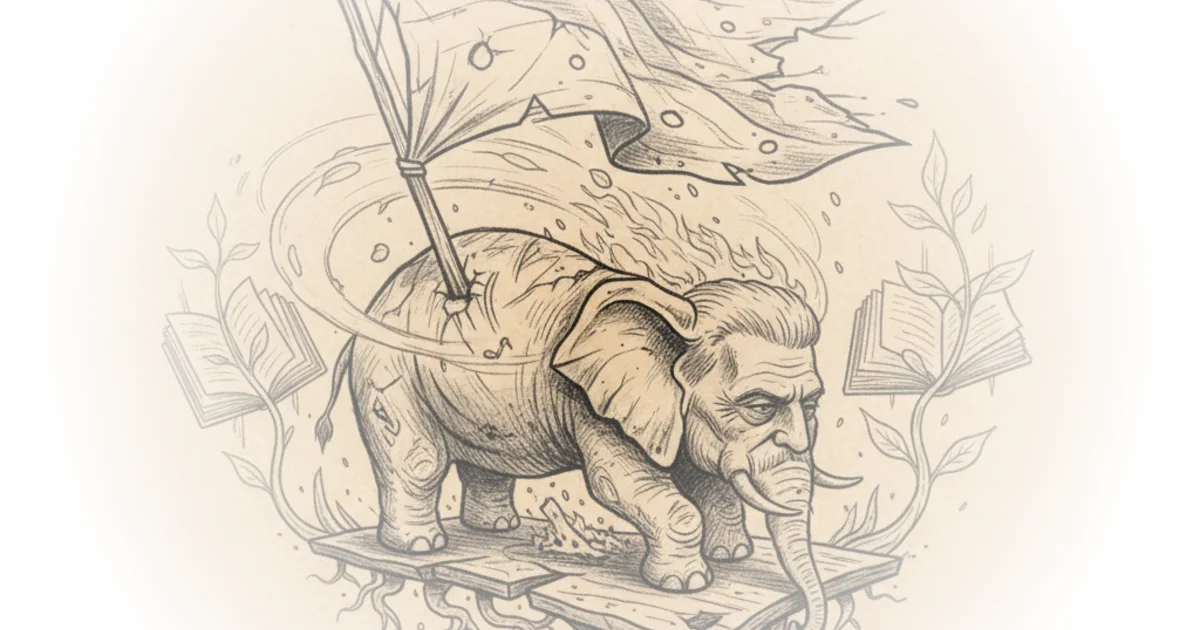
The commentary here is stark and unflinching. Mounk does not shy away from the human cost of these policies, noting that agents have "gone after law-abiding migrants and swept up U.S. citizens with no due process." By framing these actions as a departure from American tradition rather than a standard political shift, Mounk sets the stage for his argument that such overreach is unsustainable. Critics might argue that this framing underestimates the depth of populist support that sustains such a presidency, but Mounk counters by pointing to the economic realities that are beginning to fracture that support.
"It is easy to imagine that things will continue to get worse, and that America's self-degradation has not yet found a bottom. I think it is very important at this juncture for former American friends not to engage in catastrophic thinking, because catastrophe may become a self-fulfilling prophecy."
The Mechanics of Decline
The core of Mounk's argument rests on two specific checks on executive power: the electoral cycle and the judiciary. He posits that we have already seen "peak Trump," suggesting that the administration's power is not a rising tide but a receding one. He points to the recent off-year elections as evidence, stating, "The off-year vote this past November 4 showed across-the-board Democratic victories... Black and Hispanic voters, who gave Trump the winning margin in 2025, have moved back to the Democratic column in large numbers."
This analysis is particularly compelling because it moves beyond personality clashes to structural incentives. Mounk argues that the administration's economic policies are backfiring, noting that the president "promised to lower prices, and insists that they are lower, when anyone can see that they have risen." This disconnect between rhetoric and reality is eroding the coalition that brought the administration to power. Furthermore, Mounk highlights the judiciary as a formidable barrier, observing that lower courts have already "rendered void" many executive orders. He suggests that even the Supreme Court may not be as pliable as expected, especially regarding the constitutionality of tariffs.
The author draws a sharp parallel to historical moments of political fracture, implicitly referencing the QAnon phenomenon. He notes that the Jeffrey Epstein scandal, once dismissed as a conspiracy theory, has become a "gift that will keep on giving" as Republicans realize they can no longer be held in line by fear. "The spell has been broken," Mounk writes, as members of the governing party begin to vote contrary to the president's wishes to protect their own electoral viability. This shift from fear-based loyalty to pragmatic self-preservation is the most significant indicator of the administration's waning influence.
The Global Reckoning
On the international stage, Mounk argues that allies have been too quick to capitulate. He observes that foreign leaders have learned to "obsequiously bow to Trump and pleading for him to spare us the worst," a strategy he deems counterproductive. Instead, he urges a more assertive posture, citing countries like Brazil, India, and China as examples of nations that have "come out ahead in the confrontation" by pushing back. The author is particularly critical of the European Union's handling of the Ukraine crisis, arguing that Europe must stop waiting for American benevolence and instead "press their efforts to gain access to the Russian assets held in Belgium."
Mounk's framing of the Ukraine situation is especially poignant. He acknowledges the pressure from Washington to accept a "peace plan" that would ratify a capitulation to Moscow, yet he reminds readers that "over 60% of Americans favor continued aid, including military aid, to Ukraine." This disconnect between the administration's foreign policy and the American public's will underscores the fragility of the current executive agenda. The human cost of this diplomatic failure is implicit but heavy; the author notes that Putin has not relaxed his "maximalist demands," leaving Ukraine in a precarious position.
"Just as with Republicans at home, they should lose their fear of Trump and start pushing back against his crazy policies. Trump will not be around forever, and will likely be significantly weaker after next November."
Bottom Line
Mounk's strongest contribution is his refusal to accept the narrative of inevitable collapse, instead identifying the specific institutional and political fractures that are already causing the administration to stall. His argument is most vulnerable in its reliance on the assumption that the judiciary and the electorate will continue to act as effective brakes, a premise that history shows can be fragile. The reader should watch closely for the outcome of the upcoming Supreme Court cases on tariffs, as a ruling against the administration could indeed trigger the cascade of institutional failure Mounk predicts.
"The nature of executive power will be very different going forward, and that power can be used for good purposes by a good (or at least, not so bad) future president."
This piece serves as a vital corrective to despair, arguing that the very excesses of the current administration are sowing the seeds of its own decline. The path forward is not a return to the past, but a reimagining of a system that has proven resilient enough to survive its own worst moments.