Dave Borlace exposes a stunning reversal in the global energy narrative, arguing that the International Energy Agency (IEA) has been forced to retreat from its climate ambitions under intense political pressure from the fossil fuel industry. This is not merely a report on energy statistics; it is a forensic look at how geopolitical power plays are actively reshaping the data used to govern our future. For busy decision-makers, the takeaway is urgent: the baseline assumptions for the next decade are being rewritten in real-time, and the cost of ignoring this manipulation could be catastrophic.
The Great Pivot Back to Oil
The core of Borlace's argument rests on the dramatic swing in the IEA's messaging, driven by a change in US political leadership. He notes that the organization, originally founded to secure oil supplies, spent decades underestimating renewable growth before a brief moment of clarity in 2021. Borlace writes, "This year there is no need for new fossil fuel supply investments," a statement that once marked an epiphany for the agency. However, he contends that this stance was short-lived, crushed by the ideological zealots of the incoming administration who demanded a return to fossil fuel advocacy.
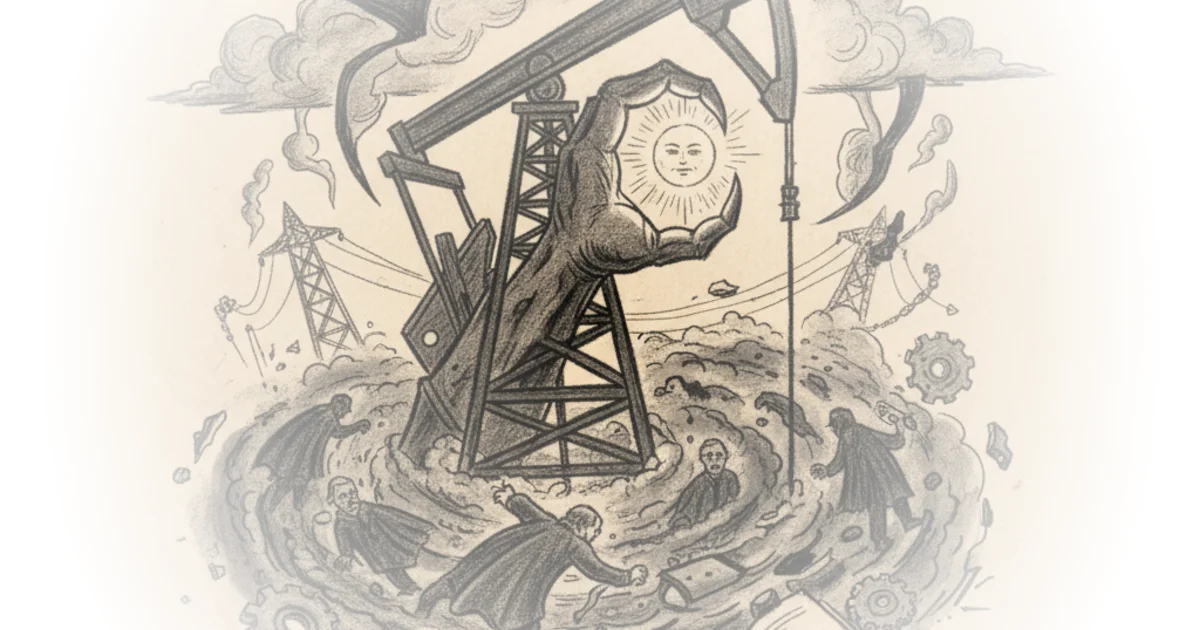
The evidence of this pressure is found in the 2025 World Energy Outlook's structural changes. Borlace points out that the agency has reintroduced the "Current Policy Scenario" (CPS), a chart quietly removed in 2019 to focus on more ambitious climate goals. "Under severe pressure from our friends in the fossil fuel industry, the CPS chart is back," he observes. This move is significant because it allows the IEA to present a future where oil and gas demand never peaks, directly contradicting the physics of climate stability.
Critics might argue that including a "business as usual" scenario is standard practice for any forecasting body, providing a necessary baseline for comparison. However, Borlace's analysis suggests this specific reintroduction is political theater designed to legitimize continued fossil fuel investment rather than a neutral analytical tool.
The multi-billionaires who control the fossil fuel industry really hate that scenario [Net Zero], and they also really resented the previous omission of the current policy scenario, which is why so much pressure was brought to bear on the IEA to reintroduce it.
The Illusion of Choice and the Reality of Efficiency
Borlace dissects the three competing narratives now presented in the report: the Current Policy Scenario, the Stated Policy Scenario, and the Net Zero pathway. He highlights the stark divergence in outcomes, noting that while the Stated Policy Scenario sees oil demand peaking around 2030, the Current Policy Scenario projects demand rising all the way to 2050. "If the fossil fuel behemoths have their way, that demand will keep trundling along long after that," he warns. This framing effectively strips away the ambiguity, showing that the choice of scenario is a choice of destiny.
Beyond the political maneuvering, Borlace brings in crucial data from industry analysts like Wood Mackenzie and Rystad Energy to counter the narrative of stagnation. He cites Rystad's finding that while primary energy consumption might plateau, "useful energy consumption actually grows through to 2050" because of massive gains in efficiency. The argument here is that electric motors and heat pumps are so much more efficient than combustion engines that we do not need to replace all primary energy to support economic growth.
This is a vital distinction that often gets lost in the noise of "energy demand" debates. Borlace suggests that the fundamental shift in conversion efficiency is "probably the only thing giving us humans any chance at all of staggering through this century with any kind of recognizable societal infrastructure still intact."
Electric motors are three to four times more efficient than combustion engines and new heat pumps deliver three to four units of heat per unit of electricity. These technological shifts fundamentally change the conversion efficiency of the global energy system.
The New Minefield: AI, Geopolitics, and Security
The commentary shifts to the emerging threats that complicate the energy transition, specifically the massive energy appetite of artificial intelligence and the fragility of supply chains. Borlace notes that global energy demand is projected to increase by an amount equivalent to the entire European Union over the next decade, driven partly by data centers and cryptocurrency. He paints a vivid picture of the risks: "International energy trading links are under pressure as a result of geopolitical fragmentation and critical minerals... have shown themselves recently to be an area of real vulnerability."
He also touches on the physical dangers, mentioning the risk of attacks on undersea cables and cyber warfare. While the IEA report acknowledges these risks, Borlace's synthesis makes it clear that the transition is not just an environmental challenge but a national security crisis. The report's conclusion is stark: "The risk of surpassing 1.5° C of warming before later stabilization is now higher than ever."
A counterargument worth considering is whether the focus on AI's energy consumption is a distraction from the much larger, established drivers of demand like industrial heating and transportation electrification. However, Borlace's inclusion of this factor highlights how rapidly the energy landscape is evolving, introducing variables that were negligible a decade ago.
The longer we delay, the harder and more expensive adaptation and resilience will become. Governments and investors need to step up policies and frameworks because business as usual leads to clearly suboptimal outcomes, insecure supply chains, higher costs, and more fossil fuels locked in.
Bottom Line
Borlace's most compelling contribution is his ability to connect the dots between high-level political pressure and the specific, dry language of energy scenarios, revealing that the "Current Policy Scenario" is less a forecast and more a political concession. The argument's greatest vulnerability lies in its reliance on the assumption that market forces and technological efficiency will inevitably outpace political regression, a gamble that may be too risky to take. Readers should watch closely for how the reintroduction of the "business as usual" scenario influences investment decisions in the next fiscal year, as this could lock in decades of emissions before the reality of climate instability forces a correction.