Adam Tooze delivers a startlingly intimate eulogy for a giant of German thought, arguing that Alexander Kluge's true legacy isn't his films or his legal work, but his radical reimagining of time itself. Tooze posits that we have been misunderstanding "reality" for centuries, treating it as a rigid wall when, in Kluge's view, it is actually a porous vessel shaped by the "anti-realism of feelings." This is not just literary criticism; it is a survival guide for navigating a world where objective facts often feel like fiction, and where the only way to make sense of history is to listen to the ghosts of our past selves.
The Architecture of Time
Tooze begins by dismantling the linear narrative we are taught to expect from history and biography. He writes, "For Alexander Kluge - Adorno-student, filmmaker, writer, one-time legal counsel of the Frankfurt School, extender of critical theory by any means necessary - it was always clear that time is multiple, overlapping, broken." This framing is crucial because it shifts the reader's focus from a chronological timeline to a psychological landscape where a six-year-old self and a thirty-year-old self can exist simultaneously.
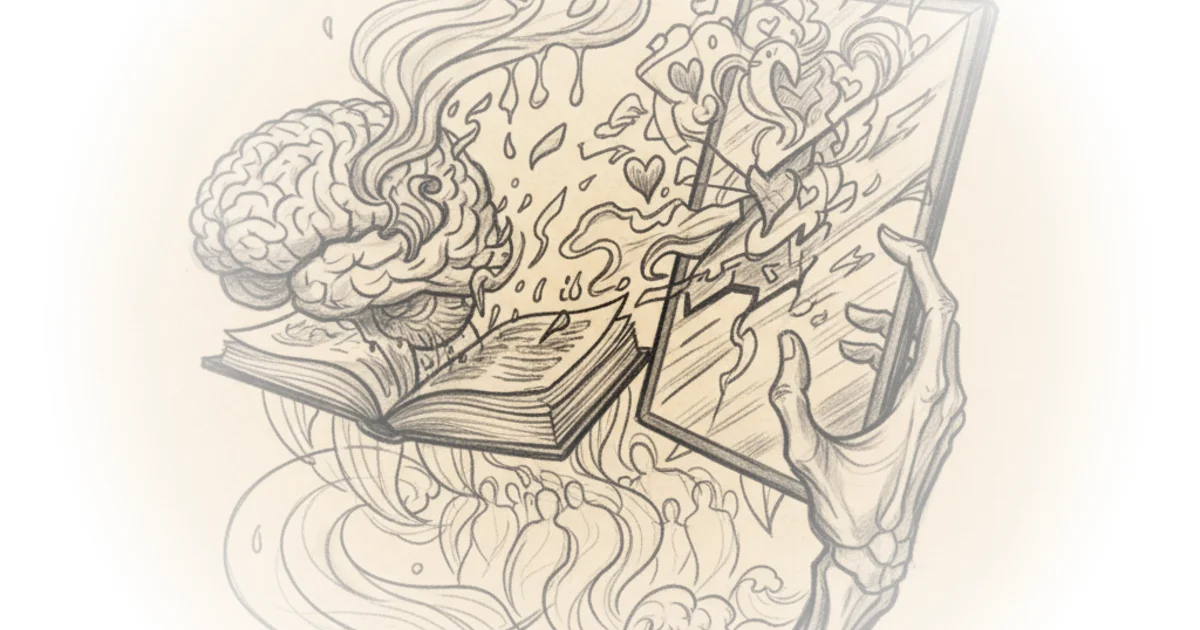
The author suggests that Kluge's genius lies in recognizing that our internal lives are not singular but layered. As Tooze puts it, "There is not one time, as the novels and new poetry of the nineteenth century would have us believe." This observation resonates deeply when considering the generational trauma that defines so much of modern European history. Just as the Battle of Stalingrad remains a living wound for generations of Germans, Kluge argues that the past is not dead; it is a active participant in the present. Tooze notes that "three generations together create an intelligible narrative space insofar as they directly engage one another in the act of storytelling."
"I cannot feel sensations without reawakening in myself the child I was and the parents who influenced that child."
This approach challenges the standard academic separation of "objective" history from "subjective" experience. Tooze argues that Kluge treats the subjective not as a distortion of reality, but as its very engine. He writes, "The sharpest ideology that exists is the one that considers reality to be real." This provocative statement forces the reader to question the "objective" structures we take for granted—laws, borders, economic systems—and see them as fragile constructs that can shatter under the weight of human emotion.
The Anti-Realism of Feeling
The core of Tooze's commentary revolves around Kluge's concept of the "anti-realistic impulse contained in human feelings." Tooze explains that this is not a rejection of facts, but a recognition that human feelings possess a material power that often overrides physical reality. "People are not objective in this respect, but rather human and subjective," Tooze writes, highlighting how Kluge views the internal emotional world as just as "real" as the wall an inmate runs into.
This perspective reframes how we understand historical events. Instead of viewing wars or economic crashes as purely mechanical outcomes of policy, Kluge sees them as the result of deep, unspoken emotional currents. Tooze illustrates this with a vivid example of Kluge's father, a doctor in East Germany, who "operated in four realities simultaneously" while a pregnant woman labored upstairs and a military parade marched outside. The doctor was thinking of Napoleon's Russian campaign while the state celebrated its own version of history.
"The things that move humans from within are indeed significantly stronger and more powerful than anything that happens on the outside."
Critics might argue that prioritizing "feelings" over "facts" risks sliding into solipsism, where objective truth becomes irrelevant. However, Tooze counters this by showing how Kluge's "materialism with the feelings put back in" actually grounds history in the human experience. He writes, "It is not about inner worlds, but rather about the feelings that can be recognized in physical structures and not just in monuments set in stone." This distinction is vital: Kluge isn't saying feelings are imaginary; he is saying they are the mortar that holds the bricks of society together.
A Chronicle of the Unseen
Tooze draws a powerful parallel between Kluge's method and the work of Michel de Montaigne, noting that both sought to understand "what brings people together" in the face of religious and political violence. He writes, "Along with Ovid, one of Kluge's great heroes is the great Renaissance essayist Montaigne." By linking Kluge to Montaigne, Tooze places him in a long tradition of thinkers who used personal reflection to navigate public chaos.
The commentary suggests that Kluge's "chronicle of feelings" is a necessary antidote to the sterile, data-driven narratives that dominate modern discourse. Tooze writes, "We have the choice between an objective chronicle, a chronicle of events, or a chronicle of feelings, which describes what happened subjectively. It seems to me that this subjectivity has more staying power." This is a bold claim, but one that feels increasingly relevant in an age of information overload where facts often fail to move people.
"Feelings are everywhere, even in unexpected places. For example, they live in institutions, which only become solid and have staying power when they are filled with feelings."
Tooze concludes by reflecting on his own relationship with Kluge, admitting that the author's death has forced him to confront the "multidimensionality" of his own life. He writes, "My younger self is now layered with many more." This personal touch elevates the commentary from a mere analysis of a text to a meditation on how we all carry the past within us.
Bottom Line
Tooze's piece is a masterful synthesis of biography, philosophy, and personal reflection that successfully argues for the material power of human emotion. Its greatest strength is the way it reframes "reality" not as a fixed set of facts, but as a dynamic interplay between the external world and our internal histories. The only vulnerability lies in the potential for this framework to be misused to dismiss objective truths, but Tooze navigates this by grounding Kluge's "anti-realism" in the concrete experiences of labor, war, and family. For the busy reader, this is a reminder that the most important history is the one we carry inside us, and that understanding it is the key to making sense of the world.