Heather Cox Richardson does not merely recount the opening shots of the Revolutionary War; she dissects the precise moment a political relationship between a government and its people shattered beyond repair. In her April 19, 2026, reflection, she argues that the violence at Lexington and Concord was not the sudden eruption of a mob, but the inevitable conclusion of a decade-long struggle over the fundamental nature of authority. For the busy reader seeking to understand how institutional overreach transforms into armed resistance, this piece offers a chillingly clear map of the erosion of trust.
The Architecture of Resentment
Richardson begins by dismantling the myth that the colonists were always opposed to British rule. She reminds us that in 1763, following the French and Indian War, "Bostonians had looked forward to a happy future in the British empire." The rupture, she argues, was engineered by a series of legislative decisions that stripped away established rights rather than addressing economic grievances. The administration in London, seeking to recoup war costs, bypassed the colonial assemblies—the bodies that controlled the purse strings—and imposed direct taxes like the Stamp Act.
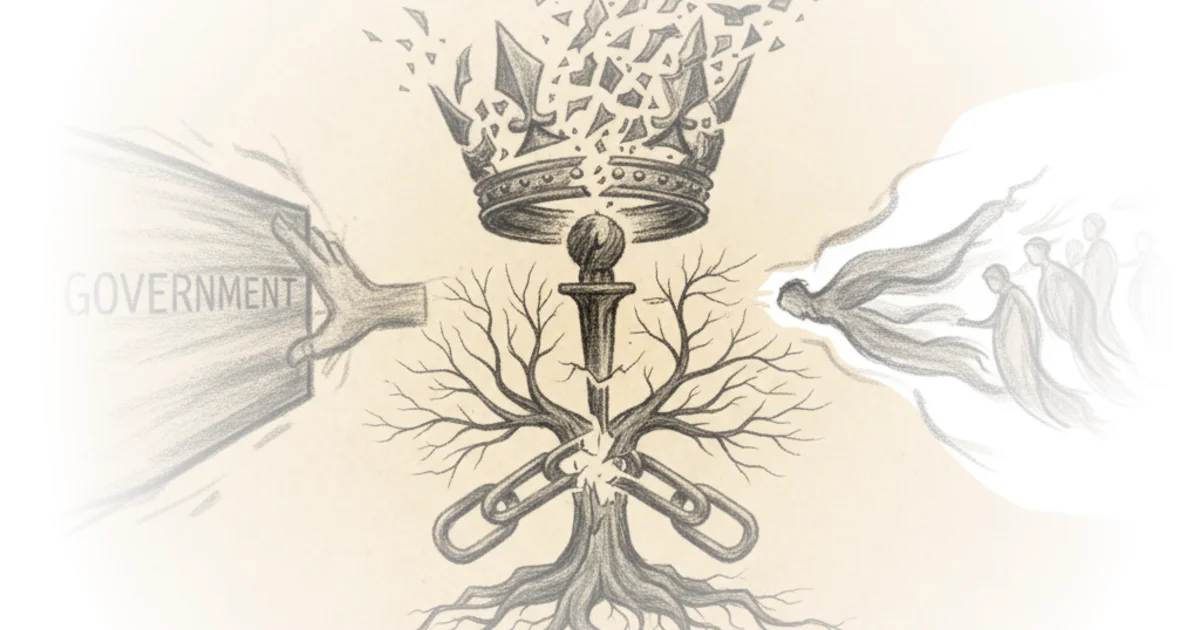
The most insidious move, according to Richardson, was the removal of the right to a jury trial. Knowing that local juries would acquit colonists who violated revenue acts, Parliament declared that suspects would instead be tried before "admiralty courts overseen by British military officers." This shift is critical to understanding the escalation. It wasn't just about money; it was about the removal of the community's ability to judge its own neighbors. As Richardson notes, this tapped into a "profound question of human governance: Could the king be checked by the people?"
The historical parallel here is stark. Just as the Royal Proclamation of 1763 had previously restricted colonial expansion to the west of the Appalachian Mountains to prevent conflict with Indigenous Americans, these new legal structures were designed to prevent the colonies from governing themselves. The result was a system where power was no longer seen as a temporary trust granted by the people, but as a divine right of the crown. Richardson writes, "The Stamp Act threatened to overturn that longstanding system, replacing it with tyranny."
The fight over the Stamp Act tapped into a struggle over a profound question of human governance: Could the king be checked by the people?
Critics might argue that the British government was simply exercising its sovereign right to tax its territories, a standard practice in empires of the era. However, Richardson effectively counters this by highlighting the unique political reality of the colonies, where distance had already forced a de facto self-governance that the central government was now trying to revoke.
The Mobilization of the Mind
What makes this coverage particularly compelling is its focus on the mechanics of organization. Richardson does not treat the Sons of Liberty as a spontaneous riot but as a sophisticated political network. She highlights the role of Samuel Adams, who used his position as clerk of the Massachusetts legislature to build a coalition. "Across the colonies, the Sons of Liberty began writing to like-minded friends, informing them about local events, asking after their circumstances, organizing," she writes.
This communication network was the precursor to the alarm system that would eventually ignite the war. When the administration decided to arrest colonial leaders Samuel Adams and John Hancock and seize military supplies in Concord, the response was not chaos, but a coordinated military maneuver. Richardson details how intelligence gathering allowed the colonists to bypass the regulars: "When the soldiers set out on the night of April 18, two Sons of Liberty flashed two lanterns in the steeple of the Old North Church... to signal to watchers that the soldiers were traveling across Boston Harbor."
The human cost of this escalation is not glossed over. Richardson emphasizes that the violence began when "soldiers from their own government had opened fire on them, killing their own people." The death of Crispus Attucks, a Black man, in the earlier Boston Massacre is noted as a pivotal moment where the narrative of the conflict was shaped by Paul Revere's engraving, which depicted soldiers as "fierce Barbarians grinning o'er their Prey." This imagery was not just propaganda; it was a reflection of the deep-seated fear that the military presence was intended to police, not protect, the population.
The tactical shift in the fighting itself underscores the depth of the divide. Richardson describes how the militiamen did not fight in the organized lines of European warfare but adopted the style learned from Indigenous Americans: "shooting from behind trees, houses, and the glacial boulders littered along the road." This was a war of the landscape against the uniform, a rejection of the British military's rigid hierarchy.
The Point of No Return
By the time the British regulars retreated to Boston, the political landscape had fundamentally altered. Richardson notes that "even before the British soldiers made it back down the Battle Road from Concord on April 19, militiamen—both white and Black, free and enslaved—from the Massachusetts countryside... rushed to surround Boston." The siege that followed, involving over 15,000 men, signaled that the era of petitioning was over. The administration's attempt to enforce order had instead created a unified front against its authority.
The article concludes by connecting these events to the Declaration of Independence a year later. The question of whether a king could be checked by the people was answered with a radical new principle: "the people had the right to be treated equally before the law, and they had the right to govern themselves." Richardson's framing suggests that the war was not an accident of history, but the logical outcome of a government that refused to acknowledge the consent of the governed.
Far more than money was at stake. The fight over the Stamp Act tapped into a struggle over a profound question of human governance: Could the king be checked by the people?
Bottom Line
Richardson's strongest contribution is her refusal to treat the Revolutionary War as a simple clash of armies, instead presenting it as the collapse of a social contract. The piece's greatest vulnerability lies in its focus on the political philosophy of the elite, which, while necessary for understanding the leadership, sometimes sidelines the complex motivations of the common soldier and the enslaved people who fought on both sides. Readers should watch for how this historical framework applies to modern questions of executive overreach and the limits of institutional power.