The Accidental Genius Who Never Believed It
In a wide-ranging conversation on the Tetragrammaton podcast, Woody Allen at nearly ninety years old offers something rare: a retrospective that is neither defensive nor self-aggrandizing, but genuinely bewildered by its own success. The through-line of the interview is not artistic vision or creative philosophy, but luck. Allen returns to the word again and again, attributing nearly every career milestone to fortunate timing, generous gatekeepers, and an almost cosmic refusal of the universe to let him fail.
This is either the deepest form of false modesty or an unusually honest accounting from someone who has spent six decades in public life. The truth, as with most things involving Allen, is probably somewhere in between.
Stumbling Upward
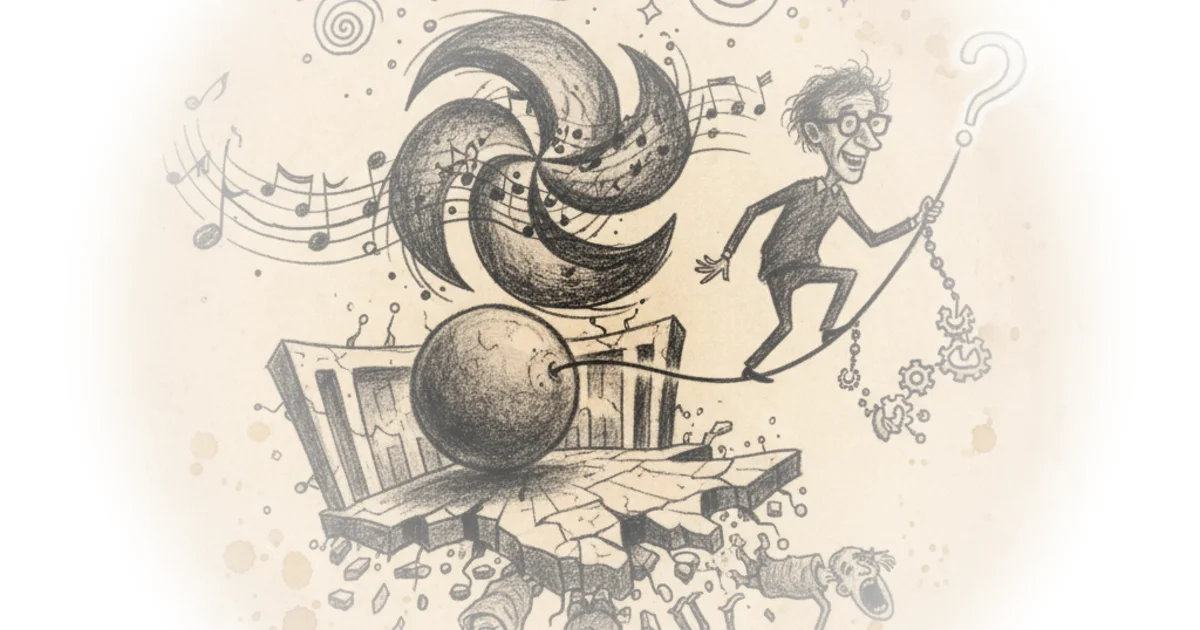
Allen's account of his early career reads less like a memoir and more like a series of happy accidents. He was a teenager writing fifty jokes a day for forty dollars a week. He joined the Sid Caesar writing room not because he campaigned for it, but because the industry kept pulling him forward. His first screenplay, What's New Pussycat, was by his own account butchered by the production, and yet it became one of the highest-grossing comedies of its era.
I was always punching upward, failing artistically, but being saved by my luck.
There is something almost pathological about this insistence on unworthiness. Allen describes getting his first directing opportunity not because anyone believed in him, but because Palomar Pictures could not attract the directors it actually wanted. He characterizes his early films as the work of someone who "knew nothing about film making." And yet Bananas, Sleeper, and Love and Death all succeeded, each one building an audience that would follow him into the more ambitious territory of Annie Hall.
The counterpoint here is obvious: luck does not sustain a fifty-film career. Allen's persistent self-deprecation obscures a relentless work ethic and a genuine, if narrow, comic talent that the industry recognized early and rewarded consistently. No amount of fortunate timing explains why audiences kept showing up for five decades.
The Mort Sahl Revelation
The most illuminating passage in the interview concerns Mort Sahl. Allen describes seeing Sahl perform at the Blue Angel as a kind of conversion experience, one that "changed my life in one second." But what makes the story interesting is not the admiration itself; it is Allen's admission that he fundamentally misunderstood what made Sahl great.
I thought, "Oh, this guy's jokes are so great." And I didn't realize that it was his persona that was so great, so that he could say anything and it would be wonderful and the jokes were superb.
Allen spent years believing comedy was about the material. His manager Jack Rollins kept telling him it was about the person. This distinction, between craft and presence, between the joke and the joker, is one that Allen says took him years to grasp. He even recalls asking Rollins why he could not simply "go out there and read the jokes."
The irony is considerable. Allen eventually became one of the most recognizable personas in American comedy, the neurotic intellectual whose anxieties were themselves the source of humor. He achieved through instinct what he could not understand analytically. His stammering, his self-doubt, his perpetual air of being slightly overwhelmed by existence: these became the persona that audiences responded to, not the one-liners.
The Problem Is Always the Writing
Allen is most convincing when he talks about craft. His observation that filmmaking problems are almost always writing problems carries the weight of hard-won experience. Camera placement, he says, is "common sense." Great actors are abundant. But a script that does not work will sink everything.
If the writing is good, you don't have a problem making the film. You know, there are many wonderful actors around, great cameramen. You, it's common sense where to put the camera and what to do.
This is a deliberately provocative simplification, and many directors would disagree violently. But it reveals something essential about Allen's approach: he has always been a writer who directs, not a director who writes. His visual style, with its long takes and muted palettes, serves the dialogue rather than competing with it. The camera in a Woody Allen film is a recording device, not a storytelling instrument in its own right.
His comparison of filmmaking to novel writing is telling. He describes the agony of reshooting scenes at a quarter-million dollars a day, then the relief of discovering that a bad chapter in a novel can simply be torn up and rewritten at no cost. Several of his best films, including Annie Hall, were essentially reconstructed in the editing room. The final product bore little resemblance to the original conception.
Fantasy, Reality, and Three Levels of Existence
Perhaps the most poignant section of the interview is Allen's description of growing up in Brooklyn with a three-tiered understanding of reality. There was actual life, which he calls "grim and grungy and realistic and sad." There was the Manhattan of the movies, with its duplex penthouses and white telephones and people who dressed for dinner. And there was the imagined Hollywood, where Humphrey Bogart lived next door to Jennifer Jones and everyone gathered around pianos to sing.
More fantasy, less reality is a bone crusher, and in the fantasy world, there is always a loveliness and charm and unreality is a very beautiful place.
This passage explains more about Allen's filmography than any critical essay. From The Purple Rose of Cairo to Midnight in Paris, his best work has always been about the seductive power of unreality and the heartbreak of having to return from it. The character who steps off the movie screen, the writer who travels back to 1920s Paris: these are not just clever premises. They are expressions of a lifelong wish to live inside the better version of reality that art provides.
What Allen does not say, but what the interview implies, is that filmmaking itself was his escape hatch. He could wake up each morning and go to a set where beautiful people wore costumes and music would eventually be layered in, where he could inhabit the 1920s or Paris or whatever world he had written into existence. Making movies was not just a career; it was a method of avoiding reality "as much as possible."
The AI Cannot Get There
Near the end of the conversation, Allen makes a brief but striking observation about artificial intelligence. Discussing the ineffable quality that separates a great musician from a competent one, he says flatly that AI will never replicate it.
That's the part that the AIs are never going to duplicate. They'll always match something, but they're never going to get that impossible to capture thing that makes Bud Powell play the piano and somebody else play it and it's just a different instrument.
Coming from a man who has spent his life trying to understand what makes comedy work, this is not a throwaway remark. Allen spent decades unable to articulate why Mort Sahl was funnier than other comedians who told similar jokes. He still cannot fully explain it. His argument is that if even a human practitioner cannot identify the source of greatness, a machine certainly cannot reproduce it.
Whether this is wisdom or sentimentality is an open question. But it is consistent with Allen's broader worldview: the best things in life, the funniest joke, the most magnetic performer, the perfect fireworks display over Central Park, arrive unbidden and cannot be engineered.
What He Would Tell His Younger Self
The most surprising moment comes when Allen is asked what he would say to his childhood self. Rather than affirming the path he took, he suggests a wholesale redirection. Do not aim for Groucho Marx and Bob Hope, he says. Aim for Kurosawa and Vittorio De Sica. Strike out trying to make great art rather than settling for making people laugh.
This is a remarkable admission from someone who built one of the most successful comedy careers in film history. It suggests that Allen, even at ninety, views his entire body of work as a compromise, a talented person who aimed too low and succeeded too easily at the wrong thing. Whether this is genuine regret or simply the restlessness of a mind that has never been satisfied with its own output is impossible to know.
Bottom Line
This interview captures Woody Allen in a reflective mode that is more candid than calculated. His insistence on luck over talent is unconvincing but revealing: it speaks to an artist who genuinely cannot see his own gifts, or who has decided that acknowledging them would be worse than denying them. The most valuable material here is not the career retrospective but the observations about craft, particularly the distinction between jokes and persona, the primacy of writing over directing, and the three-tiered fantasy that drove him out of Brooklyn and into a version of Manhattan that existed only on screen. At nearly ninety, Allen remains what he has always been: a man who built an extraordinary career while sincerely believing he was getting away with something.