The Small Touch That Makes a Life
Henry Oliver has written something that most book-review essays rarely attempt: a love letter to the minor detail, to the kind of biographical fragment that professional historians dismiss as trivia but that actually makes dead people feel alive again. His meditation on John Aubrey—the seventeenth-century antiquarian whose Brief Lives remains one of English literature's strangest and most enduring achievements—turns out to be as much a treatise on how we ought to remember people at all.
The Infovore Who Collected the World Before It Went to Dust
Born in 1626, Aubrey lived through the English Civil War and the intellectual ferment that followed. Oliver positions him against the era's obsession with novelty—the New Learning, the New Science, the new commonwealth—as something closer to a conservationist. "Aubrey was a dedicated hunter and preserver of the old. An antiquarian rather than a writer, Aubrey wished to collect the world's fragments before they went to dust." He produced the first English books devoted entirely to archaeology, place names, and folklore, and his interests ranged from astronomy to applied mathematics. What Oliver calls his "genius for history" was really a genius for paying attention.
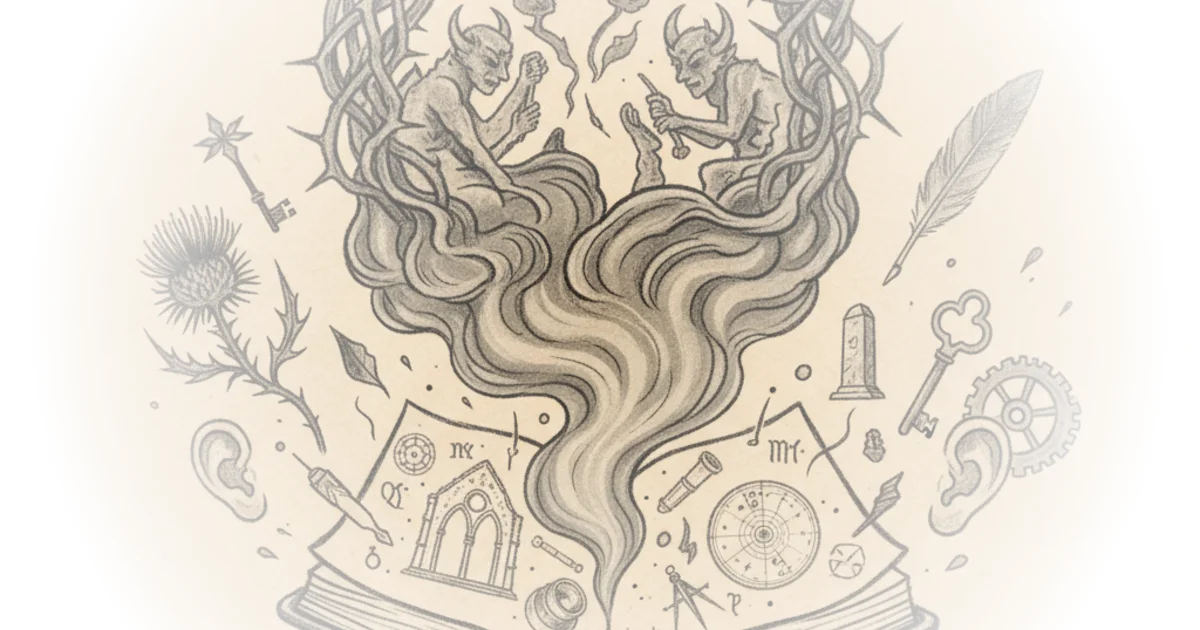
As Oliver puts it, "Aubrey is among the most curious" figures in English letters, and the word does double work: he was himself curious, and the materials he gathered remain so.
The Fertile Fact
The core of Oliver's argument rests on a distinction Virginia Woolf once drew in her own essay on biography: the difference between a sterile fact and what she called "the creative fact; the fertile fact." Aubrey had a special talent for the second kind. Oliver illustrates this with the detail that Thomas Hobbes sang quietly to himself when he thought nobody could hear him, and that in old age, when he had gone bald, flies would land on his head and irritate him. These are not the facts you find in a timeline. They are the facts that make a person breathe.
"A little detail makes a large sorrow."
The most moving passage in Oliver's piece arrives almost incidentally. At the end of Kate Bennett's scholarly edition of Brief Lives, the acknowledgments contain a note about her husband Josh, who died at forty-three, shortly after becoming a father for the second time. "Coming at the start of Brief Lives, Bennett's note gave me a shock of realizing there would be no more anecdotes for that family about that man." Oliver does not embroider the sentence. He lets the plainness of it do its work. A penny loaf eaten absent-mindedly. A widow pulled from the Thames at Cuckold's Point. A sprig tied to a rag used to clear phlegm from one's own throat. These details carry more weight than any grand narrative.
Truth in Manuscript, Not in Print
Oliver traces Aubrey's suspicion of printed text back to a deeper philosophical commitment. "I here laye-downe to you [...] the Trueth, the naked and plaine trueth," Aubrey wrote to his collaborator Anthony Wood. Print, Aubrey believed, either "treads too neer on the heeles of trueth, that they dare not speake plaine" or grows too obscure with age. He preferred the manuscript and the letter because they preserved things that print flattened out—the handwriting of a source, the marginal note, the rawness of an observation before it had been polished for publication.
"'Pox take your Orators and poets', Aubrey complained, 'they spoile lives and histories'." He adopted Francis Bacon's definition of biography as a branch of antiquities—history rather than literature—and insisted on things, documents, objects, before elegant language.
Critics might note that Aubrey's fidelity to "the naked and plaine trueth" was hardly absolute. Kate Bennett's footnotes routinely expose inaccuracies in his accounts, and as Oliver himself concedes, Aubrey "does not really meet modern standards of accuracy." He was accurate about character, perhaps, but accuracy of that kind is subjective enough to admit almost anything. The man who worried about printing errors was himself an unreliable narrator, a contradiction Oliver acknowledges but does not fully press.
The Turn to Personality
Oliver situates Brief Lives within a broader seventeenth-century shift: the move from institutional histories told in sermons and chronicles toward something messier and more human. The church wanted biographies to demonstrate Christian virtue. Congregations wanted to hear about the dead person's actual personality. Puritan diaries began appearing with guides for self-examination. Aubrey's genre of short, vivid portraits rode that cultural wave.
He was not alone. Izaac Walton—whom Oliver rescues from the "often overlooked or discounted" pile—did something similar, teaching English biographers to quote directly from letters and write about people they actually knew. Oliver includes Walton's account of George Herbert dismounting his horse to help a poor man lift a fallen load, arriving at dinner soiled and embarrassed but telling his friends that "the thought of what he had done would prove music to him at midnight." It is a passage that survives because Walton, like Aubrey, understood that personality is the truth.
But here too Oliver could push further. Walton wrote as an Anglican Tory about Anglican Tories. The selection of virtues on display is not neutral. Personality is the truth, yes—but whose personality, filtered through whose sympathies? Aubrey's anecdotes survived because he was embedded in a network of sociability that valued them. Not every life had someone to collect its fragments.
Bottom Line
Henry Oliver has written a piece that does what its subject spent a lifetime doing: it collects the small things that make the larger truth visible. The argument is not new—Woolf and Plutarch made versions of it centuries ago—but Oliver's assembly of Aubrey's most peculiar details, placed alongside Bennett's personal grief, lands with genuine force. The verdict is simple and worth keeping: a biography that cannot show you the flies on a man's head has probably missed the man.