Steve Vladeck identifies a legal pivot point that could halt the deployment of federalized National Guard troops without ever needing to prove the President's factual claims about civil unrest. The piece is notable because it shifts the battlefield from the messy reality of street protests to the dry, technical definition of "regular forces" in a 1908 statute—a move that could render the administration's current legal strategy legally incoherent.
The Statutory Trap
Vladeck argues that the Supreme Court's request for supplemental briefing is a significant, albeit subtle, victory for the state of Illinois. The Court has asked parties to clarify whether the term "regular forces" in 10 U.S.C. § 12406 refers strictly to the active-duty military or if it can be stretched to include civilian federal law enforcement. "The fact that the Court issued this briefing order thus suggests at least four things," Vladeck writes, noting that it implies there are not five votes for the administration on the non-reviewability of the President's actions, nor on the existence of a rebellion.
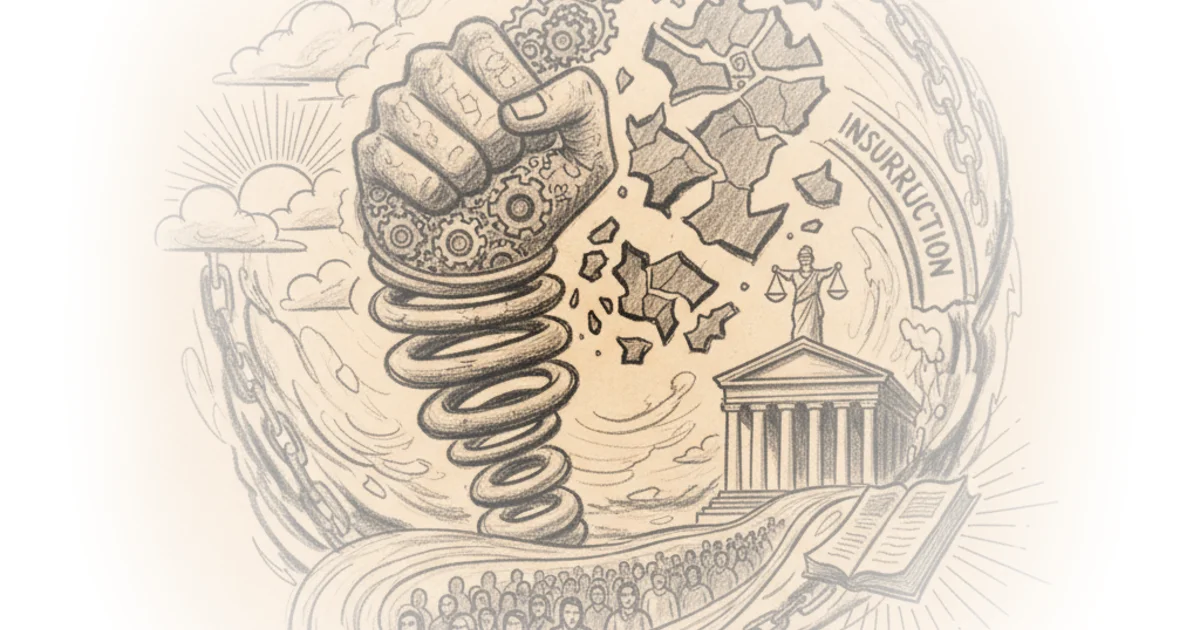
This framing is effective because it bypasses the need for the Court to make a subjective judgment on whether Chicago is actually in chaos. Instead, it forces a binary legal question: has the administration even tried to use the active-duty military before calling up the Guard? Vladeck leans heavily on the research of his colleague Marty Lederman, who argues that Congress used "regular forces" in 1908 to distinguish between the standing federal military and part-time state militias. "Congress used the term 'regular forces' in the 1908 statute... unambiguously as a reference to the standing federal military," Vladeck asserts. This interpretation suggests the administration is trying to use a law meant for a specific military hierarchy as a shortcut to bypass the stricter requirements of the Insurrection Act.
The whole point of the 1908 statute was to reconcile the 1903 creation of the modern National Guard with the existing statutes authorizing domestic deployment of federal 'regulars.'
Critics of this approach might argue that the administration is simply being pragmatic, seeking to deploy the most readily available federal assets to restore order without the political fallout of sending in active-duty troops. However, Vladeck counters that this pragmatism ignores the statutory design, which intended the National Guard to be a fallback, not the first line of defense, when local authority breaks down.
The Shadow of the Insurrection Act
The commentary takes a darker turn when Vladeck addresses the potential consequences if the Court rejects the "regular forces" argument. If the administration succeeds in using this obscure 1908 law, the next logical step for the executive branch would be to invoke the Insurrection Act of 1807, a much older and broader statute. Vladeck warns that this would be a "scarier" escalation, authorizing the domestic use of the regular military for ordinary law enforcement.
He posits a critical distinction: the factual predicates for the Insurrection Act are "meaningfully more restrictive than the statute on which President Trump has relied to date." If the administration cannot meet the higher bar of the Insurrection Act, yet succeeds in using the 1908 law, it creates a dangerous precedent where the President can deploy troops with fewer checks. "If so, there are good reasons to shift the focus of the legal debate to the scope of that statute and its precedents," Vladeck suggests, urging a move away from the 1908 law entirely.
This analysis is crucial because it highlights the human cost of legal technicalities. If the legal barrier of the 1908 statute falls, the door opens for a more aggressive military presence on American streets, a scenario with profound implications for civil liberties and public safety. The argument is not just about statutory interpretation; it is about the threshold for militarizing domestic spaces.
Other Emergency Dockets
Beyond the National Guard case, Vladeck touches on other emergency applications that reveal the Court's current dynamics. He notes the delay in the Trump v. Orr case regarding passport gender markers, which has taken longer than any other emergency application from the administration. He also discusses the copyright register firing case, Blanche v. Perlmutter, where the administration attempted to bypass the Federal Vacancies Reform Act of 1998. "One might point out that the fact that the President appoints the Librarian of Congress doesn't prove that the Library of Congress is in the executive branch," Vladeck writes, highlighting the constitutional tension in the administration's attempt to consolidate power.
These side cases serve to underscore a broader theme: the executive branch is testing the limits of its authority across multiple domains, from immigration to intellectual property. The Court's response—whether through delays, briefing orders, or denials—signals the boundaries of that power.
Whatever else might be said about the additional question the justices posed, all of those are, in my view, good signs for Illinois.
Bottom Line
Vladeck's strongest contribution is his identification of the "regular forces" definition as the likely linchpin for stopping the troop deployment, a legal nuance that offers a cleaner path to victory than debating the facts of the protests. The argument's biggest vulnerability lies in the Court's potential willingness to defer to the President's judgment on national security, regardless of statutory technicalities. Readers should watch the supplemental briefs due in mid-November, as the administration's response to the "regular forces" question will likely reveal whether they are prepared to escalate to the Insurrection Act or retreat from their current legal footing.