Phillips P. O'Brien identifies a quiet but potentially war-altering shift: the Sea of Azov is no longer a Russian sanctuary, but a contested zone where Ukrainian drones are systematically dismantling logistics. While the world fixates on the front lines, O'Brien argues that a campaign of "kinetic sanctions" is strangling Russia's ability to supply Crimea and export stolen grain, all while the administration's hesitation on air defense leaves Ukrainian cities exposed to a tripling of Russian ballistic missile attacks.
The Sea of Azov Turns
O'Brien challenges the assumption that Russia's control of the coastline equates to control of the water. He notes that for months, the Sea of Azov was treated as a "Russian lake," a secure artery for moving fuel and grain through the narrow Strait of Kerch. However, the dynamic has shifted violently. "Over the last few weeks... the Ukrainians have greatly accelerated a campaign to sink or damage Russian-controlled shipping in that body of water," O'Brien writes. This is not random harassment; it is a calculated effort to isolate the Crimean peninsula, a strategic goal that complements previous efforts to disrupt the Kerch Bridge.
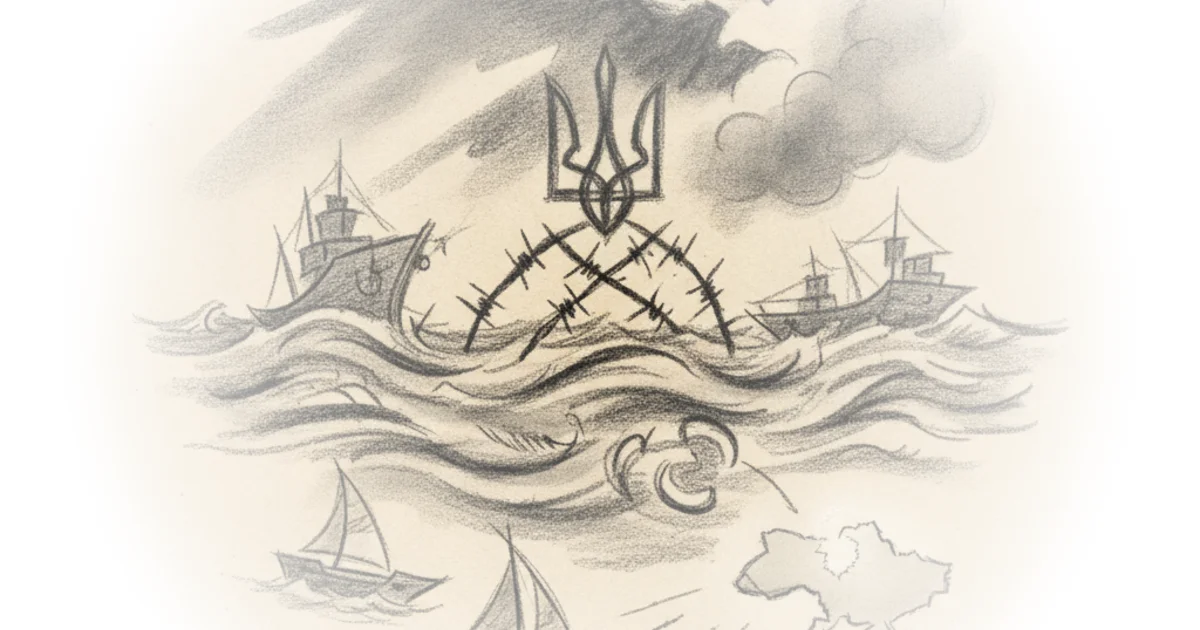
The author highlights a disturbing trend in the data: the sheer volume of targets. Citing Ukrainian military officials, O'Brien points out that attacks have targeted twenty-one oil tankers, four tugboats, and other vessels. "The Ukrainians are clearly trying to shut down a range of vessels in a clear statement to the Russians that the Sea of Azov is not to be considered a safe place for any shipping," he observes. The result is tangible; Russian authorities have already forbidden new traffic through the strait, effectively closing the waterway. This success comes despite the lack of heavy naval assets, relying instead on air and sea drones that strike with surgical precision.
"Using air and sea drones, the Ukrainians have turned the Sea of Azov into a Ukrainian lake. Think about that for a minute."
This framing is powerful because it underscores the asymmetry of modern warfare. A small body of water, once a logistical lifeline for the occupier, has become a graveyard for their supply chain. Critics might argue that closing the strait is a temporary tactical victory that Russia could eventually overcome with better air defense or larger escort vessels. Yet, O'Brien's point stands: the psychological and economic cost of losing control of this waterway is immediate and severe, hitting both military supplies and the revenue from grain and oil exports just as the Russian economy faces pressure.
The Missile Gap and the Aid Delay
The tone shifts dramatically when O'Brien addresses the air defense crisis. He argues that while Ukraine secures the seas, the administration's delay in providing Patriot missile systems has created a deadly vacuum. The situation is dire: "Having made this campaign far more deadly over the past year by starving Ukraine of Patriot interceptors, the US put off any significant aid in this area for a while." The consequences are measured in civilian lives. O'Brien details how Russian ballistic missile launches have roughly tripled year-over-year, with January 2026 setting a record of 91 missiles in a single month.
The statistics are sobering. While Ukraine intercepts nearly 90% of drones and cruise missiles, their success rate against ballistic missiles has plummeted to 40% due to a lack of interceptors. "The fact that Russia seems to be upping its strike rate... just as it is clear that Ukraine is running out of Patriots interceptors, shows how the Russians are aware of the help [the administration] has and will continue to provide for them," O'Brien writes. He describes the recent strikes on Kyiv, where entire barrages hit their targets, killing dozens. The administration's response—a vague promise to eventually license Ukraine to manufacture Patriots—is dismissed as a political maneuver that offers no immediate relief. "The only problem with waiting for years is that bombarding Ukraine with ballistic missiles is a key and growing Russian priority now," he argues.
"Trump has provided Putin at least one more whole winter, and possibly two or three... to attack what he wants."
O'Brien's critique here is sharp: the delay in defense aid is not a neutral administrative lag but a strategic gift to the aggressor. By allowing Russia to escalate its missile campaign without fear of interception, the current policy effectively sanctions the bombing of Ukrainian cities. A counterargument might suggest that manufacturing licenses are a long-term strategy to build industrial capacity, but O'Brien rightly points out that the immediate human cost of waiting years for production is unacceptable when the alternative—shipping existing interceptors—is available. The administration's hesitation has allowed the Russian military to refine its tactics and inflict maximum damage on civilian infrastructure.
Striking Deep into Siberia
Beyond the immediate front lines, O'Brien highlights a significant escalation in Ukraine's long-range capabilities. The attack on the Omsk oil refinery, located over 2,500 kilometers away in Siberia, demonstrates that distance is no longer a shield for Russian assets. "On Monday, July 6, distance no longer protected Omsk," O'Brien writes, noting that the strike hit the crucial distillation units responsible for breaking down crude oil. This is not just about damaging a facility; it is about shattering the illusion of safety for the Russian homeland.
The attack on Omsk is particularly significant because it targets the heart of Russia's fuel production. "The halt in operations at the plant, which is Russia's top producer of petrol, is likely to exacerbate fuel shortages across the country," O'Brien notes. This mirrors the broader strategy of using drones to strike deep behind enemy lines, a tactic that has evolved since the early days of the conflict. The author connects this to the broader theme of a "Revolution in Military Affairs," where cheap, unmanned systems can disable high-value, stationary targets thousands of miles away. The psychological impact on Russian air defense forces is immense; if Omsk is vulnerable, no target is safe.
"If the Ukrainians can reach out and hit Omsk... there will not be a safe Russian asset within 2000 miles of Ukraine. That is a lot of Russia and a lot of strategic targets to defend."
This expansion of the battlefield forces Russia to stretch its air defense network to the breaking point. However, O'Brien acknowledges that while these strikes are strategically damaging, they are not a silver bullet. The refinery may eventually be repaired, and the fuel crisis may be managed through rationing. Yet, the precedent is set: the war has no rear area. The ability to strike deep into Russia complicates Moscow's logistics and morale, even as the administration's air defense failures continue to cost lives in Kyiv.
Bottom Line
Phillips P. O'Brien's analysis is a stark reminder that the war is being fought on multiple, divergent tracks: a Ukrainian triumph in the Sea of Azov and deep strikes into Russia contrast sharply with a catastrophic failure in air defense due to policy delays. The strongest part of the argument is the clear link between the administration's hesitation on Patriot systems and the rising death toll in Ukrainian cities. The biggest vulnerability remains the lack of a coherent strategy to close the gap between long-term industrial plans and immediate survival needs. Readers should watch whether the administration can pivot quickly enough to prevent further escalation of the missile campaign before the next winter sets in.