Tim Mak's reporting from Kyiv reveals a chilling truth: the most damaging weapon in Hungary's election isn't a policy paper or a speech, but the weaponization of family itself. By centering the story on ethnic Hungarians in Ukraine who are being torn apart by state-sponsored propaganda, Mak exposes how the executive branch in Budapest is actively fracturing a shared identity to secure political power. This is not just about foreign policy; it is a domestic strategy that turns neighbors into enemies and relatives into strangers.
The Personal Cost of Geopolitics
Mak anchors his argument in the harrowing experience of Christian Shkiryak, a Ukrainian Hungarian who fled Bucha only to be vilified by his own family in Hungary. The author writes, "One day, a Ukrainian Hungarian man named Christian Shkiryak began finding comments like these under his Facebook posts. The catch: the comments were from his own relative." This specific detail transforms abstract diplomatic tensions into a visceral human tragedy. Mak effectively illustrates how the administration in Budapest has turned ethnicity into a loyalty test, forcing individuals like Shkiryak to choose between their heritage and their survival.
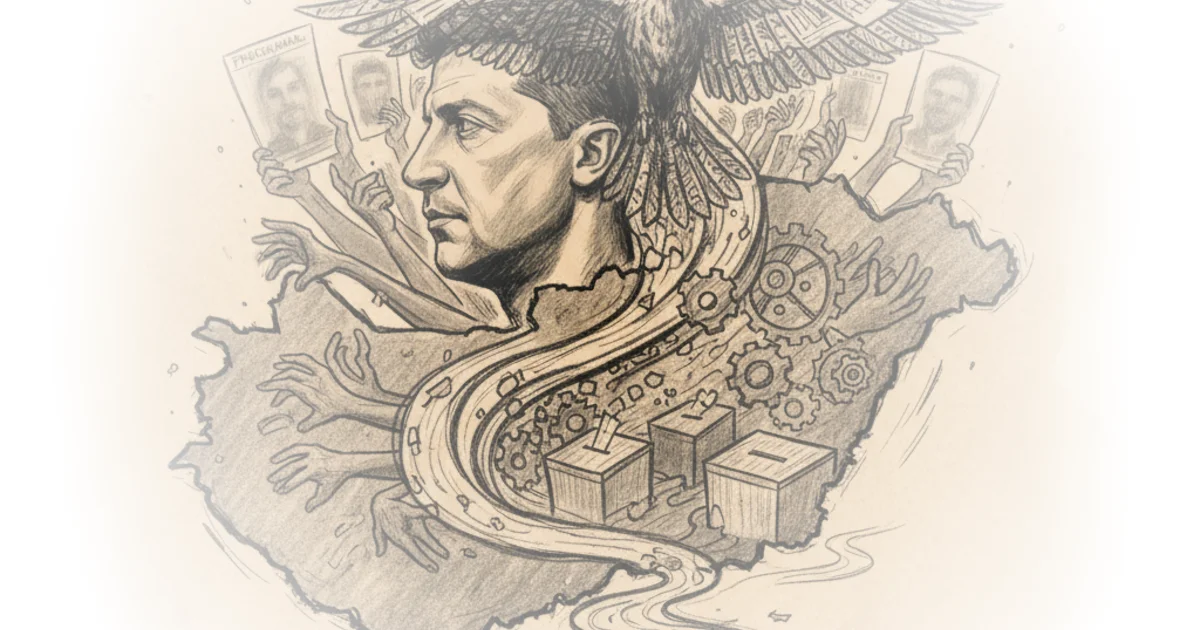
The piece details how the government has flooded the streets with images of President Volodymyr Zelenskyy, not to honor him, but to frame him as the primary threat to Hungarian safety. Mak notes, "Hungary is growing ever more hostile toward the country they call home. In doing so, it is exploiting their Hungarian ethnicity as fuel for government propaganda and political gain." This framing is crucial because it shifts the blame from the Ukrainian government to the Hungarian executive branch, which is actively manufacturing fear to distract from domestic failures. Critics might argue that the administration is simply responding to genuine security concerns, yet the evidence presented suggests a coordinated effort to deepen the rift rather than heal it.
"His own flesh and blood, living in Hungary, had become his biggest hater and the only person Christian ever blocked on Facebook."
The Machinery of Fear
Mak goes beyond the rhetoric to expose the mechanics of the fear campaign. He describes how the ruling party has deployed artificial intelligence to generate terrifying scenarios, such as a video depicting a father's execution, to terrify voters into supporting the status quo. "In February, the party released an AI-made video showing a little girl waiting for her father to return from war. In the next scene, he appears bound and blindfolded in captivity before being killed," Mak writes. This use of technology to manufacture emotional responses is a stark evolution in political warfare, one that bypasses rational debate entirely.
The author connects this domestic fear-mongering to broader geopolitical obstructionism. He points out that despite condemning the invasion, the Hungarian government has consistently blocked sanctions and aid, arguing that Kyiv violates minority rights. Mak observes, "One consequence of Budapest's obstruction was that Ukraine has been denied a €90 billion package of financial and military support that was set to begin flowing this month." This is a devastating indictment of the executive branch's priorities, suggesting that political survival at home is valued over the security of a neighbor. The article also hints at deeper, darker coordination, noting reports that Budapest has coordinated its EU vetoes with Moscow since 2022.
A Fractured Identity
The commentary delves into the cultural nuances of the Zakarpattia region, where Ukrainian and Hungarian identities have long been intertwined. Mak describes a life where "shop signs appear in both languages" and dinner tables hold both goulash and borscht. However, he argues that this hybrid identity is now under siege. "There was a certain difference — a product of the mix of Ukrainian, Transcarpathian, and Rusyn identity. It all layers on top of one another and shapes a person you can confidently call a person from Zakarpattia," Shkiryak tells Mak. This historical context is vital; it reminds readers that the current hostility is not a natural state but a manufactured crisis.
Mak also addresses the complex position of Péter Magyar, the opposition candidate who is leading in the polls. While Magyar is a challenger to the incumbent, Mak clarifies that he is not a straightforward ally to Ukraine, noting that he "opposes military aid to Ukraine as well as its fast-track accession to the EU and NATO." This nuance prevents the piece from becoming a simple binary of good versus evil. Instead, it presents a grim reality where the opposition's rhetoric is merely "more conciliatory" rather than fundamentally different. Mak writes, "I understand him as a European politician, I understand him as someone who will act in the interests of Hungary. [This] is the demand of Hungarian society, which is very afraid of war and has been very afraid of war." This admission underscores the difficulty of breaking the cycle of fear that has gripped the nation.
Bottom Line
Tim Mak's piece is a masterclass in connecting high-stakes geopolitics to the intimate pain of family estrangement, proving that the most effective propaganda is the kind that makes you hate your own kin. Its greatest strength lies in its refusal to simplify the opposition's stance, offering a realistic view of a political landscape where fear is the only currency that matters. The reader must now watch to see if the electorate can recognize the machinery of fear before the next election cycle locks in a decade of isolation. The strongest part of this argument is its human cost; its biggest vulnerability is the lack of a clear path forward for those trapped between two hostile identities.