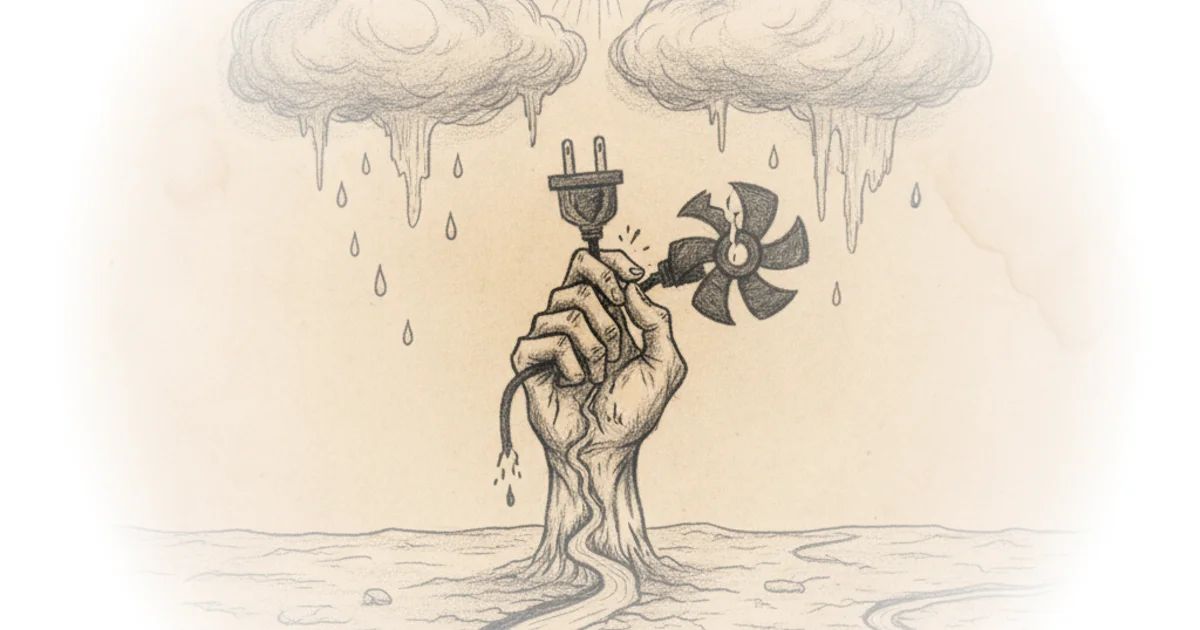
David Smith delivers a startling diagnosis of Moldova's current reality: the nation is not merely facing a hot summer, but is being strangled by a dual hydrological collapse that threatens both its tap water and its electricity grid. While the region enjoys a mild year for agriculture, Smith reveals a paradox where the very rivers that sustain life are draining dry, forcing the state into emergency mode while political squabbles threaten to turn a logistical nightmare into a humanitarian crisis.
The Water and Power Paradox
Smith frames the immediate threat not as a distant climate change projection, but as an acute administrative failure compounded by environmental reality. The core of the argument rests on the physical limitations of Chisinau's infrastructure. He notes that the water intake station in Vadul lui Voda is a "fixed intake and cannot adjust to critically low water levels," a structural rigidity that turns a regional drought into a capital city emergency.
The author highlights the friction between local and national leadership, where Environment Minister Gheorghe Hajder warns that Moldova is "consuming its strategic reserve," while Chisinau Mayor Ion Ceban initially dismissed the urgency. Smith points out the government's eventual pivot to pragmatism, with Prime Minister Tofan intervening to de-escalate the political posturing. Tofan's directive is blunt: "Providing citizens with water should not be a subject of debate and I will not accept its politicization." This is a crucial moment in the narrative, shifting the focus from blame to the deployment of emergency motor pumps and the creation of 213 water distribution points.
"Every liter saved counts."
The commentary on the electricity crisis is equally stark, drawing a direct line between the drought in the Danube and the shutdown of nuclear reactors in neighboring Hungary and Romania. Smith explains that the lack of river water for cooling has forced Hungary to shut down Paks and Romania to halt Cernavoda Unit 1. The geopolitical irony is sharp: Romania, usually a net exporter, is now relying on Moldovan company Energocom to buy power from Ukraine. The desperation is palpable; the Romanian military is reportedly detonating rocks to redirect the Danube, a dramatic attempt to raise water levels by mere centimeters to keep a reactor running.
Critics might note that Smith's focus on the immediate crisis management overlooks the long-term energy diversification strategies Moldova has been slow to implement, leaving it dangerously exposed to regional grid failures. However, the urgency of the current situation justifies the focus on emergency response.
The Fiscal Rebalancing Act
Shifting from physical survival to economic survival, Smith analyzes Prime Minister Tofan's "Tax Reform 2.0." The author contrasts this new approach with the failed reforms of the past, emphasizing a shift in philosophy. Tofan rejects the previous model, arguing that "the way a country organizes its taxes influences the way its economy works." Smith captures the essence of the new strategy: it is not about raising the overall tax burden, but about "put[ting] the accents right."
The reform proposes a significant trade-off: reducing taxes on labor and reinvested profits to encourage formal employment and investment, while simultaneously raising "sin taxes" on vices like vaping, gambling, and fireworks. Smith notes the specific details, such as the 35% increase in the personal exemption and the 0% tax on reinvested profits for companies up to 200 million lei. This "simpler, fairer and more difficult to circumvent" code aims to broaden the base while targeting specific behaviors.
"Our approach is not 'raise taxes.' Our approach is: put the accents right."
The author rightly points out that this iteration of the reform is slower and more deliberate, allowing for two weeks of public consultation rather than the rushed five days of the previous attempt. This suggests a government learning from its own volatility, prioritizing predictability over speed. However, the proposed 20% VAT on electricity and gas for usage above a certain threshold in 2027 introduces a new variable that could strain households already facing energy shortages, a tension Smith hints at but does not fully resolve.
Administrative Consolidation and Diplomatic Blunders
The piece then turns to the contentious Local Public Administration (LPA) reform, where Smith details the struggle to merge small villages into viable entities. The deadline extension to August 31 reveals the resistance on the ground, with 60 mayoralties refusing to participate. President Sandu's warning that non-participating communities will face "normative amalgamation" without financial incentives underscores the state's determination to force modernization, even if it means bypassing local consent.
Perhaps the most surprising element of Smith's roundup is the diplomatic embarrassment involving a Taliban delegation. The author meticulously traces how a routine request from a Moldovan businessman to expand into the Afghan market spiraled into a high-profile incident. The State Secretary's decision to facilitate visas without elevating the issue to the Foreign Minister or Security Services led to a senior Taliban delegation landing in Chisinau. Smith quotes Prime Minister Tofan's self-critique: "An obviously sensitive case was treated as a routine administrative file. The result was a wrong decision." This admission of bureaucratic failure is rare and significant, highlighting the gap between procedural compliance and strategic judgment.
"We do not manage papers, we manage a country and we must be more careful when making decisions."
The author uses this incident to illustrate a broader theme of institutional strain. Just as the water pumps are being rushed to the capital, the diplomatic machinery is struggling to keep pace with the complexities of global trade and security. The presence of a South Ossetian "representative" in Transnistria and the crash of a Russian drone in the Cahul district further complicate the security landscape, reminding readers that Moldova is navigating a minefield of geopolitical tensions while trying to manage its own internal crises.
Bottom Line
David Smith's strength lies in his ability to connect disparate crises—drought, energy shortages, tax reform, and diplomatic blunders—into a coherent narrative of a state under immense pressure. The piece's strongest argument is the exposure of how physical infrastructure limits (the fixed water intake) and bureaucratic inertia (the Taliban visa error) can converge to create national emergencies. The biggest vulnerability, however, is the sheer volume of simultaneous crises; the government's capacity to manage the water and power shortages while implementing complex tax and administrative reforms is being tested to its absolute limit. Readers should watch closely to see if the "put the accents right" fiscal philosophy can survive the immediate reality of a grid failure and a water rationing regime.