Then & Now delivers a rare historical deep dive that refuses to simplify the Israel-Palestine conflict into a binary moral tale, instead exposing how contradictory imperial promises and demographic shifts created an intractable trap. The piece's most striking contribution is its meticulous dissection of the British mandate's role, revealing how a single memo in 1919 explicitly dismissed the political rights of the local Arab majority in favor of a "national home" for a people fleeing persecution elsewhere. For busy listeners seeking clarity on why this conflict resists resolution, this origin story provides the essential structural context often lost in daily headlines.
The Blindness of Romantic Ideals
Then & Now begins by grounding the narrative in the desperate reality of late 19th-century Eastern Europe, where pogroms and legal marginalization made the search for a safe haven a matter of survival. The author effectively uses the work of scholars like Shlaim, Feldman, and Shikaki to show that early Zionism was not a monolith but a complex mix of secular nationalism and religious yearning. However, the commentary takes a sharper turn when analyzing the psychological state of early settlers. Then & Now writes, "They were too focused on a romantic ideal of the area and a tragic oppression they were fleeing from." This observation is crucial; it suggests that the conflict was fueled not just by competing land claims, but by a collective inability to see the existing society. The author cites Aris Shavit's concept of "blindness," noting that travelers saw "empty desert" and "possibility" while ignoring the villages and towns that were already there.
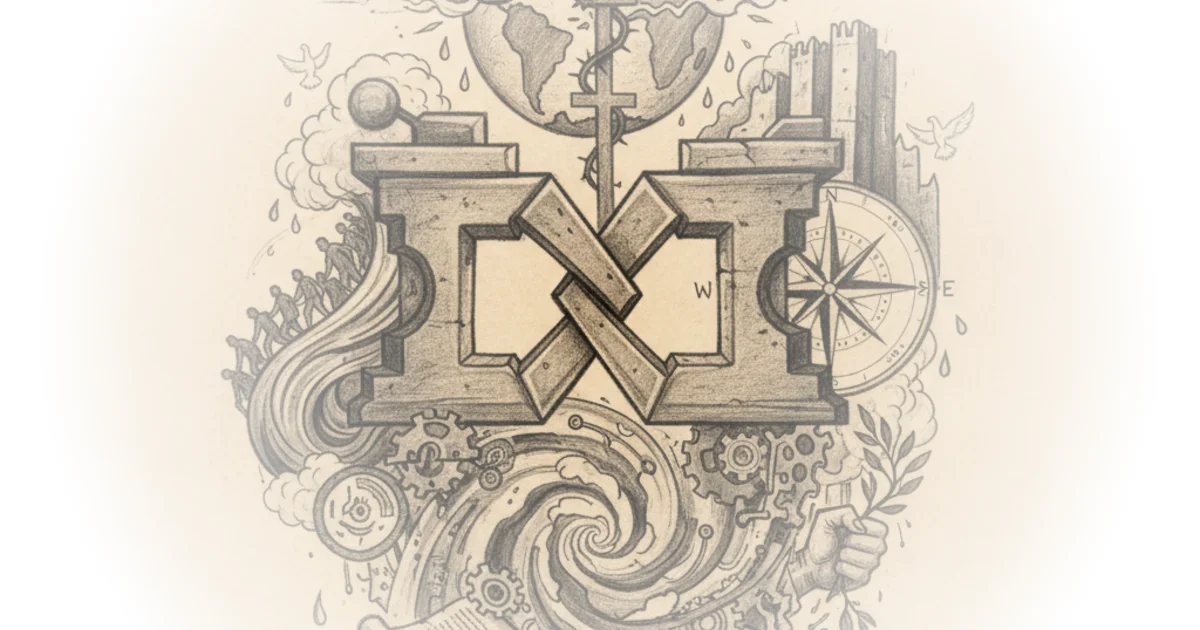
This framing is powerful because it humanizes the settlers' desperation without excusing the displacement it caused. Yet, a counterargument worth considering is whether this "blindness" was truly unintentional or a necessary ideological tool for colonization. If the land was not perceived as empty, the project of creating a new national home would have been politically impossible from the start. Then & Now acknowledges this tension by quoting the Zionist Israel's anguil, who warned that they would have to "drive out by sword the tribes in possession," a sentiment the movement largely ignored at the time.
The Architecture of Contradiction
The narrative shifts to the geopolitical machinations of World War I, where the collapse of the Ottoman Empire left a vacuum filled by British imperial interests. Then & Now highlights the Balfour Declaration of 1917 as the moment the seeds of the future conflict were sown. The author points out the declaration's glaring omission: it committed Britain to a Jewish national home while neglecting to mention the word "Arab" once, despite Arabs comprising 94% of the population. Then & Now writes, "Here lies the roots of the conflict: the contradictory promise when the promised land became twice promised."
This analysis is bolstered by a private 1919 memo from Lord Balfour, which the author brings to light to show the explicit disregard for local self-determination. Then & Now notes that Balfour admitted, "We do not propose even to go through the form of consulting the wishes of the present inhabitants of the country." The author argues that this was not an oversight but a calculated decision, prioritizing "ancient traditions" and "future hopes" over the rights of 700,000 Arabs. This is the piece's strongest evidentiary move, stripping away the myth of British neutrality to reveal a deliberate policy of favoring one group over another.
"Zionism, be it right or wrong, good or bad, is rooted in age-long traditions in present needs in future hopes of far profounder import than the desires and prejudices of the 700,000 Arabs who now inhabit that ancient land."
Critics might argue that focusing solely on British duplicity lets the Arab leadership off the hook for their own strategic failures, particularly their rejection of partition plans that could have secured a state earlier. Then & Now does address this, noting that the Arab Higher Committee rejected the 1947 UN plan and that surrounding Arab states were often motivated by their own territorial ambitions rather than pure altruism. However, the author maintains that the initial structural imbalance created by the mandate made a fair outcome nearly impossible.
The Descent into Violence
As the demographic balance shifted with the influx of refugees fleeing the Holocaust, the tension exploded into open warfare. Then & Now details the brutal suppression of the 1936 Arab Revolt, citing historian Khalidi's estimate that up to 17% of the adult male Arab population was killed, wounded, imprisoned, or exiled. The author describes the British response as a "bloody war waged against the country's majority," noting tactics such as tying prisoners to the front of cars to prevent ambushes. This section is harrowing and essential, illustrating how the conflict evolved from political disagreement to existential struggle.
The author also touches on the tragic irony of the Holocaust, which intensified the urgency for a Jewish state while simultaneously devastating the Palestinian leadership. Then & Now writes, "Even more disastrous for the Palestinians was their leadership's decision to side with Hitler in 1941." This decision, made in the belief that the Nazis would not occupy Arab land, proved catastrophic. The piece concludes by noting that by the time the war ended, the Jewish community had secured a massive arms deal with Czechoslovakia, tipping the military balance decisively. Then & Now writes, "Without these weapons we would not have remained alive by now," quoting Ben-Gurion's reflection on how the arms deal saved the fledgling state.
Bottom Line
Then & Now succeeds in reframing the conflict not as an ancient hatred but as a modern tragedy born of imperial overreach, demographic engineering, and mutual blindness. The piece's greatest strength is its reliance on primary documents to expose the deliberate contradictions of British policy, while its biggest vulnerability is the difficulty of conveying the full emotional weight of the Holocaust's impact within a historical summary. For listeners trying to understand the present, the verdict is clear: the roots of today's violence are not in the desert, but in the boardrooms of London and the desperate choices of a people with nowhere else to go.