Cory Doctorow dismantles the most persistent myth in tech policy: the idea that regulation is simply too slow to catch up with innovation. Instead, he argues that what we are witnessing is a deliberate, high-stakes con job where powerful platforms invent fake categories to evade laws that already exist. This is not a story about the future of technology; it is a story about the present theft of worker dignity, specifically targeting the nurses who keep our healthcare system running.
The Myth of the Regulatory Lag
Doctorow opens by attacking a received wisdom that excuses inaction. "If I could abolish one piece of received wisdom about tech policy, it would be this: 'Tech moves at the speed of innovation and regulation moves at the speed of government, so regulation will always lag behind tech.'" This framing is crucial because it shifts the blame from the complexity of technology to the complicity of policymakers. The author suggests that when tech bosses claim their business models are too new for existing laws, they are not describing a technical hurdle but a political choice.
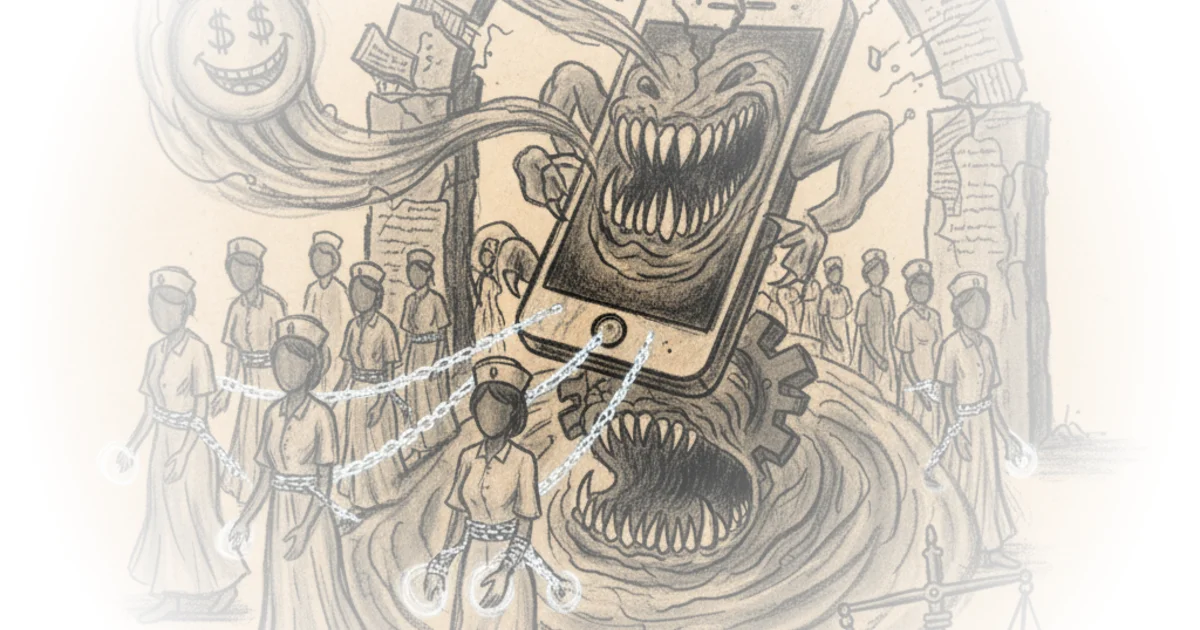
He illustrates this with the fintech sector, noting that "whenever you hear 'fintech,' you should think 'unregulated bank.'" The argument here is that these companies are not creating new financial instruments that defy classification; they are simply refusing to be regulated as banks. Doctorow writes, "There's no (good) reason not to apply those legal frameworks to the crypto industry – but there are plenty of bad reasons not to." The implication is stark: the only reason these laws aren't applied is that the people writing the laws are on the side of the money launderers and swindlers. This is a bold claim, but it is supported by the sheer volume of capital flowing into these unregulated spaces despite their obvious similarities to traditional banking.
The reason we struggle to regulate fintech is that we just don't want to.
The "Solar Panel for a Sex Machine" Gambit
The piece moves to the transportation sector to show how this playbook was perfected before being applied to healthcare. Doctorow mocks the idea that Uber is not a taxi company but a "transportation network company," calling it "about as plausible as those t-shirts that read 'It's not a bald spot, it's a solar-panel for a sex-machine.'" This vivid metaphor captures the absurdity of rebranding a service to avoid liability. The author argues that this was a transparent ruse designed to "push Uber's system of wage-theft and worker misclassification into an expanding constellation of labor categories."
Critics might argue that the gig economy does offer genuine flexibility for some workers, a point Doctorow acknowledges but dismisses as secondary to the systemic exploitation. He notes that the industry runs on the "very stupid proposition that 'it's not a crime if we do it with an app.'" This refrain becomes the central thesis: the app is not a shield; it is a weapon used to strip away protections that were hard-won by previous generations of workers.
The Human Cost in Healthcare
The stakes rise dramatically when Doctorow turns to nursing. Citing a report by the AI Now Institute, he details how gig platforms are using data brokers to identify nurses with high debt and offering them lower wages. "The most economically desperate nurses will accept the lowest pay," he explains, turning financial vulnerability into a pricing algorithm. This is not just bad business; it is a targeted assault on the most vulnerable members of the workforce.
The author contrasts these platforms with traditional staffing agencies, which, while imperfect, were subject to regulations requiring them to "register annually, disclose shareholders and executive officers, certify worker credentials, report to state authorities on the number of workers employed, document service rates charged to facilities, and list average wages paid to workers by job category." In contrast, gig platforms offer "take-it-or-leave-it offers and no opportunities to speak to a human when things go wrong." The shift from human oversight to algorithmic management is described as "enshittifying" the work, a term Doctorow has used before to describe the degradation of user and worker experience as platforms extract maximum value.
AI isn't taking workers' jobs, but it is enshittifying them, with degrading, neurosis-inducing surveillance and high-handed discipline.
The platforms are not merely matching nurses to shifts; they are actively managing wages and blacklisting workers who complain. Doctorow points out that these companies are "aslosh in investor cash," with valuations in the billions, which they use to fund "regulatory entrepreneurship." This term is key: it describes the active effort to rewrite the rules of the game rather than playing by them. In states like Georgia and Ohio, these companies are lobbying to exempt themselves from unemployment insurance and minimum wage laws, effectively asking the state to subsidize their business model by stripping workers of safety nets.
The Political Consensus
The piece concludes by situating this trend within a broader economic philosophy. Doctorow references Douglas Rushkoff's concept of "go meta," where the goal of the economy shifts from productive labor to abstract rent-seeking. "Don't drive a cab: go meta and own a medallion that you rent to a cab driver," he writes, tracing the line from physical assets to digital platforms to financial derivatives. This abstraction, he argues, is the real reason regulation fails. "Once you've decided that the most important party to a transaction is the person who has the option on the share on the platform on the license that the worker who actually does the job requires, of course you're going to see a solar-panel for a sex-machine in every bald spot."
This is a powerful synthesis of the economic and political forces at play. It suggests that the problem is not a lack of understanding among regulators, but a fundamental alignment of interests between the political class and the financial class. The only exception he notes is New York, where a 2025 law "affirmatively recognizes gig nursing platforms as entities that must comply with the state's healthcare staffing agency rules." This proves, as Doctorow states, that "If New York's state leg can figure out that a gig-work platform is just a staffing agency in app form, then other states can do so as well."
If they don't figure that out, that's because they don't want to.
Bottom Line
Doctorow's most compelling argument is that the "regulatory lag" is a fiction used to justify the systematic dismantling of worker protections in favor of platform profits. The piece's greatest strength is its refusal to accept the technological determinism that usually excuses these abuses, instead pointing directly to the lobbying efforts and political collusion that enable them. The vulnerability of this argument lies in the sheer scale of the financial interests involved; while New York has shown the way, the momentum of 17 other states pushing for deregulation suggests a steep uphill battle for any meaningful reform.