This isn't another take on tariff politics; it's a legal autopsy of how emergency powers are being weaponized to bypass Congress, and why the Supreme Court's upcoming ruling could reshape global trade for a decade. Jordan Schneider, hosting a high-stakes dialogue between legal pragmatist Peter Harrell and policy architect Oren Cass, reveals a startling truth: the most arbitrary tariffs might be the most legally defensible, while the most substantive trade wars face the highest legal hurdles.
The Legal Paradox of Emergency Powers
Schneider frames the discussion around a bizarre legal inversion. The administration's reliance on the International Emergency Economic Powers Act (IEEPA) — a 1977 statute designed for genuine crises — has created a scenario where the "universal and reciprocal" tariffs, which seem most politically motivated, are the hardest to challenge in court. Schneider notes, "The weird wrinkle of all this is that if the administration didn't have 'Liberation Day,' but just spent a few more months writing some Section 232 findings... the standing for the Supreme Court to jump in and say, 'You can't do this,' would have been much smaller."
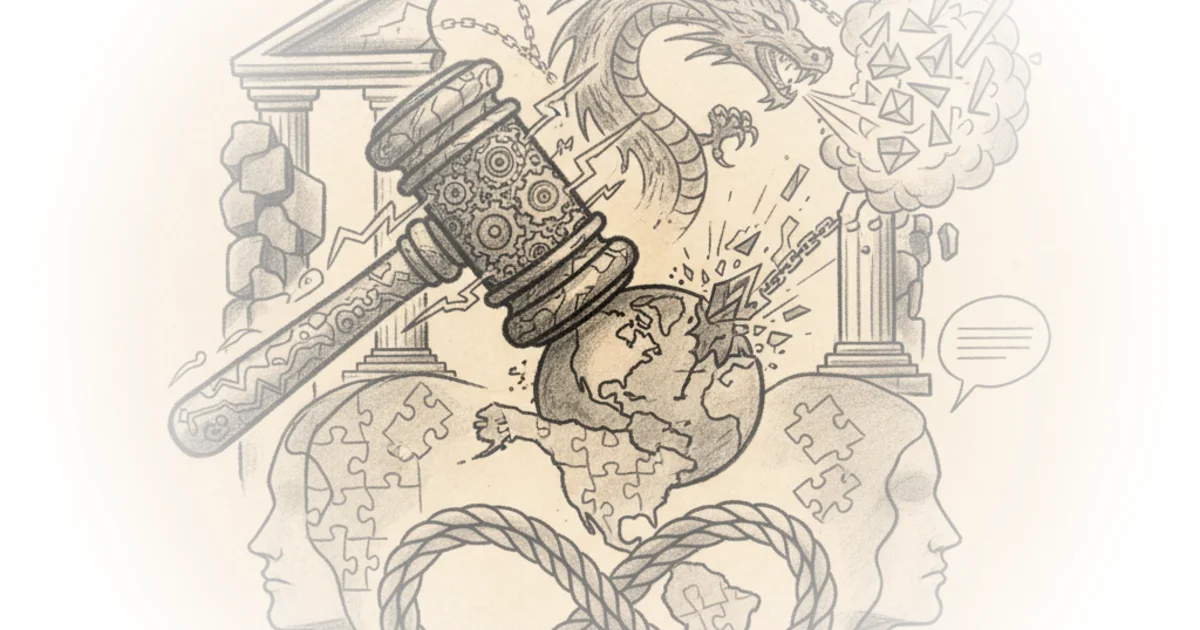
This observation cuts to the heart of the institutional crisis. By choosing speed over process, the executive branch has invited judicial scrutiny it might have otherwise avoided. Cass argues that the Court is unlikely to deliver a clean victory or defeat. Instead, "the court will probably give a bunch of new guidelines and principles and then remand the case back to a lower court to figure out how to implement them." This mirrors the Court's recent handling of presidential immunity, prioritizing long-term doctrinal markers over immediate resolution.
"Anyone who's looking for a clear-cut and decisive victory or devastating loss will almost surely be disappointed."
Harrell pushes back on the idea of a stalling tactic, suggesting the Justices are genuinely skeptical of the executive's reach. He heard "skepticism from the Chief Justice, Justice Barrett, and even Justice Gorsuch on the extent of the IEEPA's authorization." If the Court strikes down the universal tariffs, the administration has fallback options, but they come with significant friction. Harrell points out that while the administration could recreate over 50% of the tariffs using other statutes, "I do not think it is 100%, even after he jumps through all the hoops that these other statutes require."
Critics might note that relying on the "Major Questions Doctrine" — the principle that Congress must speak clearly on issues of vast economic significance — could backfire if the Court decides the 1977 emergency powers are simply too broad to cover modern trade wars. Yet, the administration's strategy seems to be betting that the chaos of litigation buys enough time to lock in policy changes before a final ruling.
The Diplomatic Reality Check
The conversation shifts from legal theory to geopolitical reality, where the stakes are far higher than courtroom procedure. Schneider asks whether the specter of losing these tariffs in court weakens the administration's hand in negotiations with Beijing. Harrell delivers a blunt assessment: "I actually don't think that the specter of Trump losing tariffs in court has that much of a meaningful impact on the China negotiations."
The logic here is coldly pragmatic. Because existing Section 301 authorities already cover China, the administration can pivot quickly if IEEPA tariffs are struck down. "China is the country he could most quickly and easily pivot to these other dials to re-impose the tariffs," Harrell explains. This suggests that for Beijing, the legal battle is a sideshow; the threat remains real regardless of the Supreme Court's docket.
The situation is different for allies. European and Japanese officials are watching closely, but their reaction is one of cautious endurance rather than defiance. They understand that "if Trump loses, he can recreate some of it under other authorities, so why would we anger him by provocatively walking away from the trade deals we've just signed?" This dynamic reveals a troubling asymmetry: the administration can threaten allies with tariffs that lack clear legal footing, while allies feel compelled to comply because the executive branch has multiple legal backdoors.
"You could not possibly do that through legislation. You couldn't go back to Congress in the middle of a negotiation and say, 'Hey, now we want you to do X instead of Y because that's what we threatened at the table yesterday.'"
Cass highlights this irony: the tariffs that seem most unsubstantiated are the most defensible under emergency powers precisely because they are tools of foreign policy negotiation, not just economic adjustment. This creates a dangerous precedent where the executive can leverage legal ambiguity to force concessions that Congress would never authorize.
The Path to Legislative Clarity
The final segment of the discussion confronts the elephant in the room: the need for Congress to step in. Cass divides the tariff landscape into three camps — global tariffs, reciprocal deals with allies, and the China strategy. He sees a narrow but viable path for legislation, particularly regarding China. "The main move would be to repeal Permanent Normal Trade Relations (PNTR)," Cass argues, noting that "it is hard to envision who exactly these days would be fighting to maintain PNTR with China."
However, the political reality is grim. Cass admits that without a functional Congress capable of passing a budget, "it is hard to envision getting a big bipartisan win for the president on elements of the trade stuff." The USMCA, the North American trade agreement, is emerging as the template for future negotiations, but it requires a level of legislative clarity that currently seems out of reach.
"If you're going to have a stable new expectation domestically and globally of what U.S. trade policy is, there is some — not a lot — bipartisan support for some sort of global tariff."
Harrell agrees that the USMCA is the "linchpin" of any new trade order, but he warns that the administration must articulate a clear vision before demolition becomes permanent. The risk is that the Court's ruling, rather than clarifying the law, will simply force the administration to shuffle between different statutes, creating a patchwork of trade policy that lacks coherence and stability.
Bottom Line
Schneider's coverage succeeds in exposing the legal fragility of the administration's trade strategy while acknowledging its political durability. The strongest argument is that the Supreme Court will likely issue a narrow, procedural ruling that leaves the administration with enough breathing room to continue its aggressive posture. The biggest vulnerability, however, is the long-term erosion of institutional norms; by relying on emergency powers for routine trade policy, the executive branch risks delegitimizing the very tools it needs for genuine crises. Readers should watch for the Court's remand instructions, as they will signal whether the era of unchecked tariff power is ending or merely evolving.