Phillips P. O'Brien does not merely report on the US-Iran conflict of 2026; he indicts the very machinery of the American state, arguing that the war has become a vehicle for unprecedented financial predation. The piece's most startling claim is that the conflict is not driven by strategic necessity or national security, but by a series of coordinated insider trades and backroom deals that have turned the US government into a tool for enriching a specific circle of elites. For a reader trying to understand why escalation continues despite clear diplomatic fatigue, this reframing offers a chilling, if disturbing, explanation: the war persists because it is profitable for those in charge.
The Architecture of Predation
O'Brien anchors his argument in a series of specific, time-stamped financial anomalies that suggest a direct line from the White House to the trading floor. He writes, "On April 17, a $760 million bet on falling oil prices was placed minutes before Iran's foreign minister publicly announced that the Strait of Hormuz would be open to commercial vessels." The timing is too precise to be coincidence, leading O'Brien to conclude, "This was no accident it was almost certainly corruption." He details a pattern where futures trades betting on price drops consistently precede public announcements of de-escalation by mere minutes, generating windfalls for the insiders while honest investors suffer.
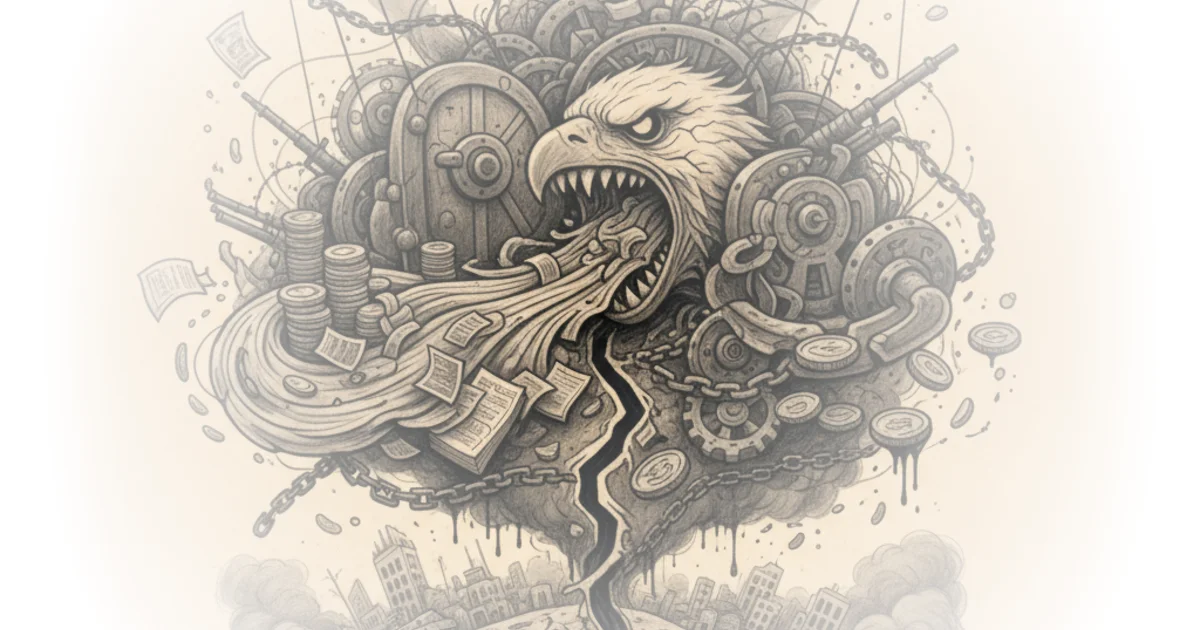
The author's framing here is aggressive, moving beyond speculation to assert that "the US government is now arguably the most corrupt institution on earth—at least in terms of overall value of corruption." This is a heavy charge, but O'Brien supports it by connecting the dots between geopolitical maneuvering and personal enrichment. He points to the UAE's request for financial aid, noting that the administration's positive response ignored the broader economic context in favor of personal ties, specifically referencing how "UAE backed money seems to have piled into the Trump family crypto ventures right before Trump became president for the second time." By weaving in the specific figure of a $500 million stake in Trump crypto and the subsequent cash-out, O'Brien transforms abstract allegations of corruption into a tangible ledger of transactions.
"Every element of US policy seems to be crafted with an eye towards making money. Announcements seem to be made to benefit insider trading, deals made to reward past bribes, and government policy is in the hands of those with massive financial stakes from countries who are trying to influence US policy."
Critics might argue that attributing every market fluctuation to insider trading ignores the complexity of global finance and the role of algorithmic trading. However, the sheer volume of the bets—such as the $950 million wager before the April 7 ceasefire announcement—and the consistent 14-to-47-minute lead times O'Brien cites make a compelling case for systematic abuse rather than random market noise.
The Human Cost of Financialized War
The most harrowing aspect of O'Brien's commentary is his insistence that this financialization of war has a direct, devastating human cost. He argues that the soldiers fighting and the civilians dying are merely collateral in a game of enrichment. "For the US military, this has to be a devastating situation," O'Brien writes. "Soldiers sign up to defend the Constitution of the USA, on the assumption that when they are put in harms way, it is being done for the greater good of the country. To understand that they are now tools for corruption of their masters, not for the country at large, has to destroy the whole idea of serving the country."
This moral injury extends beyond American borders. O'Brien notes that the Iranian people, who were encouraged to rise up with the promise of support, have been abandoned. "They might have had hope for a while... that the USA would help them. Now they know the US cares not at all for them, used them for what Trump had hoped to be his political advantage, and has now abandoned them to a worse version of their original government." The author's choice to center the narrative on the betrayal of these two groups—the American soldier and the Iranian civilian—strips away the geopolitical jargon and leaves only the stark reality of exploitation.
The connection to broader financial entanglements deepens this critique. O'Brien highlights the role of Jared Kushner's Affinity Partners, noting that "at least $4 billion being handed over to Kushner to invest through his Affinity Partners investment fund" from Saudi, Qatari, and UAE sources. This mirrors the broader pattern seen in other deep dives on the administration's financial ties, where foreign capital flows directly into the pockets of those negotiating the very conflicts that destabilize the region. The implication is clear: the negotiators have a financial stake in the outcome, creating a conflict of interest that undermines the integrity of the peace process.
Strategic Purgatory and the Illusion of Control
Beyond the corruption, O'Brien offers a sharp analysis of the strategic deadlock. He argues that the administration is trapped in a "strategic purgatory," desperate for a deal to claim victory but unable to extract one because the Iranian regime has realized the US is running out of options. "Trump is so desperate to get out of the war that he started, that he seems to be convincing the Iranians that the time initiative is in their hands," O'Brien observes. The administration's threats of escalation are revealed as bluffs, a point underscored by former officials like Miles Taylor, who notes that the Iranian leadership sees the US President as "terrified to do what he just said hours ago he was going to do."
This dynamic creates a dangerous volatility. Because the administration cannot achieve its desired outcome through negotiation, O'Brien warns, "he might decide to just do it to try and break the logjam." The blockade strategy, intended to force compliance, is failing to yield quick results because Iran has built up cash reserves and is willing to endure the pain. As O'Brien puts it, "The blockade strategy will hurt Iran... but it will take time. Iran has built up cash reserves and the Iranian regime will do what it must to stay in power."
The oil markets, currently optimistic based on the administration's rhetoric, are described as sitting on a powder keg. "If this continues, what we will see is far worse for the world economy than the situation a month ago," O'Brien warns, noting the risk of a "double-blockade" where both the US and Iran control Gulf traffic. The market's reliance on the administration's optimistic tweets is portrayed as a fragile foundation for global economic stability.
"We are witnessing a war by the corrupt for the corrupt, with Iranian civilians and US service personnel tools in the corrupt game. This is what the USA has become."
Bottom Line
Phillips P. O'Brien's argument is at its strongest when it connects the dots between specific financial transactions and the broader trajectory of the war, presenting a coherent narrative of systemic corruption that is difficult to dismiss. The piece's greatest vulnerability lies in its reliance on market data to prove intent; while the timing is suspicious, proving the existence of a conspiracy requires evidence beyond market anomalies. However, the moral weight of the argument—that the war is being fought for profit rather than principle—resonates deeply, forcing the reader to confront the possibility that the institutions meant to protect the nation are instead being used to exploit it. Readers should watch for whether the administration's desperation leads to a genuine escalation or a sudden, unexplained de-escalation that aligns with the financial interests of the insiders.