The Federal Communications Commission, long dismissed as a bureaucratic backwater for radio frequencies, has quietly transformed into one of Washington's most aggressive national security gatekeepers. Jordan Schneider's interview with Adam Chan reveals a startling shift: the agency is now using a 1934 statute to block the import of advanced robotics, effectively deciding which future technologies the United States can access. This is not merely regulatory housekeeping; it is a strategic pivot that treats consumer electronics as potential weapons and supply chains as battlefields.
The Quiet Rewiring of the Import Market
Schneider frames the story by highlighting how the FCC has spent the last year "quietly rewiring the American import market, first routers, then drones, next undersea cables, and as of last week, robots." This progression is not accidental. The author notes that a combination of a 1934 statute and bipartisan bills from 2020 and 2021 have empowered the agency to act with unprecedented speed. The core mechanism is the "covered list," a regulatory tool that prevents new models of equipment from being authorized for import or sale in the United States.
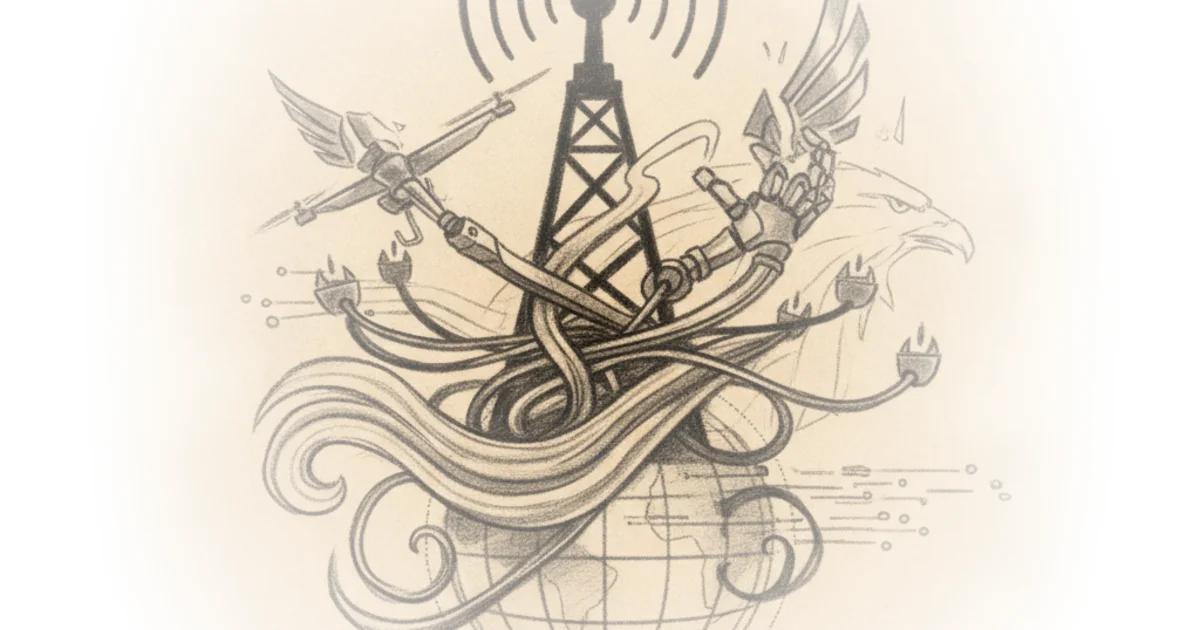
Chan, the national security counsel to FCC Chairman Brendan Carr, explains the legal architecture: "The way that works is we have a covered list of equipment and services... Instead, we require another national security agency or interagency body to make a determination that is the legal predicate by which the FCC then updates the covered list." This separation of powers is crucial. It means the FCC does not unilaterally decide what is dangerous; it acts on the legal findings of the executive branch, creating a streamlined enforcement pipeline. The result is a system where the FCC can "shut off new models of devices from coming into the country" with the same finality as a court order.
"The covered list works best in fast-evolving industries, where probably the robot of today is not really going to be on the market in five years."
This approach mirrors the urgency seen in the "Battle of the Beams" during World War II, where radio technology dictated the outcome of aerial warfare. Just as the 1930s recognized that radios were the future of conflict, the current administration is betting that robotics will define the next century of national security. By acting now, before the industry matures, the goal is to avoid the costly "rip-and-replace" scenario the U.S. faced with Huawei and ZTE in telecom networks.
The Case for "Simple and Stupid" Rules
One of the most provocative arguments in Schneider's piece is the defense of blunt regulatory instruments over nuanced, complex frameworks. In an era where agencies often get bogged down in endless comment periods and legal carve-outs, Chan advocates for a "simple and stupid" policy. He argues that this approach "allows for fast action, we avoid the whack-a-mole problem of naming specific entities or coming up with complex definitions and long transition periods, and we send a very strong market signal."
This is a significant departure from the traditional regulatory playbook, which often prioritizes due process and specificity. Critics might note that such broad bans risk stifling legitimate innovation or accidentally blocking non-threatening devices, such as the "two-kilogram exception" debate regarding small insect-like robots. However, Chan counters that the system is designed to be adaptive. He points to the drone sector, where a broad definition was later refined to exempt toy drones, proving that "further exceptions or expansions can be built in later" without dismantling the entire framework.
The efficiency of this model is reinforced by the speed of the conditional approval process. Chan notes that the Department of War is reviewing applications for conditional approval in "just a few weeks," a pace that is "much faster than many other kinds of national security reviews in the interagency process." This speed is essential for an industry where obsolescence cycles are rapid. The logic is that a clear, immediate barrier forces capital and investment to flow toward domestic manufacturing, a strategy that has already yielded results in the drone sector with "over $5 billion" in investment and "a million square feet of manufacturing capacity."
Industrial Policy as National Security
The interview dismantles the conventional wisdom that separates national security from industrial policy. Schneider presses Chan on whether the motivation is truly about preventing remote sabotage or simply about building a domestic industrial base. Chan's response is unequivocal: "I really see that as a false dichotomy. It's not necessarily the case that there's a bucket of national security concerns and then a bucket of industrial policy concerns. Industrial policy really is critical to national security."
This framing is the intellectual backbone of the new regulatory regime. It posits that dependency on foreign supply chains for critical future technologies is, in itself, a national security vulnerability. As Chan puts it, "if we want to be secure as a national security matter, we need to be able to produce drones and not be entirely dependent on foreign countries." This logic extends to robotics, where the U.S. currently faces a "nascent industry" that is "overwhelmingly reliant on foreign imports."
The stakes are high. If the U.S. fails to build a domestic ecosystem, it risks being locked out of the industries of the future, much like the reliance on Chinese parts that has complicated Ukraine's defense efforts. The FCC's actions are not just about blocking bad actors; they are about ensuring that the United States retains the capacity to produce the tools of tomorrow. As Chan observes, "Getting ahead of the humanoids" is about preventing a scenario where the U.S. is "very dependent on foreign sources" for devices that may become critical to military and industrial applications.
"Industrial policy really is critical to national security."
Bottom Line
Schneider's coverage effectively illuminates how the FCC has evolved from a spectrum regulator into a primary architect of U.S. technology sovereignty, using a "simple and stupid" regulatory framework to block foreign competition before it takes root. The strongest part of this argument is the seamless integration of industrial policy with national security, proving that supply chain independence is now a frontline defense. However, the biggest vulnerability lies in the potential for overreach, where the "blunt instrument" of the covered list could inadvertently stifle legitimate innovation or create diplomatic friction with allies whose companies are caught in the crossfire. The reader should watch closely to see if the conditional approval process can truly keep pace with the rapid evolution of robotics without becoming a bottleneck itself.