This piece cuts through the noise of daily political scandals to deliver a sobering historical verdict: the current political crisis is not a temporary fever, but a decade-long structural shift that rivals the presidencies of Franklin D. Roosevelt and Ronald Reagan in magnitude. Longwell, Miller, and Kristol argue that we are not merely enduring a bad year, but living through a defining era where the very guardrails of constitutional government are being dismantled by a leader who views elections as a conquest rather than a process.
The Decade That Defines a Century
The authors, Sarah Longwell, Tim Miller, and Bill Kristol, anchor their argument in a stark timeline, reminding readers that the "Trump era" began a full decade ago, not with the 2024 election, but with the 2016 primary season. "Ten years ago, in early February 2016, it was still unclear that Trump would be that year's Republican nominee," they write, noting how quickly the political landscape shifted from uncertainty to dominance. This framing is crucial because it forces the reader to confront the longevity of the phenomenon rather than dismissing it as a fleeting reaction to current events.
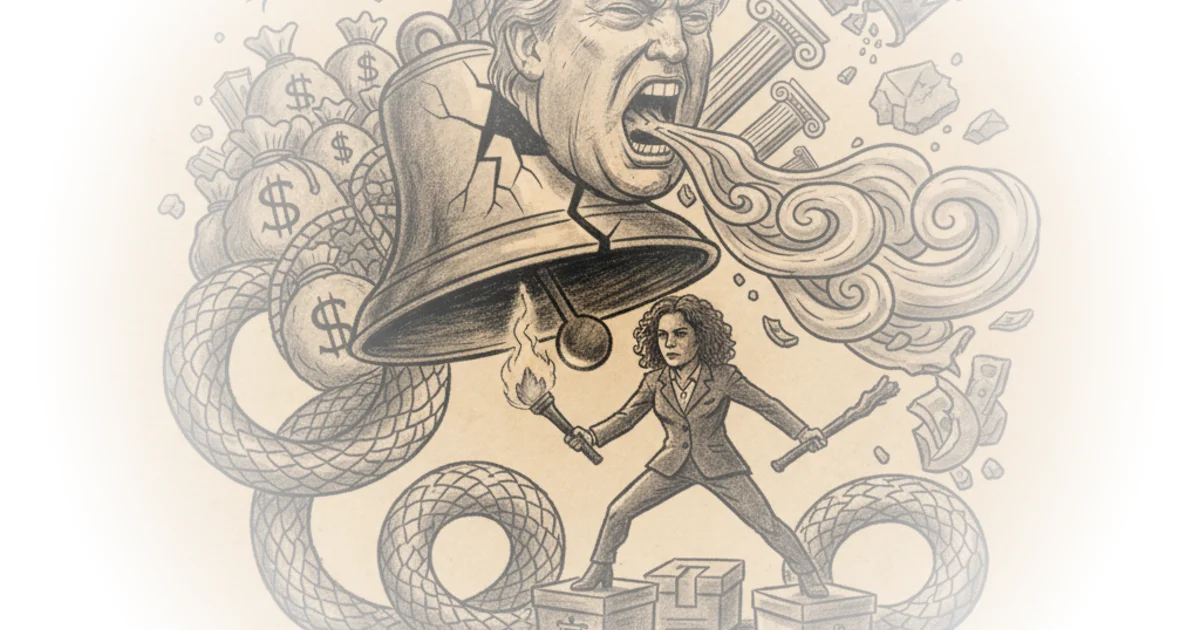
The commentary draws a sharp parallel to the twentieth century's titans, suggesting that future historians will organize the twenty-first century around this single figure. "His legacy will be negative. He'll be known for inspiring a riot at the Capitol, not for legislation passed in the Capitol," the authors state. This is a powerful, if painful, distinction. It shifts the focus from policy wins to institutional damage. The argument holds weight because it refuses to let the reader off the hook with the idea that this is just about personality; it is about the erosion of the system itself.
His legacy will be negative. He'll be known for inspiring a riot at the Capitol, not for legislation passed in the Capitol.
Critics might argue that comparing a figure associated with democratic backsliding to FDR or Reagan, who are credited with saving the nation from existential threats, is a false equivalence that inflates the subject's historical importance. However, the authors counter this by redefining "consequence." They argue that the sheer scale of disruption, regardless of its moral valence, makes the figure historically inescapable. "I'm afraid it's hard to deny that he is by far the most consequential figure of American politics in the twenty-first century so far," they assert, grounding the claim in the reality of sustained political dominance rather than the quality of leadership.
The Failure of Institutions
The piece takes a particularly hard line on the moral failure of the American public and its institutions to resist this rise. Invoking Abraham Lincoln's 1838 speech, the authors contrast the grand threats Lincoln imagined with the reality of the current moment. "We don't face some kind of world-historical or formidable foe of the sort Lincoln imagined," they write. Instead, the nation has succumbed to a "second-rate demagogue and grifter, aided by third-rate bigots and authoritarians."
This framing is effective because it removes the excuse of external pressure. The authors emphasize that this collapse happened "not after the great shocks of a depression or a world war," but during a time of relative peace and prosperity. "We have no excuse for having succumbed to the degree we already have," they declare. This is the piece's most stinging indictment: the idea that the threat was manageable, yet the response was a total failure of nerve and principle.
The commentary also highlights the internal fractures within the movement itself, noting that even allies are turning on the administration. Citing Marjorie Taylor Greene's recent comments, they observe that the populist insurgency is now targeting the administration's donors. "When she's right, she's right," the authors concede regarding Greene's claim that the slogan is a lie serving big donors. This detail adds necessary texture, showing that the movement is not a monolith but a chaotic ecosystem of opportunism.
We have no excuse for having succumbed to the degree we already have.
The Assault on the Ballot and the Law
The authors pivot to the immediate dangers facing the 2026 elections and the rule of law, describing a scenario where the executive branch openly flouts constitutional norms. They highlight the administration's threats to subvert elections, quoting the president's own words: "The Republicans should say, 'We want to take over.' We should take over the voting in at least fifteen places. The Republicans ought to nationalize the voting."
The commentary treats this not as political hyperbole but as a direct assault on the Constitution. "To say the federal government ought to seize control of state elections is a straightforward assault on the plain text of the Constitution," they argue. The piece connects this rhetoric to concrete actions, such as the FBI raid on a Fulton County election office and the presence of intelligence officials at the scene. "What we're seeing in Trump 2.0 isn't just the collapse of any sort of wall of separation between the Justice Department and the White House," they write. "It's the abandonment even of any pretense of impartiality."
The inclusion of the legal battle over Haitian Temporary Protected Status in Springfield, Ohio, further illustrates the administration's disregard for due process. The authors note that a federal judge blocked the revocation of status, ruling it was based on "hostility to nonwhite immigrants" rather than safety assessments. This serves as a grim counterpoint to the administration's claims of order, revealing a pattern of targeting vulnerable populations without legal or moral justification.
The Human Cost of Political Exhaustion
Ultimately, the piece is a call to endurance. The authors acknowledge the psychological toll of fighting a decade-long battle, comparing it to the endless loop of Groundhog Day. "As Sarah always remind us, the authoritarians want us tired, doubtful, and demoralized," they write. The argument here is that the primary weapon of the current administration is not just policy, but the exhaustion of its opponents.
The authors conclude by reframing the struggle as a moral imperative to protect the "noble edifice" of liberty for future generations. "It would be a dreadful thing to be the generation that failed in this task," they warn. This is a plea to the reader to reject the fatigue that the administration cultivates. "If fighting the good fight for this republic means having to spend another three years—or more—feeling like we're enduring one Groundhog Day after another, so be it," they assert. The message is clear: the cost of inaction is far higher than the cost of endurance.
It would be a dreadful thing to be the generation that failed in this task.
Bottom Line
The strongest element of this commentary is its refusal to treat the current political crisis as a temporary aberration, instead framing it as a decade-long historical epoch that demands a generational response. Its greatest vulnerability lies in its reliance on the assumption that the public and institutions retain the capacity to resist, a premise that the authors themselves admit is currently under severe strain. Readers should watch for whether the legal challenges to the administration's overreach, particularly regarding election integrity and immigration, can translate into the institutional guardrails the authors believe are necessary for survival.