Most parents and educators accept dyslexia as a fixed, genetic neurological condition, a label that often becomes a life sentence of remedial struggle. Peter Gray, in this provocative piece for Play Makes Us Human, flips the script entirely, arguing that what we call dyslexia is often a self-inflicted wound of the school system itself. He posits that the disorder is not a brain defect but a trauma response to the high-pressure, anxiety-inducing environment of standard reading instruction.
The Myth of the Defective Brain
Gray begins by dismantling the prevailing scientific consensus with a sharp critique of the evidence. He notes that if you search for the biological cause of dyslexia, you find a mess of contradictory data rather than a clear diagnosis. "One review of the research a few years ago concluded there is no good evidence for localized brain differences associated with dyslexia... and that 'all the estimates [from brain studies] are weak and noisy,'" Gray writes. He argues that the brain is plastic, changing in response to experience, much like a muscle. Therefore, the observed differences in the brains of struggling readers are likely the result of the struggle itself, not the cause.
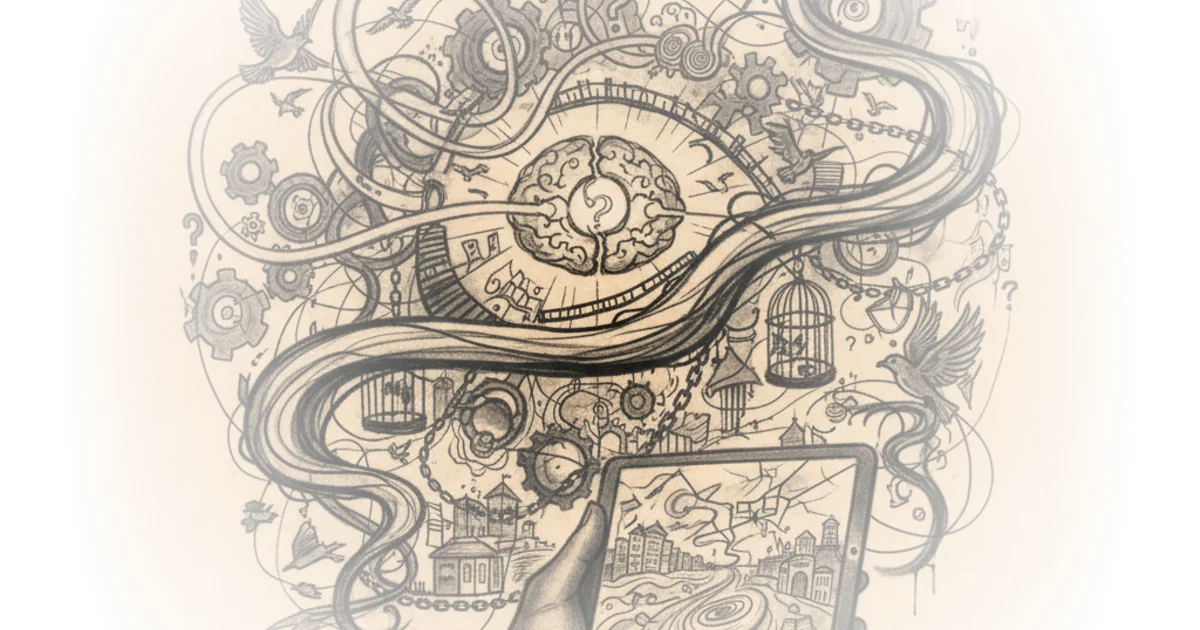
This reframing is powerful because it shifts the locus of the problem from the child to the environment. Gray suggests that the assumption that a child who hasn't learned to read must have a broken brain is a logical fallacy. "The implicit assumption is that if you haven't learned to read despite the school's efforts to teach you, there must be something wrong with your brain, not the school," he observes. This is a bold claim that challenges the medicalization of learning difficulties. Critics might note that this view risks dismissing the very real, biologically based reading disorders that do exist for a small minority of children, potentially delaying necessary interventions for those who truly need them. However, Gray's point is that the current diagnostic system is too broad, catching many children who are simply reacting to stress.
The Sudbury Anomaly and the Power of Removing Pressure
To support his theory, Gray turns to a natural experiment: the Sudbury Valley School, where there is no curriculum and students learn at their own pace. He recounts the stories of graduates who arrived at age 15 unable to read, labeled as dyslexic, yet learned to read within months of entering the school. "For the first time in my life nobody cared if I could read," one student told him. The removal of judgment and pressure allowed the learning to happen naturally.
"With pressure off, they could relax about reading; and with this new mental set they learned."
Gray expands on this with an informal survey of parents who removed their children from traditional schools. The consistency of the results is striking. Parents reported that their children, previously terrified of reading, began to learn once the anxiety was removed. One parent described their child's recovery from "reading trauma at school," noting that the child "avoided reading like the plague" until the pressure was lifted. Another shared that their son, who had a "meltdown" at the mere suggestion of reading, eventually became a college student who "loves Shakespeare and poetry." The evidence suggests that the barrier was emotional, not cognitive. The mental block created by shame and fear prevented the brain from engaging with the task of reading.
The Cost of Early Academic Training
Gray connects the rise in dyslexia diagnoses to a broader societal trend: the push to teach reading to children who are not developmentally ready. He points to the Tennessee Pre-K experiment as a damning piece of evidence. In this study, children enrolled in a rigorous pre-K program were, by sixth grade, performing worse on academic measures and were significantly more likely to be diagnosed with a learning disorder than the control group. "By sixth grade 14.5% of those from the pre-K program had been diagnosed with a learning disorder contrasted with just 8.4% in the control group," Gray notes. This represents a 74% increase in diagnoses.
This finding aligns with historical context regarding the shift in early education. As the push for "whole language" and early literacy accelerated, the expectation for young children to perform complex cognitive tasks at an age when their brains are still developing social and emotional regulation grew. Gray argues that forcing reading on four-year-olds is essentially "child abuse" that induces shame and anxiety. He suggests that the correlation between dyslexia and social anxiety is not a coincidence but a causal link. "You are a little child, forced repeatedly to read out loud in front of not just your teacher but your classmates. You stumble, you are embarrassed, you feel shamed... You develop then a mental block," he writes. The fear of public failure becomes the primary obstacle to learning.
Bottom Line
Peter Gray's argument is a necessary corrective to the rush to medicalize learning difficulties, offering a compelling case that school-induced anxiety is a major driver of what we label as dyslexia. The strongest part of his evidence lies in the consistent anecdotes of children who flourish once the pressure is removed, suggesting that the "disorder" is often a reversible reaction to the environment. However, the piece's biggest vulnerability is its reliance on anecdotal surveys and a specific type of alternative school, which may not fully account for the complexity of neurodivergence. As the debate over early education intensifies, Gray's warning that pushing children too hard too soon may be creating the very problems we seek to solve deserves serious attention.