Mandy El-Sayegh does not merely make art; she performs a radical act of triage on a world that has lost its syntax. In this intimate tour of her studio, Louisiana Channel captures an artist who refuses to separate the personal trauma of psychosis from the collective trauma of war, arguing that the only way to survive a reality that "makes no sense" is to build a new language from the wreckage. This is not a standard artist profile; it is a raw, unfiltered map of how a mind processes the collision of the Abu Ghraib prison scandals, the war in Gaza, and the intimate history of her migrant family, all while navigating the terrifying hyper-connectivity of a psychotic break.
The Architecture of a Broken Syntax
El-Sayegh frames her entire practice as a desperate necessity rather than a career choice. She explains that her work stems from a "broken syntax" born of her upbringing as the child of migrant parents who valued medicine and science over the arts. The author notes that for El-Sayegh, art became the only viable outlet when language failed to contain her experience. "I think it's something about language not being satisfactory and you kind of are unconsciously building out kind of language out of necessity," Louisiana Channel writes. This is a profound redefinition of the artist's role: not as a creator of beauty, but as a builder of survival tools.
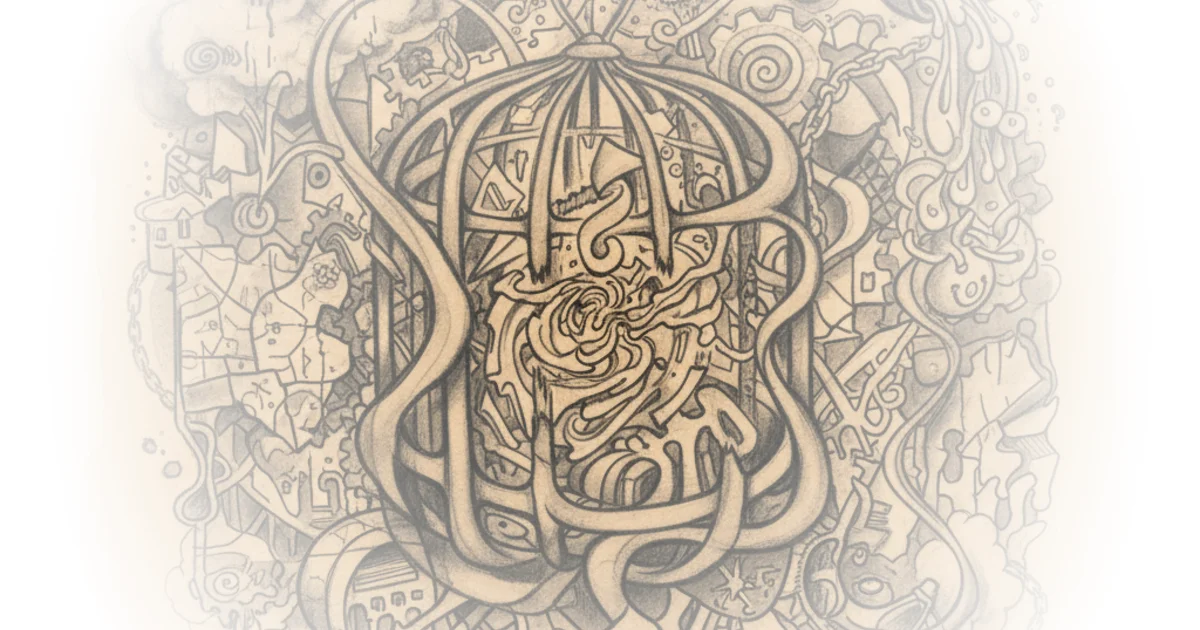
The commentary here is striking because it refuses to romanticize the struggle. El-Sayegh describes her descent into depression and eventual psychosis not as a mystical awakening, but as a literal unraveling where the internal and external worlds merged. "I lost my mind... The isolation, I was alone for I think 6 months... eventually that went into full-blown psychosis," she recounts. The author effectively uses this personal history to explain the visceral nature of her work. When El-Sayegh says, "That inner world that I pull from and consciously make work from became a very persecutory reality on the outside talking to me," it reframes her chaotic collages as a direct translation of a mind where everything is a literal sign. Critics might argue that this conflation of clinical psychosis with artistic genius risks trivializing the severity of mental illness, but El-Sayegh is careful to ground her experience in the physical reality of her materials, insisting that the work is a way to "start with acknowledgement" rather than a glorification of suffering.
"I'm trying to process this reality because none of it makes sense. And once it's processed, which I don't think is ever complete, it goes out and then I have a dialogue with the outside."
The Erotics of Violence and the Weight of Images
The piece shifts powerfully when El-Sayegh tackles the visual culture of violence, specifically the infamous images from Abu Ghraib. She does not look away; instead, she dissects the "erotics of the image" and how the camera phone transformed humiliation into a viral spectacle. Louisiana Channel highlights her observation that these images marked a "big moment in this kind of cultural imagination and how the image worked." El-Sayegh's approach is to take these horrific fragments and re-contextualize them through materials like latex and silicone, creating a tension between the "deathly color" of violence and the "high-end lifestyle luxury color" of consumerism.
This section is particularly effective because it challenges the viewer's comfort. El-Sayegh describes finding a cover image that reminded her of "film and porn and like the erotics of it," a connection that is both disturbing and intellectually rigorous. She argues that we must confront the "brutal figurative shrapnel" of these images rather than hiding behind abstraction. "But then this hystericism in me of not wanting to negate the brutal figurative shrapnel of where it started from," she explains. The author's coverage here is crucial: it shows how El-Sayegh uses the "slowest form" of painting to resist the instant, disposable nature of digital censorship and image saturation. However, a counterargument worth considering is whether re-purposing such traumatic imagery, even with the intent of resistance, risks re-traumatizing the subjects who have no consent, a dilemma El-Sayegh acknowledges but ultimately resolves by focusing on the "resistant force" of the image itself.
Materiality as Memory and Labor
Perhaps the most grounded part of the interview is El-Sayegh's discussion of her materials, specifically latex. She connects the smell of ammonia and the sticky, rotting nature of rubber directly to her mother's childhood labor on a rubber tapping farm in Malaysia. "It's a connection back to that labor and it's not necessarily part of the kind of overt discourse, but when I'm working with it, I feel um not so romantic," she says. This is a masterclass in connecting the micro (the smell of the studio) to the macro (global labor histories and colonial extraction).
El-Sayegh describes the material as "unruly," noting that it "will rot like a body" and is "preserving but dying." Louisiana Channel captures the physicality of her process, from the "glitter lamp light" to the "evil eye" amulets she wears for protection. These details are not mere set dressing; they are essential to her argument that art must be embodied. "I feel like I'm just in this thing that can will do what it wants to do regardless of what my intentions of it are," she admits. This surrender to the material is a direct counter to the control exerted by the digital world and the political powers that erase history. The author's choice to include these sensory details makes the abstract concept of "processing reality" tangible for the listener.
"To start from a place of a wound or disturbance or a negation is so so key to staying sane. Cuz if you skip over, if you don't show or you don't work with or process, it's going to come up again like a fistula in society, in your mind, in the family."
Bottom Line
Louisiana Channel's coverage of Mandy El-Sayegh succeeds by refusing to sanitize the artist's mental health crisis or the horrific subject matter of her work, instead presenting them as the essential fuel for a new visual language. The piece's greatest strength is its ability to link the intimate mechanics of a psychotic break with the global mechanics of war and censorship, proving that the personal is not just political, but a matter of survival. The only vulnerability lies in the sheer density of the trauma presented, which demands a level of emotional endurance from the audience that not everyone may be prepared to give, but El-Sayegh's insistence on "acknowledgement" makes that demand feel necessary rather than exploitative.