Heather Cox Richardson delivers a searing historical indictment, arguing that the current administration's immigration and labor policies are not a break from American tradition, but a deliberate resurrection of the 1850s "mud-sill" theory of social hierarchy. By juxtaposing modern executive actions with the rhetoric of enslaver James Henry Hammond, the piece forces a confrontation with the idea that the government is actively constructing a permanent, disenfranchised underclass. This is not merely policy analysis; it is a warning that the foundational contract of American democracy is being rewritten in real time.
The Mud-Sill Returns
Richardson anchors her argument in a recent social media post by Stephen Miller, the White House deputy chief of staff, who explicitly called for a "labor class" stripped of political rights. "The West is the first and only civilization to import a foreign labor class that is granted full political rights," Miller wrote, framing the current system as an anomaly that must be corrected. Richardson immediately draws a parallel to 1858, when Senator James Henry Hammond justified slavery by arguing that every society requires a "class to do the menial duties, to perform the drudgery of life."
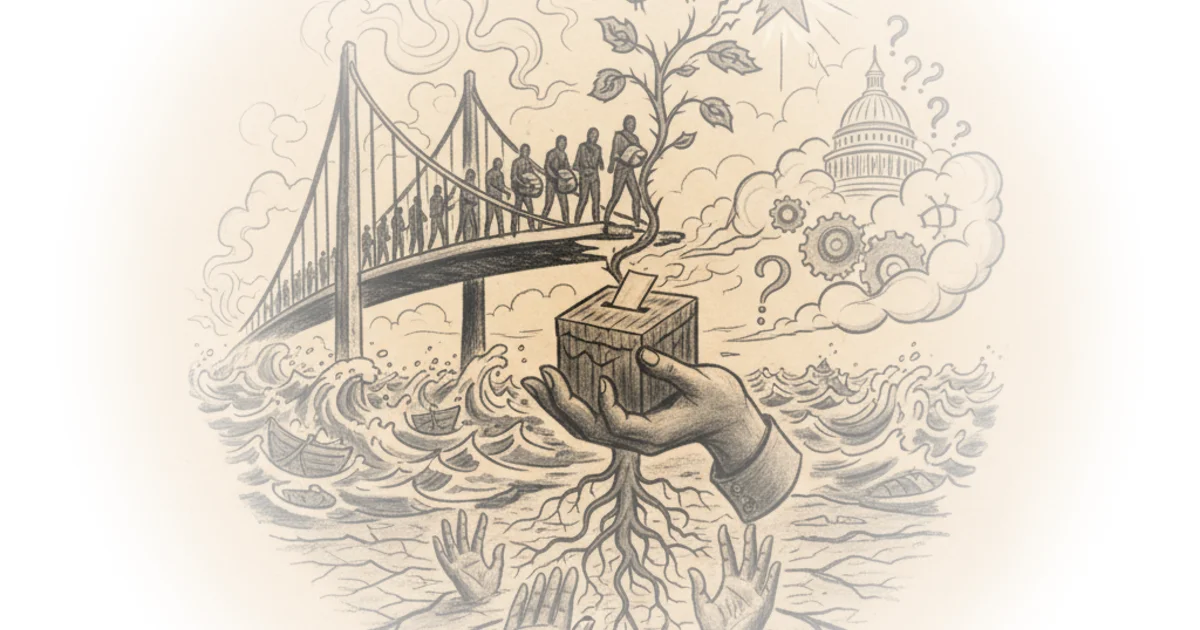
The author's choice to link Miller's modern white nationalism directly to Hammond's defense of chattel slavery is the piece's most potent move. She notes that Hammond believed such workers needed "few brains and little skill," serving only to support an aristocracy of wealthy men. Richardson writes, "Hammond called such workers 'the mud-sill of society and political government.'" This historical framing is devastatingly effective because it strips away the modern euphemisms of "border security" or "economic protectionism" to reveal the underlying desire for a caste system. Critics might argue that comparing legal immigration policy to the defense of slavery is hyperbolic, but Richardson counters this by highlighting the shared goal: the concentration of power and wealth in the hands of a few while the many are kept in a state of subordination.
Miller's white nationalism is not the concept on which this nation was built. The United States of America was built on the principles of the Declaration of Independence and the sweat and blood of almost 250 years of Americans, often those from marginalized communities, working to make those principles a reality.
The article further deepens the historical context by referencing the personal corruption of the historical figures involved. Richardson reminds readers that Hammond's political career was nearly derailed by his admission of sexually assaulting his young nieces, yet he still positioned himself as part of an "aristocracy" of "men without fear and without reproach." This detail serves to dismantle the moral authority of the current administration's leadership, suggesting that their claims of superiority are as baseless as Hammond's were.
The Crisis of the Rule of Law
Moving from labor theory to immediate violence, Richardson documents the administration's aggressive enforcement tactics in Portland, Oregon. She cites reports of federal agents indiscriminately throwing tear gas and flashbangs at peaceful protesters, including children. "Today I saw ICE gas little white kids in the streets of Portland with chemical weapons," writes Tim Dickinson, a quote Richardson uses to underscore the brutality of the state's actions. The author emphasizes that the administration is not just enforcing laws but actively dismantling the rule of law to protect a specific class of power.
This section highlights the hypocrisy of the administration's legal stance. Richardson points to Deputy Attorney General Todd Blanche's refusal to release Epstein files showing "death, physical abuse, or injury," suggesting a government that shields the powerful from accountability. The author connects this to a broader pattern where the executive branch views itself as above the law. She notes that the administration has committed to allowing the United Arab Emirates to purchase advanced AI chips, reversing previous restrictions, in exchange for a secret deal involving the President's family crypto venture. "The deal was backed by Sheikh Tahnoon bin Zayed Al Nahyan... who oversees more than $1.3 trillion," Richardson writes, illustrating the transactional nature of the administration's foreign policy.
The human cost of this legal erosion is made visceral through the story of Liam Conejo Ramos, a five-year-old asylum seeker. Richardson quotes U.S. District Judge Fred Biery, who ordered the child's release and posted a biblical passage: "Jesus wept." The judge's observation that officials are driven by a "perfidious lust for unbridled power" serves as a judicial rebuke of the administration's cruelty. Richardson argues that this is not an aberration but a feature of a system designed to crush dissent and enforce hierarchy.
The People Push Back
Despite the overwhelming force of the executive branch, Richardson highlights a significant counter-movement in the Texas Senate special election. Democrat Taylor Rehmet, a machinist and Air Force veteran, defeated a heavily funded Republican candidate in a district that had been held by Republicans since the 1990s. Richardson notes that despite spending nearly $2.2 million less than his opponent, Rehmet flipped the seat by a 14.4-point margin. "After removing the minor-party candidates in the vote, the swing from the Republican in 2024 was 32 points toward the Democrats," she writes.
This electoral upset serves as a rebuttal to the administration's narrative that their policies are universally supported or that the electorate is passive. Richardson frames this as a rejection of the "mud-sill" theory in action, where voters chose a candidate who represents the working class over one backed by the wealthy elite. She writes, "In a nation of immigrants and men who have worked their way up from day laborers to become prominent men, Lincoln stood firm on the Declaration of Independence." The election results suggest that the American public is not ready to accept a permanent caste system.
Critics might note that a single special election does not guarantee a national shift, and the administration retains significant institutional power. However, Richardson's point is that the ideological foundation of the administration is fragile. The "mud-sill" theory relies on the belief that the lower classes will remain docile, but the Texas result and the protests in Portland suggest otherwise.
Bottom Line
Richardson's most compelling argument is that the current administration is not innovating but regressing, attempting to import a 19th-century aristocratic worldview into the 21st century. The piece's greatest strength is its unflinching connection between historical rhetoric and modern policy, exposing the moral bankruptcy of the "mud-sill" theory. The biggest vulnerability in the administration's position is its reliance on a narrative of order that is increasingly at odds with the reality of public resistance and judicial pushback. Readers should watch for how the administration responds to these electoral and legal challenges, as the gap between their vision of hierarchy and the American public's demand for equality continues to widen.
The hierarchical system Miller embraces echoes the system championed by those like Hammond, who imagined themselves the nation's true leaders who had the right to rule. They were not bound by the law, and they rejected the idea that those unwilling to recognize their superiority should have either economic or political power.