In a landscape of cautious climate optimism, Good Times Bad Times delivers a jarring diagnosis: Germany is not just struggling with its green transition, it is actively dismantling its own industrial base through a policy of "voluntary de-electrification." The author argues that the nation's leadership has ignored immutable physical laws in favor of ideological purity, resulting in an energy crisis that has turned the EU's economic engine into its largest net importer of power. This is not a story about slow progress; it is a narrative of structural collapse, backed by stark data showing a 40% drop in per capita electricity production since 2008.
The Physics of Failure
Good Times Bad Times opens with a blunt assessment of the nuclear phase-out, calling it a "serious strategic mistake" that sacrificed generation capacity for political signaling. The author posits that reality is "unforgiving" and does not reward "moral posturing," a framing that immediately sets the piece apart from standard policy analysis. By anchoring the argument in the laws of physics rather than political ideology, the author forces the reader to confront the tangible consequences of shutting down baseload power.
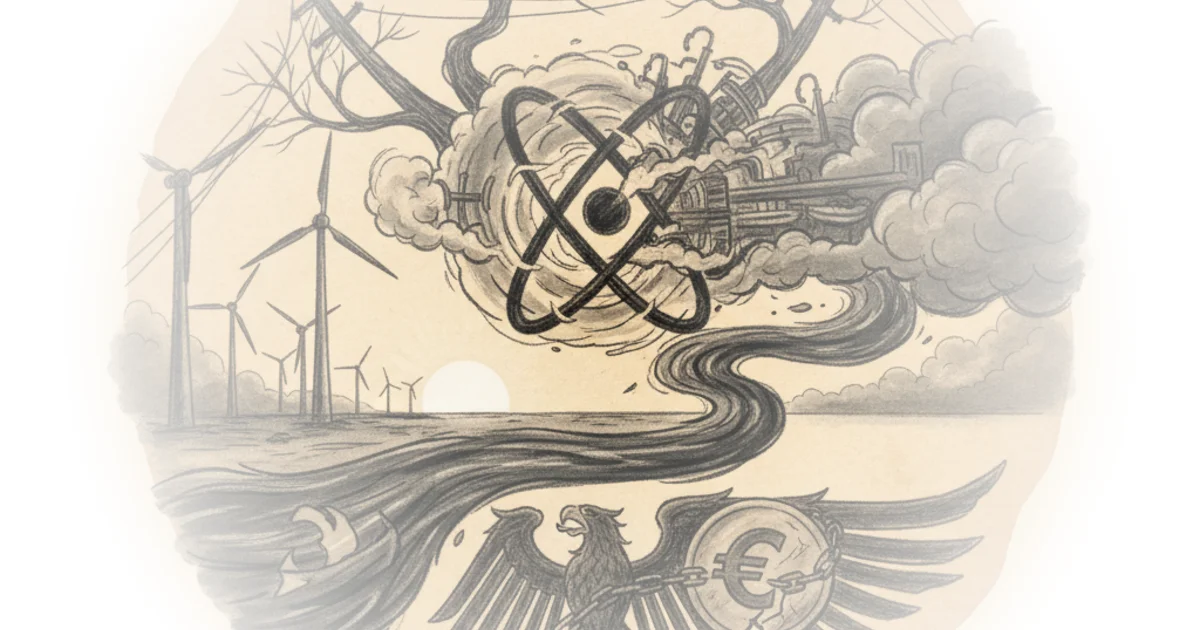
The core of the argument rests on a dramatic divergence between energy consumption and generation capacity. The author notes that while electricity demand fell by 20% over two decades due to industrial relocation, supply collapsed even faster. "Electricity production per capita in Germany stood at nearly 9,000 kilowatt hours annually in 2008. By 2024, it had fallen to just 5,500 kilowatt hours, a drop of nearly 40%." This statistic is the piece's smoking gun. It suggests that the transition was not merely inefficient but actively destructive to the nation's energy sovereignty.
Critics might note that the article attributes the drop in demand almost entirely to policy failure, potentially underestimating the role of global economic shifts and the natural maturation of a service-based economy. However, the sheer scale of the supply-side collapse—down 35% since 2017—supports the author's claim that renewable replacements failed to materialize at the necessary scale.
"One might say the operation, the energy transition was a success. The patient Germany died."
The Competitiveness Chasm
The commentary then pivots to the economic fallout, painting a grim picture of German industry hemorrhaging jobs and market share. Good Times Bad Times highlights the widening gap between German and Chinese production costs, noting that "energy in Germany is up to three times more expensive than in China." This price disparity is presented not as a temporary fluctuation but as a structural defect that has reversed Germany's trade relationship with Beijing.
The author effectively uses specific industry data to illustrate the breadth of the crisis. From chemical firms to automotive giants, the report cites that "51% of chemical firms, 47% of electronics and optics manufacturers, and 40% of mechanical engineering companies report significant losses." This granular approach moves the argument beyond abstract macroeconomic theory into the realm of factory floors and closing plants. The narrative suggests that the "most expensive energy transition in the world" has directly fueled a "slow by persistent contraction of the entire sector."
A counterargument worth considering is that high energy costs are partly a global phenomenon driven by geopolitical instability, not just domestic policy. Yet, the author's focus on the specific timing of the nuclear shutdowns and the simultaneous rise of Chinese industrial capacity makes a compelling case for domestic policy as the primary accelerant.
The Political Reckoning
As the piece progresses, it details the political awakening within Germany's elite, suggesting a quiet but growing rejection of the Green Deal's rigid pathways. The author describes a shift in the ruling coalition's rhetoric, moving toward "flexible targets instead of rigid pathways" and "technological openness instead of ideology." This is framed as a desperate attempt to salvage the economy rather than a genuine change of heart.
Chancellor Mertz's admission that the nuclear shutdown was a mistake is cited as a pivotal moment where "reality knocks ever more insistently on the door of the chancellor's office." The author argues that the government's proposed solution—subsidizing electricity prices to lower them—is a costly band-aid. "In the long run, this is a very costly measure and it does not address the root cause of the problem," the piece warns, quoting energy expert Andras Fisher. This critique underscores the difficulty of reversing a decade of policy momentum without causing further fiscal damage.
The article concludes by highlighting the precarious position of German exports, particularly in the face of US tariffs and Chinese competition. The author notes that "China's record trade surplus is accelerating the decline of domestic industry," a stark reversal of the traditional German economic model. The potential for new trade agreements with South America and India is mentioned, but the author remains skeptical, noting that legal challenges could delay these lifelines indefinitely.
Bottom Line
Good Times Bad Times offers a devastating, data-rich critique of Germany's energy policy, successfully arguing that ideological rigidity has compromised the nation's industrial future. Its greatest strength lies in the juxtaposition of falling electricity production against rising global competition, creating an undeniable case for policy reversal. The argument's vulnerability, however, is its near-total dismissal of the long-term necessity of decarbonization, risking a narrative that solves the immediate crisis by ignoring the climate imperative. Readers should watch closely to see if the government's new "technological openness" translates into actual nuclear or gas capacity, or if it remains merely rhetorical.
"Reality does not care about your ideological frameworks it does not reward moral posturing and the laws of physics remain immutable."
The Cost of Ideology
The author's final warning is clear: without a fundamental restructuring of the energy mix, Germany faces a future of permanent de-industrialization. The piece serves as a stark reminder that economic models built on artificially high energy costs are unsustainable in a hyper-competitive global market. As the author puts it, "The shock from China is hitting Germany with full force," and the window for a graceful correction may be closing. The ultimate verdict is that while the political establishment is finally waking up, the damage to the industrial base may already be irreversible.