Jason Slaughter doesn't just critique American trucks; he frames them as an existential threat to the very fabric of European road safety. In a landscape often dominated by abstract trade debates, he delivers a visceral, data-driven warning: the mutual recognition of vehicle standards between the US and EU could turn European streets into a "bloodbath." For busy readers who assume safety regulations are a settled matter, Slaughter's assertion that the EU is considering lowering its guard for the sake of trade deals is a jarring, necessary wake-up call.
The Physics of Danger
Slaughter's argument begins with the undeniable physics of mass and momentum, stripping away the marketing gloss that surrounds modern SUVs and pickups. He writes, "American SUVs and pickup trucks are dangerous, and there is irrefutable evidence of this. Their extreme weight and stiff frames makes them dangerous to other vehicles in a crash, which has turned road safety into an arms race that favors those who can afford the biggest and heaviest vehicle." This framing is effective because it shifts the blame from individual driver error to the vehicle design itself, a distinction often lost in public discourse.
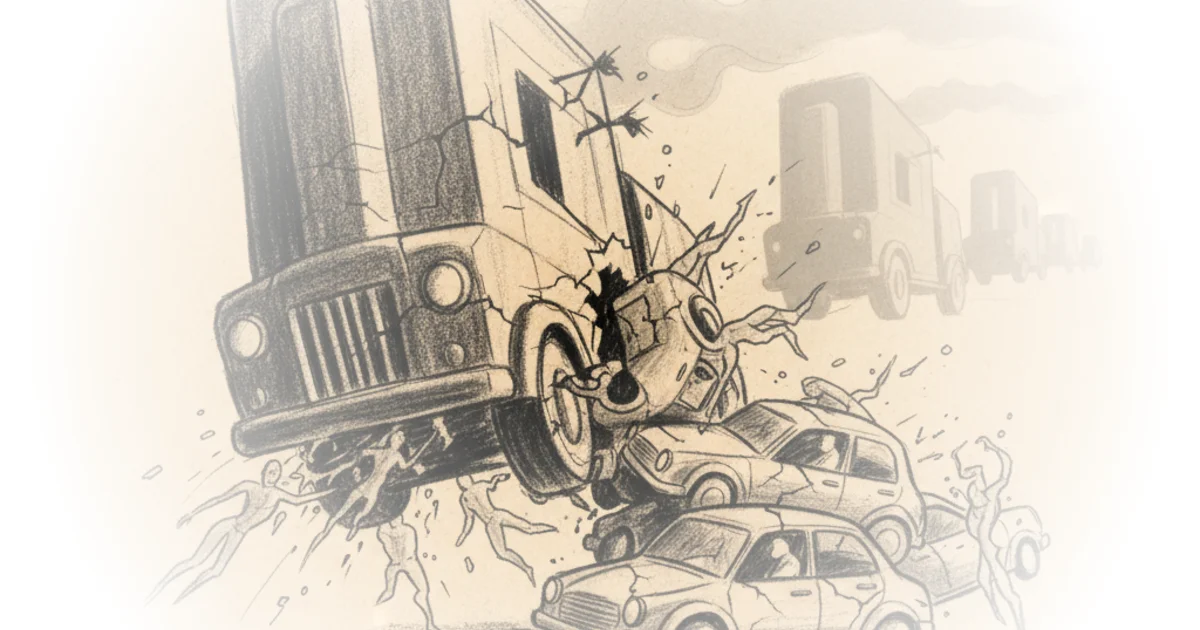
The author marshals staggering statistics to illustrate the human cost of this engineering philosophy. He notes that research shows people are "44% more likely to die when hit by an SUV or light truck than they are if hit by a car," with the risk soaring to "130%" for children under 10. Slaughter argues that the blunt, vertical front ends of these vehicles are designed for aesthetics rather than safety, turning a collision into a fatal event where pedestrians are knocked back and run over rather than landing on a hood. This evidence is compelling, yet critics might note that the data relies heavily on crash outcomes rather than the frequency of crashes, though Slaughter does address the latter by pointing out that these vehicles are also more prone to rolling over due to their high center of gravity.
When a person is hit by a car, they're likely to land on the hood, which would not be particularly enjoyable. But a person hit by one of these trucks is much more likely to be knocked back and impact the ground or be run over by the truck.
The Blind Spot Crisis
Beyond the physics of impact, Slaughter highlights a critical design flaw that renders these vehicles invisible to their drivers. He points out that due to "insanely huge front blind spots," an NBC News investigation revealed that "nine children can sit in front of a typical American SUV and be completely invisible to the driver." This creates a terrifying reality where parents are inadvertently running over their own children in driveways. The author's description of these as "front over and back over accidents" driven by sheer invisibility is a powerful rhetorical device that personalizes the statistical danger.
He contrasts the US regulatory approach with the European model, arguing that the US relies on a "trust me bro approach to safety" where manufacturers self-certify their vehicles. In contrast, the EU requires independent public authorities to grant type approval. Slaughter writes, "US automotive safety testing focuses primarily on occupant safety in typical crash scenarios... while Europe tests not just the vehicle but also how it interacts with other road users." This distinction is crucial; it suggests that American safety standards are myopic, protecting the driver at the expense of everyone else on the road. The inclusion of the Euro NCAP's "mobile progressive deformable barrier test" illustrates how European standards penalize vehicles that endanger others, a concept largely absent in US testing.
Critics might argue that self-certification allows for faster innovation and lower costs for consumers, but Slaughter counters this by invoking the historical shadow of the Ford Pinto, suggesting that without external oversight, profit motives will always override safety. He writes, "If X is less than the cost of a recall, we don't do one," a chilling summary of the cost-benefit analysis that has historically plagued the American auto industry.
The Trade Deal Trap
The core of Slaughter's commentary shifts from engineering to geopolitics, exposing the political maneuvering behind the proposed trade deal. He argues that the push for mutual recognition is not driven by consumer safety but by corporate desperation. He notes that German manufacturers, facing arbitrary US tariffs, are desperate to lower barriers, even if it means "risking the lives of millions of Europeans." Slaughter writes, "The real push for this trade deal comes from within the EU itself, mostly from German automobile manufacturers." This is a bold claim that reframes the trade negotiation from a diplomatic win to a potential public health disaster.
He highlights the stark divergence in outcomes: while EU road deaths have decreased by 36% since 2010, US deaths have increased by 30%. Slaughter emphasizes that "pedestrian deaths in the US have increased by 80% since 2010, and they are now at the highest level they have been since the 1980s." The author's tone becomes increasingly urgent as he questions why Europe would trade its safety record for a country that has proven to be "lawless, arbitrary, and vindictive" in its trade policies. He points out that the US has managed to reduce pedestrian fatalities not by safer cars, but by having "fewer pedestrians," a grim statistic that underscores the failure of American urban design.
People actually walk in Europe. So if these trucks become common here, it will be a bloodbath and for no good reason.
Bottom Line
Jason Slaughter's most potent contribution is his ability to connect the dots between vehicle engineering, regulatory philosophy, and geopolitical trade deals, revealing a clear path to increased mortality. While his reliance on the "bloodbath" rhetoric may feel hyperbolic to some, the underlying data on pedestrian fatality rates and the fundamental differences in safety testing standards are undeniable. The biggest vulnerability in his argument is the assumption that political will in the EU can easily override the economic pressure from powerful automotive lobbies, but his warning remains a critical lens through which to view the upcoming trade negotiations.
The strongest part of this argument is the exposure of the "mutual recognition" principle as a potential Trojan horse for deregulation. Readers should watch for the finalization of the US-EU trade talks, as the outcome will determine whether European roads remain a global benchmark for safety or succumb to the dangerous arms race that has plagued North America.