Noah Smith cuts through the viral noise of "Chinamaxxing" to reveal a startling truth: the trend isn't about China's rising allure, but America's crumbling promise. While social media feeds are flooded with influencers mimicking Chinese morning routines, Smith argues this is less a cultural wave and more a desperate signal of Western dissatisfaction. For the busy listener trying to decode global power shifts, this piece offers a crucial reality check on what soft power actually looks like versus what it merely resembles.
The Illusion of a Chinese Wave
Smith begins by dismantling the assumption that China's economic might will naturally translate into cultural dominance. He contrasts China's trajectory with the organic rise of South Korea and Japan, noting that "China is a deeply repressive nation, with universal surveillance, fine-grained media and speech control, and ubiquitous censorship." This structural reality, he argues, means that "artistic and cultural ferment will arrive in China only weakly, and with a lag." The author suggests that while China may produce blockbuster movies or hit video games, the closed political system prevents the kind of boundary-pushing creativity that drives genuine global influence.
This framing is sharp because it moves beyond simple censorship complaints to analyze the output of such a system. Smith points out that the most celebrated Chinese cultural products, like the animated film Ne Zha 2 or the game Black Myth: Wukong, have generated the vast majority of their revenue domestically. "Other than the rapper Skai Isyourgod, who has had several songs go viral on TikTok, there are not many Chinese musicians known in the West," Smith notes. This mirrors the disconnect seen in other deep dives on East Asian media; just as platforms like ReelShort and DramaBox have found success by adapting Western formats rather than exporting authentic Chinese narratives, China's cultural exports remain largely contained within its own borders.
"So while I expect China to produce some hit video games and big-budget movies, I don't think it will do much to push the boundaries of culture, despite the individual creativity of its people."
Critics might argue that this view underestimates the potential for subcultural pockets to eventually break through the Great Firewall, but the data on tourism and student exchange suggests a hard ceiling. As Smith observes, "tourism to China was still way down from the years before the pandemic, and the number of Americans studying in China had collapsed even further." The numbers tell a starker story than the viral videos: Americans are not flocking to China in the way they are to Japan or South Korea.
The "Chinamaxxing" Mirage
The article then dissects the specific phenomenon of "Chinamaxxing," where Western creators adopt stereotypical Chinese aesthetics like drinking hot water or wearing tracksuits. Smith describes this trend as "the phenomenon of 'Chinamaxxing' has swept feeds with videos of people sipping hot water, shuffling around the house in slippers and donning a viral Adidas jacket resembling historic Chinese fashion." He rightly identifies the hollowness of this engagement: "Western youngsters are not, in general, watching Chinese dramas or microdramas... The most trumpeted Chinese cultural products still don't seem to be finding much purchase outside China."
The commentary here is particularly effective in distinguishing between appreciation and appropriation that lacks substance. Smith argues that this trend feels "fake and forced," often resembling a "deliberate publicity campaign" rather than an organic cultural shift. The videos tend to focus on "grandiose infrastructure" and sterile cityscapes, ignoring the lived reality of Chinese citizens. This is a vital distinction; the "Chinamaxxing" aesthetic often glorifies the idea of Chinese order while ignoring the human cost of that order, much like how the "uncle core" trend romanticizes communal street life without addressing the lack of social safety nets.
"The subtext of every 'very Chinese era' video isn't really about China. It's about what young Americans feel they've been denied."
Smith's analysis of the urban environment is especially biting. He notes that Chinese cities, built rapidly, are dominated by "sterile gated tower blocks... large surface streets, and huge shopping malls." In contrast to the organic, walkable streets of Tokyo or Paris, these environments lack the "life at ground level" that attracts tourists. The "breathless" videos of Chinese cities, he argues, are often just shots of "vast concrete plazas and soaring towers — impressive, but fairly sterile." This critique cuts through the propaganda of "Chinamaxxing" influencers who present these spaces as utopias, ignoring the reality that they are often designed for efficiency rather than human connection.
The Real Story: American Decline
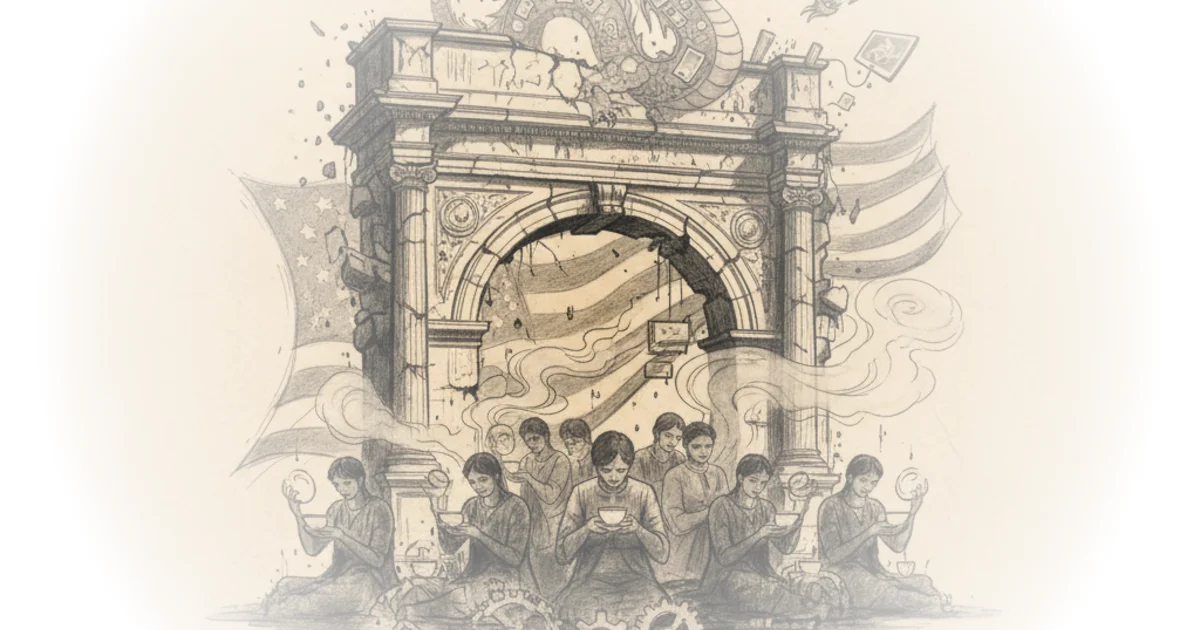
The most compelling part of Smith's argument is his reframing of the trend as "Americaminning." He posits that the fascination with China is actually a projection of American anxieties. "Chinamaxxing romanticizes things that feel structurally out of reach at home — compact, affordable-looking apartments; public transit that works; streets safe to walk at night," Smith writes. The trend is a reaction to domestic failures: "You told us we couldn't have a high-speed railroad and universal health care, and it turns out they have it across the street! I'm going to live at their house now!"
This perspective shifts the focus from China's rise to the erosion of the American narrative. Smith points out that the "American century was built on the world's desire to be American," but the current generation is looking elsewhere due to "student loans, their rent, their medical bills, and their crumbling train stations." The executive branch's recent policies and the broader political climate have contributed to a "decline in the US' global image," making China appear as a viable alternative, even if that appearance is misleading.
"In other words, American youngsters idealizing China — without actually engaging with China or knowing much about it — is really about expressing their dissatisfaction with America."
Smith does not shy away from the uncomfortable reality that the "superiority of life in China over life in America is more myth than reality." He cites data showing that China faces similar, if not worse, crises regarding inequality, education costs, and youth unemployment. "The bottom quintile of Chinese families spend a massive 57 percent of household earnings on their children's education," he notes, highlighting that the "affordability crisis" is a global phenomenon. Furthermore, the "criminalized homelessness" in China merely hides the problem rather than solving it, creating a false image of safety and order.
Critics might argue that Smith is too harsh on the "progressive ideology" responsible for American urban decay, suggesting that the blame is shared across the political spectrum. However, his core point remains valid: the perception of safety and order in China is being used as a weapon against American dysfunction, regardless of the underlying reality.
Bottom Line
Noah Smith's piece is a necessary corrective to the hype surrounding China's cultural rise, revealing that the "Chinamaxxing" trend is less about China and more about a crisis of confidence in the West. The argument's greatest strength lies in its ability to separate the aesthetic fascination with China from the actual substance of its soft power, exposing the trend as a symptom of American decline rather than a sign of Chinese dominance. The biggest vulnerability, however, is the risk of underestimating how quickly perceptions can shift if China manages to export even a fraction of its economic success through digital platforms. For the listener, the takeaway is clear: the world isn't turning to China because it loves China; it's turning away from America because it feels left behind.