The Communications Tower
PILCROW's second chapter of Vice Nimrod does something rare: it makes the Tower of Babel feel like a corporate office building. The biblical story of humanity's doomed attempt to build a tower reaching heaven becomes a workplace satire about institutional cruelty, communications spin, and the slow erosion of self that comes from climbing any ladder built on bitumen and broken bodies.
The narrator Ishkebek arrives as a refugee from a "brimstone-wrecked small town"—a clear reference to Sodom and Gomorrah, the cities destroyed by divine fire. He lands a job in Communications at Nimrod's Mighty Tower, where the ancient king Nimrod's ambition to build beyond human limits gets recast as modern corporate ambition. PILCROW writes, "The top of the tower was incredible, at first. People at the bottom of the tower and in the city beyond believed incredible things about its top—that from it you could scoop out some of the warm substance of the passing moon."
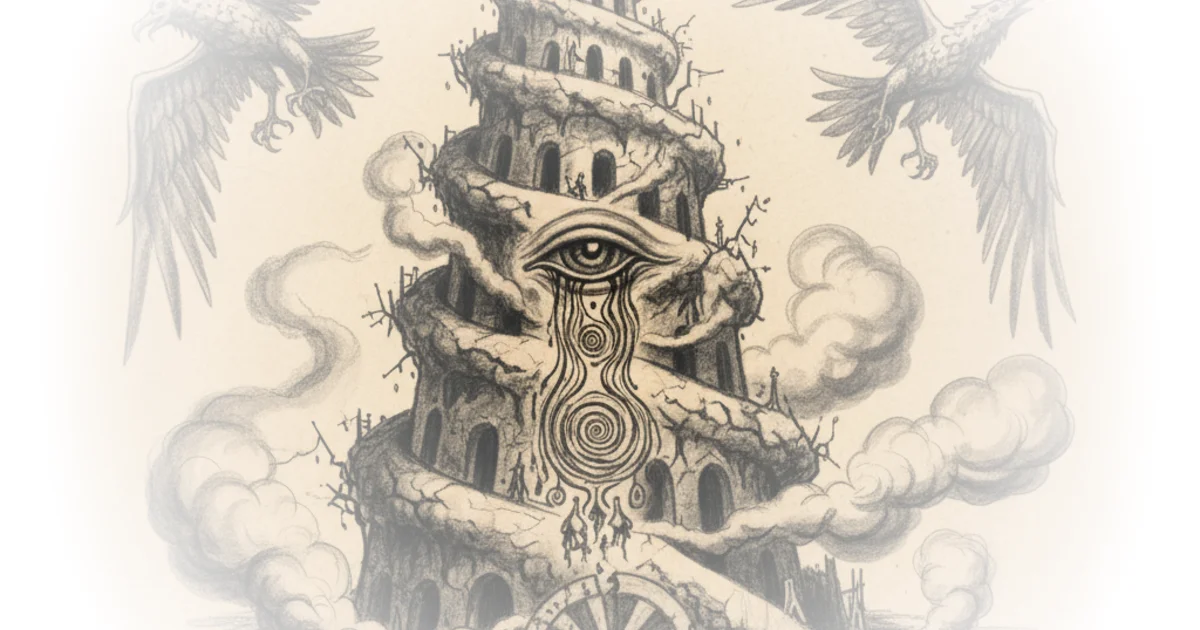
But the reality is brutal. Relentless sun. Murderous gusts. Interns collapsing from heat and dehydration. The communications team's job: make it sound like career advancement.
The Water Clock
The chapter's most devastating image is the water clock. Ishkebek is issued a cheap timekeeping device—two cloudy glass bottles sealed together, half-filled with water. It tells him when to repeat announcements to the interns. But he's thirsty. He sips. The clock empties faster. He must repeat announcements more frequently. His throat dries further. He sips more.
PILCROW puts it plainly: "Soon, my water clock was mostly empty, and I was driving my section of interns half crazy by repeating the company line without cease in a miserable, halting croak."
An older colleague, Rochek, intervenes. He takes the clock behind the crane apparatus and returns it "with nothing more to drink, but plenty of time." The clock now contains urine. It stinks. It leaks. But it buys Ishkebek distance from the drama of collapsing interns.
"But when people spill bitumen, it streaks the tower. A big enough spill will stick on the tiers below. It makes the whole tower look sloppy, accidental, she said, and costs a lot more to clean up than it does to onboard a new batch of interns."
This is the tower's moral calculus. Dead workers are cheaper than cleanup. Human collapse is an optimization problem.
Internal Communications
Ishkebek eventually escapes the roof. He moves indoors to Policing, Sanitation & Internal Communications. His boss Yersinia edits his writing with one word: "Rework it." She wants ambiguity, not communication.
PILCROW writes, "I'd learned the aim wasn't to communicate at all, but to cultivate enough ambiguity that the people at the top could have it both ways. As for the people below, who were being communicated to, the aim was for them to feel as though they'd been given some kind of answer, without giving one."
The scroll Ishkebek drafts must address a "recent rash of jumpers"—a hundred men dashing themselves to pulp rather than submit to lifetime minor promotions. The announcement mentions employee safety standards. It mentions the "invisible ladder to the next world." It does not mention that the ladder is invisible because it does not exist.
Yersinia forbids the word "invisible." The tower cannot admit its promises are unseen.
The Diminution of Self
The chapter's sharpest insight is about what large institutions do to human identity. PILCROW writes, "The problem was that they couldn't fathom or endure the steady diminution of self that the staggering scale of the tower inflicts on all of us without even meaning to."
Interns are "too educated." They enjoyed "too many months thinking they belonged to themselves." The tower requires they become "not very much at all."
Critics might note that PILCROW's allegory is so thick it occasionally suffocates the prose. The names—Meconia Dohegson Ozymandias Mansom, Yersinia—feel like authorial wink rather than character. The biblical references are clear but sometimes heavy-handed.
Yet the core observation holds: institutions that demand total commitment consume the selves of those who serve them. The Tower of Babel was meant to reach heaven. In PILCROW's telling, it reaches only into the next intern's bladder.
Bottom Line
PILCROW has written a workplace horror story dressed in biblical costume. The Tower of Babel becomes any organization that promises ascent while delivering exhaustion. The Confusion of Tongues—the divine punishment that scattered humanity's languages—becomes the ambiguity cultivated by communications teams to protect leadership from accountability. The verdict: sharp, dark, and uncomfortably familiar.