G. Elliott Morris cuts through the noise of conflicting economic data to deliver a blunt, data-driven verdict: the disconnect between strong macro indicators and miserable consumer sentiment isn't a psychological glitch or a media fabrication. It is a direct, measurable reaction to the fact that prices are simply too high, regardless of how slowly they are rising. For busy listeners trying to make sense of why the economy feels broken despite the headlines, Morris offers a rare clarity that shifts the focus from abstract percentages to the tangible reality of the household budget.
The Myth of the "Vibecession"
The piece begins by dismantling a popular theory among analysts who argue that Americans are merely misinformed. Morris writes, "The unemployment rate is historically low. Real wages are rising. The stock market is near all-time highs. By every standard macro yardstick we've ever used to measure whether Americans should feel good about the economy, Americans should feel good about the economy." This framing sets up the central conflict: the data says we are fine, but the people say we are not. Morris acknowledges the proponents of the "Stancil view," which suggests the problem is entirely psychological—a product of negative news cycles and social media doom-scrolling.
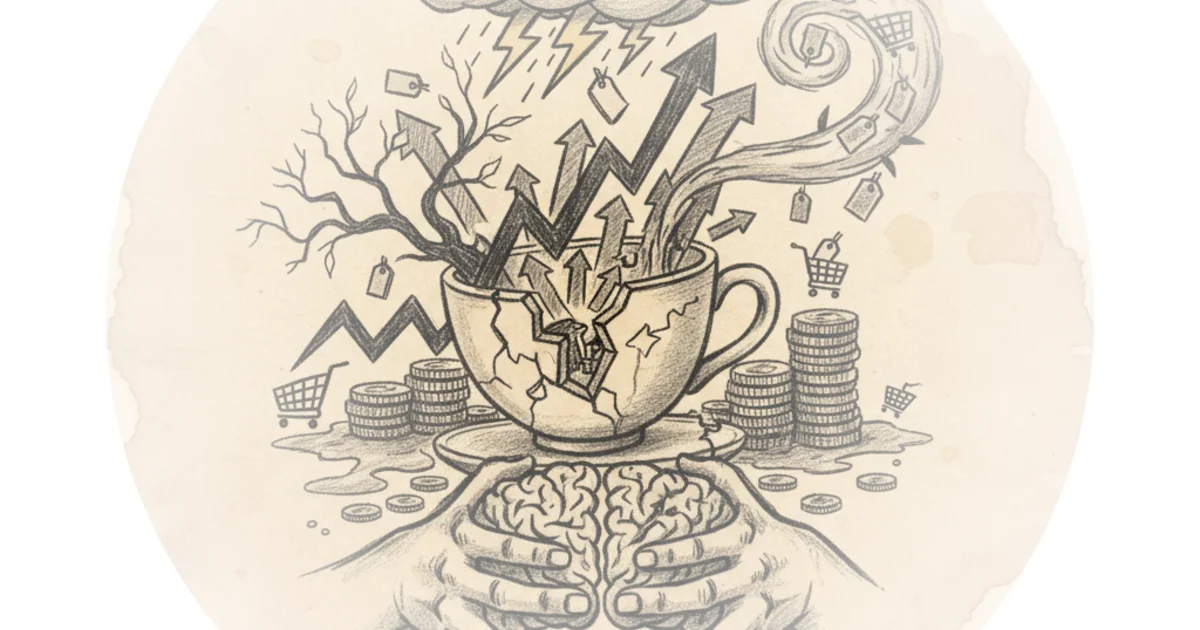
However, Morris quickly pivots to show why this explanation fails the math test. He argues that even when you strip away the "bad-vibes megaphone," the gap between reality and perception stubbornly refuses to close. As he puts it, "If they don't [feel good], the problem is not the economy. The problem is that they are being told... that the economy is bad. Under this view, if you strip away the bad-vibes megaphone, sentiment would snap back into line with the fundamentals." The author's analysis suggests this is a dangerous oversimplification. While news sentiment does play a role, treating it as the primary driver ignores the visceral experience of paying bills.
"The single best predictor of how Americans feel about the economy is how Americans feel about prices."
This conclusion is powerful because it validates the lived experience of the reader over the abstract comfort of aggregate statistics. It suggests that the "vibecession" isn't a mood swing; it's a rational response to a new, expensive reality.
The Level vs. The Rate
The core of Morris's argument rests on a crucial distinction that often gets lost in economic reporting: the difference between the rate of inflation and the level of prices. He explains that official statistics measure year-over-year changes, but households live in the present. "When you fill the grocery cart, pay the rent, cover the utility bill, or renew the car insurance, you're paying today's sticker — not today's sticker minus last year's." This is a vital correction to the narrative that "inflation is cooling," which implies the problem is solved. Morris notes that people do not forget the original price shock just because the rate of increase slows down.
To prove this, Morris runs a series of predictive models. He finds that standard variables like unemployment and the S&P 500 fail to predict the current drop in sentiment. However, when he introduces the concept of "felt prices"—the share of Americans who say high prices are hurting their finances—the model aligns perfectly with reality. He writes, "The gap between the black line and red dashed line in the plot above is a measure of how much extra Americans are paying for everyday goods and services than they would have if inflation had stayed steady at the normal 1990-2019 rate." The data shows prices are still roughly 10% above the pre-pandemic trend, a cumulative shock that no amount of positive news can erase.
Critics might argue that focusing solely on price levels ignores the structural benefits of low unemployment and rising real wages, which do provide a buffer for many. Yet, Morris's data suggests that for a significant portion of the population, the cumulative cost of living has overwhelmed those gains. The historical context of the University of Michigan Consumer Sentiment Index supports this; the current readings are the worst in the survey's history, a stark contrast to periods of high inflation in the 1970s where the psychological toll was similarly devastating despite different underlying causes.
The Weakness of the Media Narrative
Morris also takes a hard look at the role of the media, testing whether negative coverage is the true culprit. He builds a model to see if news sentiment predicts presidential approval and consumer sentiment. The results are telling. "News sentiment is positive and green, inflation and stock market crashes are negative and red," he notes, observing that while news tone matters, it is a "pretty weak driver in its own right." A one-standard-deviation rise in positive news sentiment is worth only about half a point of approval, whereas a comparable rise in gas prices costs the administration about 0.2 points.
This finding is significant because it challenges the administration's strategy of trying to improve sentiment through communication alone. If the gap were purely a media problem, a shift in tone would fix it. But Morris demonstrates that "the news-narrative theory simply can't carry all that analytical weight." The evidence suggests that until the actual cost of living drops, or at least stabilizes in a way that feels manageable to households, sentiment will remain depressed regardless of the daily news cycle.
"People don't like paying so much money for things. Yes, it really is that simple."
This blunt summary cuts through the complexity of economic modeling to reveal the human truth at the center of the data. It is a reminder that economic policy is ultimately about people's ability to afford their lives, not just the health of the stock market.
Bottom Line
G. Elliott Morris's analysis is a necessary corrective to the disconnect between Wall Street optimism and Main Street anxiety, proving that consumer sentiment is driven by the absolute level of prices, not just the rate of change. The argument's greatest strength is its rigorous use of data to validate the public's frustration, while its main vulnerability is the lack of a clear policy path to reverse cumulative inflation without triggering a recession. Readers should watch for how the administration addresses this specific "felt price" gap, as traditional macroeconomic fixes may no longer be sufficient to restore confidence.