Sabine Hossenfelder delivers a rare, unvarnished autopsy of a scientific empire that spent decades promising a "Theory of Everything" but delivered only mathematical elegance and career incentives. This is not a dry history of equations; it is a forensic analysis of how a community of thousands convinced itself that a theory was viable simply because the math was too rich to abandon, even as the evidence evaporated. For the busy professional, this piece offers a masterclass in how institutional momentum can override empirical reality, turning a search for truth into a self-sustaining industry.
The Accidental Messiah
Hossenfelder begins by dismantling the myth of grand design, revealing that the most famous theory in modern physics was born from a mistake. "String Theory it was supposed to be physicist's crowning achievement a theory that explains no less than everything with just one simple and elegant idea," she notes, only to immediately undercut the narrative. The theory emerged accidentally when physicists studying the strong nuclear force noticed that gluons formed "flux tubes" that behaved like strings. It was a "bottom up approach" that accidentally stumbled upon a particle resembling a graviton, sparking the hope that it could unify gravity with the other fundamental forces.
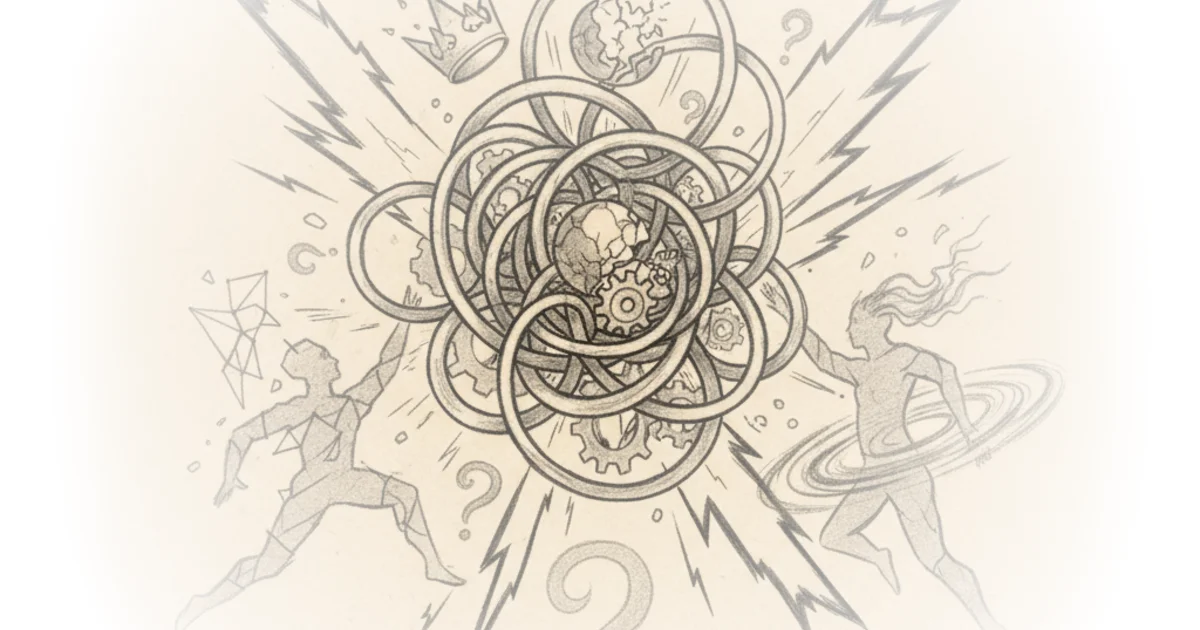
The core of the argument here is that the theory's ascent was driven by its ability to solve its own internal contradictions rather than external data. When the math predicted a universe that would collapse into pure energy, theorists invoked "super symmetry" to fix it, requiring a partner particle for every known particle. When those particles weren't found, the explanation shifted: they were just too heavy to see. Hossenfelder captures the circular logic perfectly: "String theorists simply say that we haven't built a collider large enough to see those super symmetric partner particles."
This framing is effective because it exposes the fragility of a theory that requires constant, ad-hoc adjustments to survive. Critics might note that all scientific theories require refinement, but the sheer frequency of these fixes—adding R-symmetry, rolling up extra dimensions, adjusting the cosmological constant—suggests a model that is bending reality to fit the math, not the other way around.
The Landscape of Ambiguity
As the decades passed, the theory became increasingly untethered from the observable universe. Hossenfelder points out a critical failure: the theory requires ten dimensions, yet we only observe three. The solution? The other six are "rolled up" so tightly they are invisible. But this introduced a new catastrophe: the number of ways to roll up those dimensions is astronomical. "There's a huge number of ways to roll these Dimensions up... some hundred thousands or so," she writes. This realization killed the idea that string theory was unique.
Faced with this ambiguity, the community made what Hossenfelder calls a "particularly idiotic move": the postulation of the "landscape." "I've always found that to be a particularly idiotic move just because you can't figure out which Theory describes reality doesn't mean all of them are real," she argues. This was a retreat from prediction to possibility. Instead of finding the theory, they claimed all 10 to the 500 versions existed simultaneously. The motivation, she suggests, was not scientific rigor but the sheer mathematical richness of the field: "it was mathematically an extremely rich Theory... there was just so much to learn and understand and of course to write papers about."
I've always found that to be a particularly idiotic move just because you can't figure out which Theory describes reality doesn't mean all of them are real.
This is the piece's most damning insight: the field grew not because it was right, but because it was a playground for mathematicians. The "landscape" was a defense mechanism, a way to claim victory in a game where the rules had changed to ensure no one could ever lose.
The String Wars and the Funding Bubble
The tension between mathematical beauty and empirical silence eventually exploded in the late 1990s, a period Hossenfelder dubs the "String Wars." The catalyst was a desperate attempt to make the theory testable before the Large Hadron Collider (LHC) came online. Prominent physicists like Lisa Randall and Nima Arkani-Hamed argued that extra dimensions might be large enough to detect, a claim Hossenfelder dismisses as having "no reason" behind it other than the need for funding and prestige.
She describes the mechanism of this bubble with surgical precision: "The key for getting this nonsense past peer review was to invent reasons for why this supposed evidence for string theory had not been seen so far but would show up in the next experiment." It became a self-fulfilling prophecy where "it's always the next experiment that'll find it." The result was a massive influx of citations and careers built on predictions that never materialized. "Lisa randau became one of the best cited physicists ever for her work on it... It wasn't because of the scientific relevance there wasn't any it was because their papers on the idea had been cited 10 thousands of times."
When the LHC finally turned on in 2010 and found nothing—no super symmetry, no extra dimensions, no string balls—the bubble burst. Hossenfelder notes the unprofessional response from the establishment, who attacked critics like Lee Smolin and Peter Woit with "at hominum arguments" rather than addressing their points. "The unprofessional behavior of people like Lenny saskin and Michael Duff in response to very valid criticism... significantly contributed to the demise of string theory," she observes. The "wars" were less about science and more about protecting a status quo that had become indistinguishable from dogma.
The Pivot to Holography
With the dream of a testable Theory of Everything dead, the field did not vanish; it mutated. Hossenfelder shifts her focus to the "other branch" that survived: the AdS/CFT correspondence, discovered by Juan Maldacena. This is a technical pivot where string theory in a universe with a negative cosmological constant (Anti-de Sitter space) is shown to be mathematically equivalent to a quantum field theory without gravity in one fewer dimension.
She explains this as a "holographic principle," where a three-dimensional universe with gravity can be described by a two-dimensional surface without gravity. "It's sometimes said to be a sort of Hol graphic principle because it expresses this three-dimensional space with information on a two-dimensional slice," she writes. While this is a profound mathematical tool, Hossenfelder is quick to temper expectations, noting that our actual universe has a positive cosmological constant, making the direct application of this correspondence to our reality tenuous at best.
Critics might argue that this mathematical duality is a breakthrough in its own right, regardless of its applicability to our specific universe. However, Hossenfelder's point stands: this is a retreat from the original goal. It is a shift from explaining our universe to exploring a vast, abstract mathematical landscape that may have little to do with physical reality.
Bottom Line
Sabine Hossenfelder's analysis succeeds by stripping away the mystique of high-energy physics to reveal the human machinery of careerism, funding, and groupthink that sustained a theory for too long. Her strongest argument is that the "landscape" was a surrender, not a solution, and that the "String Wars" were a failure of scientific culture to self-correct. The biggest vulnerability in the field remains the same as it was twenty years ago: the lack of empirical evidence. The reader should watch for whether the new "holographic" approaches can ever generate a testable prediction for our positive-energy universe, or if they will simply become the next rich mathematical playground for a new generation of theorists.