In a world drowning in synthetic waste, Dave Borlace presents a startling twist: nature has not only adapted to our pollution but is evolving a biological weapon to dismantle it. This piece moves beyond the usual despair of oceanic plastic to spotlight a specific, accelerating scientific breakthrough where a single amino acid change could unlock a circular economy. For the busy reader, the urgency lies not just in the discovery of a plastic-eating bacterium, but in the rapid engineering of enzymes that could turn our greatest environmental liability into a renewable resource.
The Accidental Discovery
Borlace anchors his narrative in a 2016 event at a recycling plant in Kyoto, Japan, where scientists encountered a "mysterious sludge" consuming piles of polyethylene terephthalate (PET) bottles. He draws a compelling parallel to Alexander Fleming's discovery of penicillin, noting that the Japanese researchers stumbled upon a microorganism that had "adapted to digest the plastic down into its constituent parts using the carbon content as an energy source." This framing is effective because it humanizes the scientific process, suggesting that the solution to our industrial mess was hiding in plain sight, waiting for the right moment to be noticed.
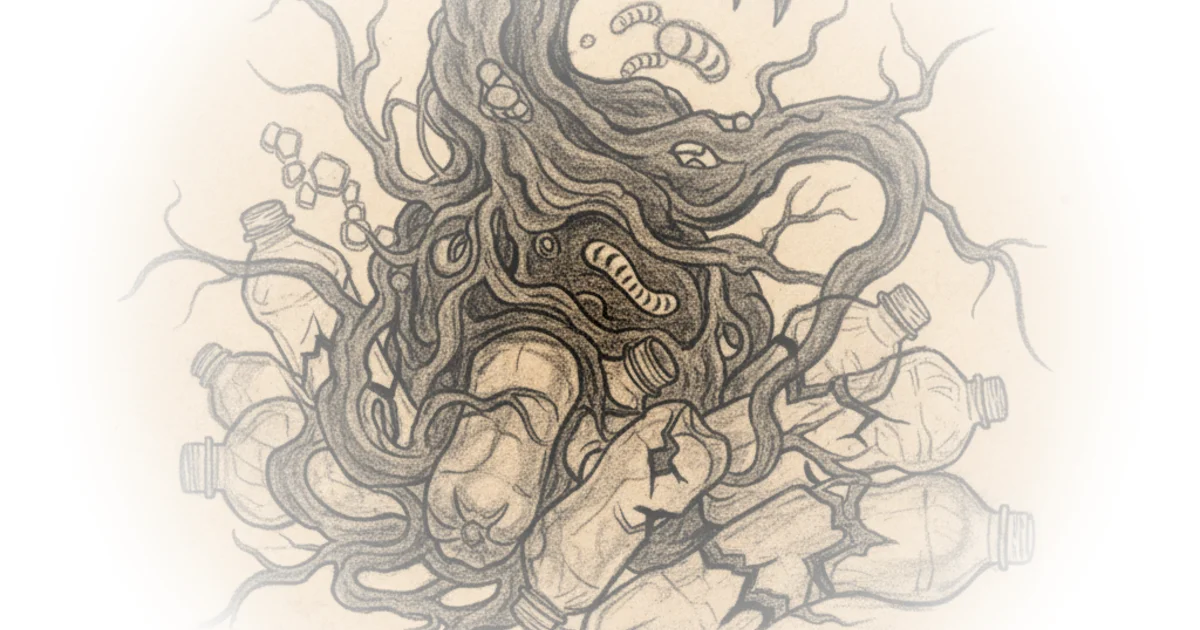
The author explains that PET was once hailed as a triumph of human ingenuity because its tight polymer chains prevented carbon dioxide from escaping carbonated drinks, a feature that doubled sales in the 1950s. However, Borlace points out the dark side of this durability: "about 8 million tons of that plastic is now floating around in our oceans," where it degrades into microplastics that infiltrate the food chain. The sheer scale of the problem—480 billion bottles produced annually with only 7% recycled—sets the stage for why this biological adaptation is not just a curiosity but a potential lifeline.
Engineering the Solution
The narrative shifts from observation to intervention, detailing how scientists isolated the specific gene responsible for the digestion and reproduced the enzyme in a lab. Borlace highlights a critical realization: while the natural bacterium was a breakthrough, it was too slow for industrial needs. "Genius is 1% inspiration and 99% perspiration," he quotes Thomas Edison, underscoring the grueling work required to accelerate the process. The core of the argument here is that nature provided the spark, but human engineering must provide the fire.
At the University of Portsmouth's Center for Enzyme Innovation, Professor John McGeehan's team utilized advanced genetic engineering to understand the enzyme's structure. Borlace explains that the team discovered the plastic-eating enzyme, PETase, shared almost identical building blocks with Cutinase, an enzyme nature evolved over millions of years to break down plant waxes. The pivotal moment came when researchers realized that "with only a single amino acid change in its structure the PETase enzyme had changed the shape of the jaws at its active point to make the gap almost three times wider." This specific detail is crucial; it demonstrates that the barrier between consuming natural and synthetic materials is incredibly thin, requiring only a minor tweak to overcome.
The mutation that allowed bacteria to eat synthetic plastic took only 50 years to occur, a blink of an eye in evolutionary time.
Critics might note that relying on biological solutions for industrial-scale waste management carries risks, such as the potential for engineered organisms to escape containment or the high energy costs of scaling up fermentation processes. Borlace acknowledges the difficulty, noting that the initial rate of digestion was "far too slow to cope with the incredible rate that new plastics are being churned out," which is why the focus has shifted to genetic modification to achieve a hundred-fold increase in speed.
The Economic Imperative
The piece concludes by addressing the practical and economic realities of implementing this technology. Borlace argues that while government funding would be ideal, "in the real world of market driven capitalism it'll most likely be commercial investment that provides the key." He highlights the dual benefit for investors: the ability to recycle plastic at scale and the production of valuable byproducts. Anne Meyer, a researcher at the Technical University of Denmark, is cited noting that the breakdown products include ethylene glycol, a component of antifreeze, and a hybrid material for carrier bags.
The author suggests that the future of this research depends on finding similar enzymes for other types of plastic, urging scientists to continue "rooting around in plastic recycling dumps." This call to action reframes waste sites not as eyesores but as treasure troves of evolutionary innovation. Borlace posits that "there's very little chance they're going to run out of raw material any time soon," turning the overwhelming volume of plastic waste into a guarantee of supply for a new green industry.
Bottom Line
Dave Borlace's strongest argument is the demonstration that the gap between natural and synthetic degradation is bridged by a single genetic mutation, offering a tangible path forward for the plastic crisis. However, the piece's biggest vulnerability is the assumption that scaling these enzymes will be economically viable without significant policy intervention or subsidies. The reader should watch for the next phase of this story: the transition from laboratory success to industrial application, where the true test of this biological revolution will begin.