Texas is attempting a radical experiment that defies a century of American educational tradition: a state-mandated reading curriculum backed by specific testing. Natalie Wexler uncovers a proposal that moves far beyond vague standards, demanding that every public school student from first to eleventh grade read a specific list of literary works, from Charlotte's Web to Hamlet. This is not merely a policy shift; it is a direct challenge to the entrenched culture of local control that has long defined the state's education system.
The End of Local Autonomy
For decades, the prevailing wisdom in Texas—and much of the nation—has been that districts should choose their own path. Wexler notes that the Texas Education Agency (TEA) previously admitted they had no data on which curricula districts used because "merely asking that question would be seen as infringing on local autonomy." Now, the state is reversing course entirely. The legislature passed HB1605, requiring the State Board of Education to specify vocabulary and literary works for every grade level. The TEA's response was not a suggestion, but a mandate: 34 works for first graders, 17 for fifth, and 23 for eleventh.
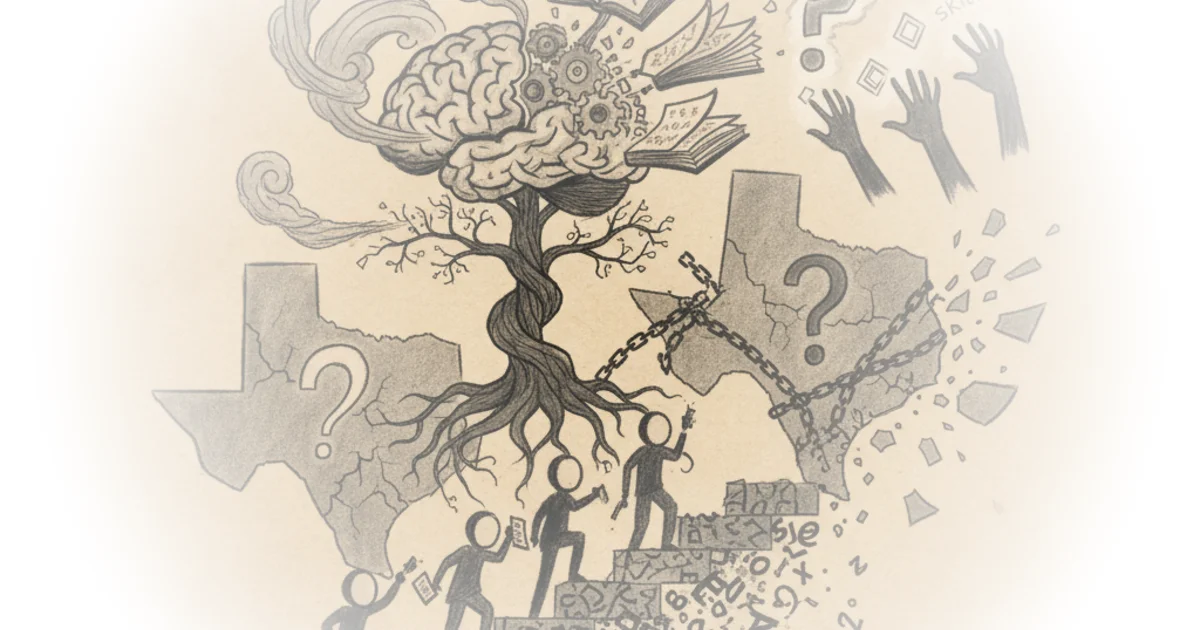
Wexler argues this is a "breathtaking departure from the U.S. tradition of local control of curriculum." The plan is comprehensive. Once the list is approved, publishers will have two and a half years to create textbooks, and state assessments will be updated to include passages from these specific works. The goal is to ensure that by the 2030-31 school year, the entire state is reading the same texts. This approach directly addresses the failure of current testing models. As Wexler writes, "State reading tests purport to test abstract reading comprehension skills... That approach doesn't actually boost comprehension." By grounding tests in specific content, the state hopes to force teachers to focus on deep understanding rather than abstract skill drills.
This is a breathtaking departure from the U.S. tradition of local control of curriculum.
The logic here is sound, echoing the "Matthew effect" in reading, where students who lack background knowledge fall further behind because they cannot decode complex texts. A standardized curriculum ensures all students, regardless of their district's wealth, are exposed to the same rich vocabulary and concepts. However, critics might note that imposing a single list on a state as vast and diverse as Texas risks ignoring local community values and student demographics.
Whole Books vs. The Excerpt Economy
A central pillar of Wexler's commentary is the proposal's insistence on whole books. This stands in stark contrast to the national trend of using brief excerpts to teach isolated skills. The current system, she argues, creates a false efficiency. "As one teacher explained to a parent I know... 'the skills are the same,'" she paraphrases, highlighting the flawed logic that leads educators to skip full texts. Wexler counters that relying on brief passages "fails to build reading stamina and cultivate the patience needed to make it through a whole book."
The proposed list includes anchor texts that serve as hubs for related nonfiction and poetry. For seventh graders, The Diary of a Young Girl by Anne Frank is paired with a nonfiction book on Jewish resistance and a poem by Hannah Szenes. This method, Wexler suggests, is "a great way to build students' knowledge and to make a literary work more meaningful by providing context." It mirrors the depth required to understand complex historical events, much like how deep dives into "heir property" laws reveal the systemic roots of wealth inequality that simple summaries miss. By engaging with full narratives, students gain the cultural literacy necessary to navigate a complex world.
The Controversy of Canon and Creed
Despite the pedagogical strengths, the list is fraught with political and religious tension. Wexler points out that the proposal includes significant biblical content, from the parable of the prodigal son in first grade to seventeen chapters of the Book of Job in high school. State officials defend this as necessary for cultural knowledge, arguing that "many texts in our society are strewn with allusions to concepts like the prodigal son." Yet, Wexler warns that the line between cultural literacy and indoctrination is thin. She notes that in the existing Bluebonnet Learning curriculum, "the way Bible stories are handled... sometimes crosses the line into indoctrination."
The political messaging is equally subtle but potent. The inclusion of Margaret Thatcher's eulogy for President Reagan alongside Shakespeare, or a Civil War novel paired with a poem drawing moral equivalence between Union and Confederate soldiers, raises questions about the narrative being constructed. Wexler observes that while the list includes works by Frederick Douglass and Martin Luther King Jr., it omits crucial context for texts like The Crucible, failing to address the "rabid anti-communism of the McCarthy Era." This selective framing risks presenting a sanitized version of history that may alienate the state's growing non-Christian and liberal populations.
The way Bible stories are handled in the Bluebonnet curriculum sometimes crosses the line into indoctrination.
The resistance is already palpable. Wexler reports that despite financial incentives, fewer than 200 of Texas's 1,200 districts have adopted the related curriculum. Some districts have even excised religious content to avoid parental pushback. This friction highlights the difficulty of top-down reform in a system accustomed to local choice. As Wexler puts it, "Texas may show up as deep red on an electoral map, but its population is not monolithic."
A Better Path Forward?
Wexler concludes with a conflicted but clear recommendation. While she applauds the move toward a knowledge-based curriculum, she doubts that a heavy-handed mandate is the right tool. "Carrots are likely to work a lot better than sticks in this area," she argues, citing Louisiana's success in getting 80 percent of districts to voluntarily adopt a knowledge-building curriculum through incentives and professional learning. She suggests a lighter touch: a state list of one or two required literary works per grade, tested to ensure they are taught, but without the rigidity of a full state-mandated curriculum.
She also takes aim at the media's tendency to oversimplify literacy debates. Wexler criticizes headlines that equate the "science of reading" solely with phonics, calling it a "total distortion." She notes that the real issue is not phonics, but the focus on "discrete comprehension skills" driven by testing pressure. This distinction is vital; as she writes, "If you want to know more, read Matthew Levey's excellent piece describing what's missing." The media's reductionism obscures the need for the very content-rich approach Texas is attempting.
Bottom Line
Natalie Wexler's analysis exposes a bold, necessary, yet deeply flawed attempt to fix America's literacy crisis. The strongest part of the argument is the undeniable link between specific content knowledge and reading comprehension, a link the current skills-based model ignores. However, the proposal's vulnerability lies in its rigidity and the political baggage of its chosen canon. The future of Texas literacy depends on whether the state can soften its approach, embracing the what of the curriculum without forcing the how and why down the throats of a resistant local system.