This piece succeeds not by recounting history, but by exposing how quickly the architecture of fear can dissolve into the mundane texture of daily life. Dan Perry argues that the true legacy of Berlin's division is not found in monuments, but in a specific cultural "relentlessness" that once fueled genocide and now manifests as rigid adherence to rules on public transit.
The Architecture of Absence
Perry begins by dismantling the certainty of hindsight. He recalls his 1988 visit when the Cold War's end was invisible to those living through it, noting the "arrogance of certainty" that blinded observers to the coming collapse. He describes the stark contrast between the prosperous West and the drab, fearful East, where the "humorless, soul-emptying anvil of Soviet communism" subdued the city's imperial core. This historical grounding is crucial; it reminds us that geopolitical shifts are rarely felt in real-time by the people living them.
"Almost nothing animating our lives now was visible then, yet we had the arrogance of certainty."
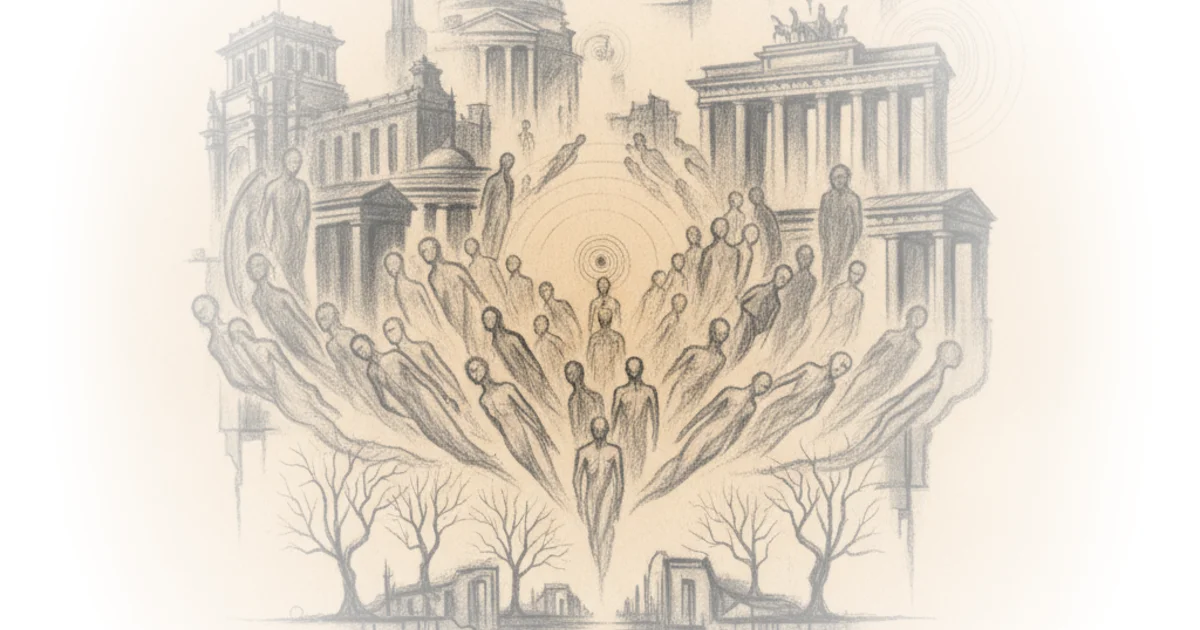
The author contrasts this grim past with a modern Berlin where Checkpoint Charlie is merely a tourist attraction and the Wall has vanished without a trace. He walks past the Brandenburg Gate, once trapped by concrete, now open to bicyclists and green transport. The transformation is so complete that the absence of the wall feels almost surreal. Perry captures this disorientation well: "No sign whatsoever of a wall." Yet, he suggests that the physical removal of barriers does not erase the psychological imprint of the era. He references the Stasi's pervasive surveillance to underscore how deep the roots of fear ran, making the current normalcy feel fragile rather than permanent.
The Weight of Relentlessness
The essay's most compelling turn occurs when Perry and his friend Ulli confront the nature of German character at the Holocaust Memorial. Designed by Peter Eisenman to evoke feeling through abstraction rather than explicit symbols, the field of gray concrete slabs forces visitors into a claustrophobic silence. When Perry asks how such evil could arise from a culture of Mann and Luther, Ulli offers a chilling diagnosis: "It is not evil. We are something else... Relentless."
"When we start to do something, nobody does it with such relentlessness."
This reframing is powerful. It shifts the narrative from inherent malice to an unchecked drive that, when misdirected by ideology, becomes catastrophic. Perry illustrates this with a story of a ticket inspector ejecting an Israeli woman for an expired pass, ignoring her protests because "Rules are rules." The laughter of bystanders at this absurdity signals a healing process: the sound of 81 years passing where such rigidity is now a source of dark humor rather than terror. However, critics might argue that equating bureaucratic pedantry with historical trauma risks trivializing the scale of the Holocaust. While the anecdote highlights cultural change, it simplifies the complex moral evolution required to confront such a past.
The Strategic Vacuum in Europe
The conversation naturally pivots from history to the present security dilemma. Perry, speaking through Ulli, challenges the assumption that Germany can rely indefinitely on American protection against Russia. He notes that while Russia is "a gas station masquerading as a country," it retains nuclear capabilities that Germany lacks. The argument rests on the demographic and industrial weight of Central Europe: "Germany plus Austria and Switzerland... is over a hundred million people."
"With America being what it has become — and I do not know if it is permanent — it's time that you guys handled your own defense against Russia."
Perry weaves in the decline of British military capacity to bolster his point, noting the Royal Navy's reduction from fifty destroyers to fewer than twenty and the army shrinking to its smallest size since modern history began. This data supports his assertion that a European defense architecture must stand on its own feet. Yet, this perspective overlooks the deep political fragmentation within the EU regarding nuclear sharing and the logistical nightmare of integrating disparate national command structures. The "relentlessness" Ulli praises in cultural matters may not translate easily to the fractured world of alliance politics.
"The sound of that laughter — this is the sound of 81 years passing."
Bottom Line
Dan Perry's strongest contribution is identifying "relentlessness" as the dual-edged sword of German identity, capable of both industrial efficiency and historical horror. His biggest vulnerability lies in assuming that cultural confidence can rapidly bridge the gap between a nuclear-armed Russia and a demilitarized Europe without a clear political roadmap. Readers should watch for how European leaders navigate this specific tension: whether they can channel their national seriousness into a unified defense strategy before the next geopolitical storm hits.