Most historical narratives treat the fall of Rome as a chaotic collapse, but Kings and Generals argues that the rise of the Frankish kingdom was a calculated political maneuver to fill a vacuum, not a barbarian invasion. The piece's most striking claim is that King Clovis's conversion to Catholicism was less a spiritual epiphany and more a strategic masterstroke that allowed a Germanic warlord to co-opt the existing Roman administrative machinery. This reframing transforms a religious legend into a case study in state-building that remains relevant for understanding how legitimacy is constructed in post-imperial spaces.
The Myth of the Miracle
Kings and Generals opens by dismantling the legendary account provided by the chronicler Gregory of Tours, who described Clovis praying to Jesus Christ before the Battle of Zulpik in 496. The author notes, "Gregory's account of the reasons behind Clovis's baptism is legendary in character. Yet the fact remains that the Frankish king did turn towards Christianity at the turn of the 5th to the 6th century." By separating the miracle from the political reality, the commentary forces the reader to look at the tangible assets Clovis acquired. The text explains that after defeating the Roman commander Syagrius, Clovis didn't just seize land; he inherited "state-owned lands with tax revenues and agricultural estates, mints, and arms factories." This evidence suggests that Clovis was already operating within the Roman framework before his conversion, using the empire's own tools to consolidate power.
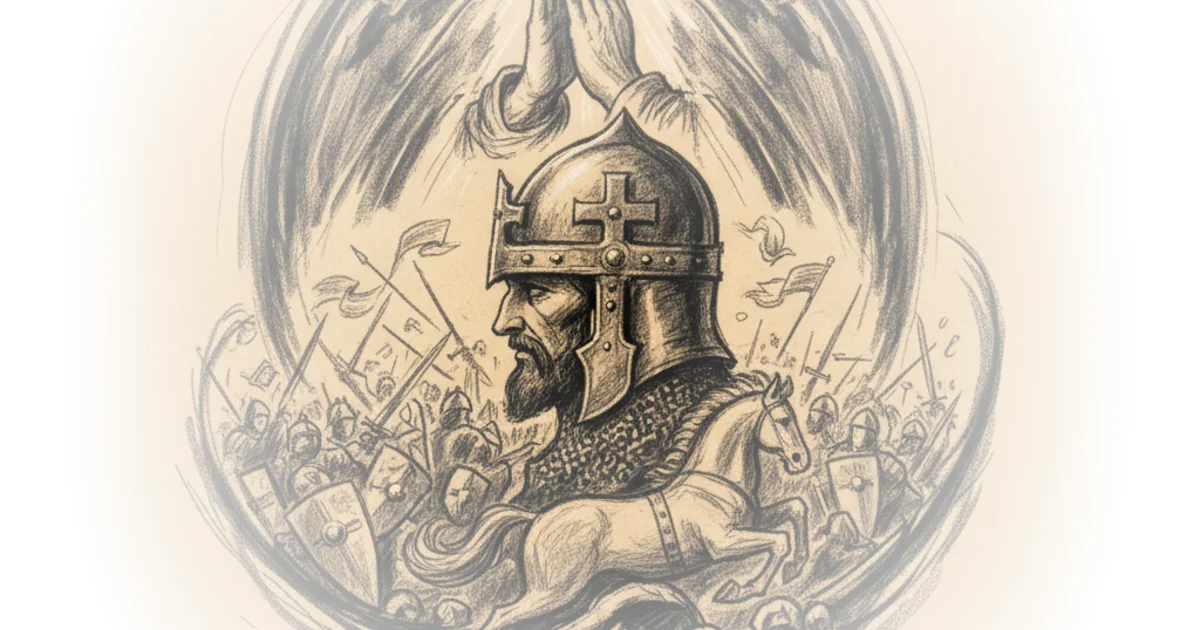
The argument gains strength when it details how the Frankish warlords viewed themselves. "Frankish warlords like Clovis and other Germanic leaders saw themselves as legitimate representatives of the Roman imperial order," Kings and Generals writes. This is a crucial distinction that overturns the outdated narrative of "savage Germanic tribes overrunning Roman territory." Instead of destroying the system, the new rulers were desperate to stabilize it because they were a tiny military elite ruling over a massive population of Romanized natives. The conversion was the final piece of the puzzle to legitimize this rule.
These assets elevated Clovis above the other Frankish warlords.
Critics might argue that attributing such calculated political foresight to a 5th-century warlord risks oversimplifying the role of genuine religious conviction. However, the piece effectively balances this by acknowledging that while the spiritual element existed, the political utility of the church was undeniable.
The Church as the State
The most compelling section of the coverage is its analysis of the Bishopric as a surviving Roman institution. As the secular government crumbled, the church stepped in to fill the void. Kings and Generals observes, "As the secular governmental institutions of the Roman state declined after the fall of the empire, bishops assumed various public functions." They were not just spiritual leaders; they were administrators who fed the poor, organized building projects, and oversaw defenses. This structural reality meant that for Clovis to rule effectively, he had to align with the bishops, who were often drawn from the very senatorial aristocracy that had governed the empire for centuries.
The commentary highlights a letter from Archbishop Remigius of Reims, which advises Clovis to "heed the council of his bishops and treat them with honor." The author uses this to demonstrate that Clovis was already integrated into this system, with the bishop addressing him as a "fellow Christian rather than as a pagan" even before the official baptism. This suggests the conversion was a formalization of an existing relationship rather than a sudden, isolated event. The text argues that "the church and its diocesan structure preserved key elements of Roman governance and its ruling elite," making the alliance between the Frankish sword and the Roman cross essential for survival.
The Catholic Choice
Perhaps the most distinctive argument in the piece is the comparison between Catholicism and Arianism. While other Germanic kingdoms like the Visigoths and Burgundians had already converted to Christianity, they adopted Arianism, a sect considered heretical by the Roman majority. Kings and Generals explains the theological divide: "In Arianism, Christ is a divine being but not of the same essence as God... the son Jesus is created by God and therefore subordinate to him." By choosing Catholicism, Clovis made a deliberate political break from his peers.
This decision allowed Clovis to position himself as the protector of the Catholic population living under Arian rule. The author notes, "In choosing Catholicism, Clovis publicly broke with the religious alignment of the other Germanic kings by inviting Catholic bishops living under Aryan rule." This move sowed distrust between Arian rulers and their subjects, effectively giving Clovis a fifth column in enemy territories. The piece suggests that this religious alignment was a primary driver of his military success against the Visigoths, as he could count on local support that a pagan or Arian ruler would never have received.
He signaled to the powerful Romanized subjects of Germanic Aryan kings that a legitimate Catholic alternative now existed.
A counterargument worth considering is whether the theological differences were as sharp in practice as the piece suggests. The text itself admits that "the division between Aryan conquerors and Catholic conquered was real but not absolute," noting that some Arian rulers convened synods without Catholic objection. While the political utility of the Catholic faith is clear, the extent to which it was the sole determinant of Clovis's success may be slightly overstated compared to his military innovations.
Bottom Line
Kings and Generals successfully reframes the conversion of Clovis from a religious miracle into a sophisticated political strategy that secured the Frankish kingdom's dominance for centuries. The strongest part of the argument is the detailed explanation of how the church functioned as a surrogate state, providing the administrative continuity necessary for a Germanic warlord to rule a Roman population. The piece's biggest vulnerability is the slight tendency to reduce complex religious motivations to pure political calculation, but it remains a vital correction to the simplistic "barbarian invasion" narrative. For the modern reader, it serves as a powerful reminder that the stability of any post-imperial order depends on the ability of new leaders to co-opt the existing institutions of legitimacy.