The most chilling revelation in Michael Macleod's reporting isn't the viral video itself, but the quiet, administrative machinery that nearly failed to deliver justice for an act that could have been a murder. By obtaining exclusive CCTV footage from the floor below the incident, Macleod exposes a terrifying proximity to tragedy that the original Snapchat clip obscured, forcing a confrontation with the reality behind the "content."
The Content of Crime
Macleod frames this story not as a moral panic about "bad kids," but as a systemic collision between the dopamine economy of social media and an overloaded justice system. He notes that the crime was effectively "content," and that "getting the content was the purpose of the crime." This distinction is vital; it shifts the lens from simple recklessness to a calculated risk-taking behavior where the reward is online validation. The author writes, "The crime was content, and it seemed that getting the content was the purpose of the crime." This is a sharp observation of a modern phenomenon where the digital footprint becomes the primary evidence, often more damning than the physical act itself.
"No way bro almost killed someone"
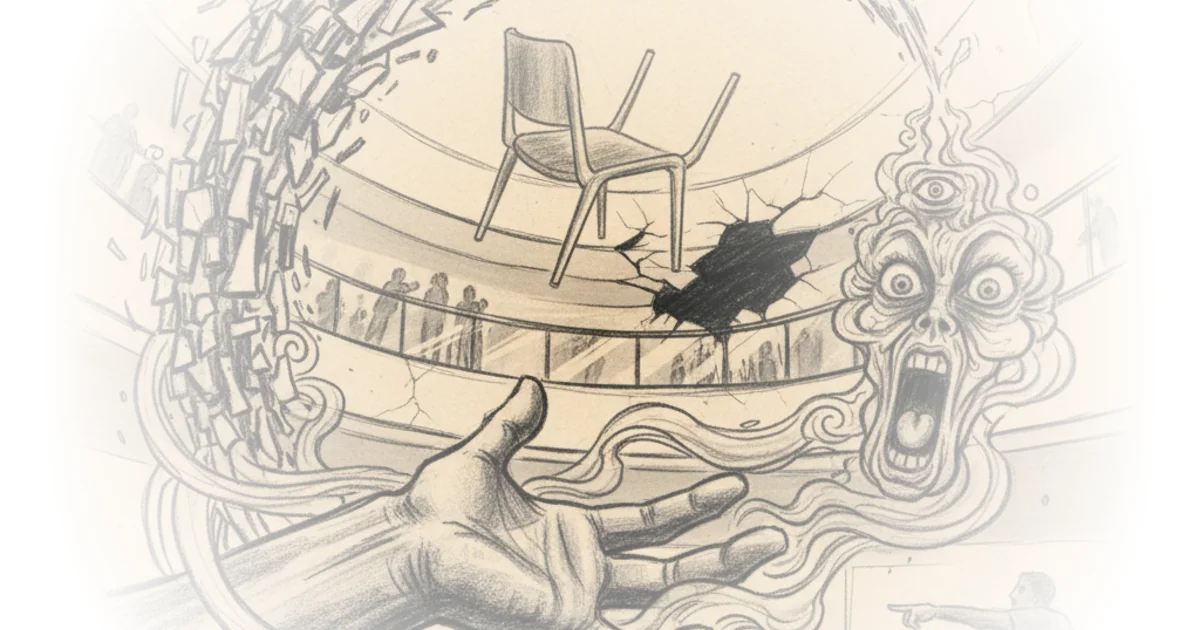
The article highlights the absurdity of the situation: a boy who filmed a 15kg chair being thrown from a 50ft drop captioned his own potential manslaughter with laughing emojis. Macleod argues that in a "pre-smartphone world that would have probably been the end of the story," but the viral nature of the footage alerted police who then identified the perpetrators through their own uploads. The irony is palpable: the very act of documenting the crime for fame ensured the perpetrators were caught. Critics might argue that the focus on "viral" behavior distracts from the underlying lack of supervision, but Macleod effectively demonstrates how the medium is inextricably linked to the method of the offense.
A System in Delay
The narrative takes a darker turn as Macleod details the procedural failures that turned a swift intervention into a year-long ordeal. The author points out that "Repeated delays to the trial date and other problems with the justice system meant this was the boy's ninth trip to court in little over a year." This isn't just bureaucratic red tape; it is a failure of timing that altered the legal outcome. Because the case dragged on, the teenager aged from 14 to 15, moving him into a bracket where custodial sentences were immediately eligible, whereas a 14-year-old would only face custody as a persistent offender.
Macleod writes, "The time taken to deal with the case meant the teenager moved into the upper bracket." This is a damning indictment of a system where administrative incompetence can inadvertently escalate punishment. The delays were caused by a litany of failures: interpreters booked for the wrong language, missing reports, and legal aid portal glitches. The author notes that "Sometimes it was as simple as notes not having been retrieved in time for the hearing." This suggests that the justice system is not just slow, but fundamentally broken in its ability to handle youth cases with the urgency they require.
"We must deal with young people as quickly as we can."
The judge's plea for speed, quoted by Macleod, stands in stark contrast to the reality of the delays. The system's inability to process the case quickly didn't just frustrate the court; it changed the life trajectory of the defendant.
The Geography of Exclusion
Macleod refuses to let the story remain a simple tale of individual pathology, instead weaving in the complex socio-economic fabric of Stratford. He describes the shopping center, built for the 2012 Olympics, as a "hub for local young people" who have nowhere else to go. A youth worker is quoted saying, "This [Westfield] is the biggest youth centre in Newham," noting that kids come for the wifi and the shops. This reframes the mall not just as a retail space, but as a de facto community center for a generation with few alternatives.
The article connects this to the broader history of the area, noting that Stratford has been "a laboratory for regeneration schemes since the 1980s." Macleod cites urbanist Paul Watt, who explains that while the area has seen massive investment, it suffers from "social polarisation." The author writes, "Essentially, putting it crudely, you've got social polarisation." This context is crucial; it suggests that the aggression seen in the mall is partly a reaction to an environment that "both attracts and repels" local youth. The regeneration created a "glittering space full of displays of expensive consumer goods" in one of the poorest parts of the capital, creating a friction point that the article suggests fuels the anti-social behavior.
Critics might argue that linking regeneration to crime risks excusing dangerous behavior, but Macleod is careful to state that he is "not trying in any way to justify crime or anti-social behaviour." Instead, he offers a structural explanation for the tension, noting that wages have lagged far behind rents, leaving residents facing "London levels of rent" on "Blackburn levels of wages."
The Human Cost
Ultimately, the piece returns to the human element, stripping away the viral spectacle to reveal a frightened teenager. Macleod describes the boy in court, who admitted, "I thought it was a joke," before realizing the gravity of his actions. The author captures the moment of realization: "I could have killed someone. That's serious, very serious."
The lawyer for the boy, Nimra Ashraf, described him as someone who "gets caught up with his peers and does silly things," highlighting a lack of maturity and susceptibility to peer pressure. Macleod contrasts this with the older boy who threw the chair, who had a history of more serious offenses. The sentencing outcome—a 12-month referral order with a curfew for the filmer, and an eight-month detention for the thrower—reflects the nuanced, albeit delayed, attempt at justice.
"I could have killed someone."
This admission, coming from a boy who once laughed at the prospect, underscores the central tragedy of the piece: the gap between the digital impulse and the physical reality.
Bottom Line
Macleod's strongest argument is that the "viral video crisis" is not merely a cultural phenomenon but a symptom of a justice system too slow to adapt to the speed of digital crime, and a city too polarized to provide safe spaces for its youth. The piece's biggest vulnerability is its reliance on the assumption that structural factors like gentrification directly cause specific acts of violence, a link that is complex and often debated. However, by anchoring the story in the exclusive CCTV footage and the procedural failures of the court, the author delivers a compelling, necessary warning about the consequences of treating public safety as content.