The Bioelectric Tech Stack
Cam Watson's latest piece cuts through biotech hype with a sobering industrial lens. Rather than celebrating lab breakthroughs, Watson asks why China scales biology while the West stalls — and answers with infrastructure, not innovation.
Biology as Manufacturing, Not Magic
Watson reframes biotechnology as industrial infrastructure, not research extension. The distinction matters. Watson writes, "Biomanufacturing becomes the continuous conversion of electricity and feedstocks into molecules under tight physical constraints, where energy, mass transfer, sterility, uptime, and reliability dominate outcomes." At bench scale, biology feels like software — fast iteration, cheap experiments, forgiving failures. At industrial scale, that resemblance vanishes. Watson notes, "Yield improvements matter, but they operate within an energy-dominated cost structure that cannot be engineered away downstream."
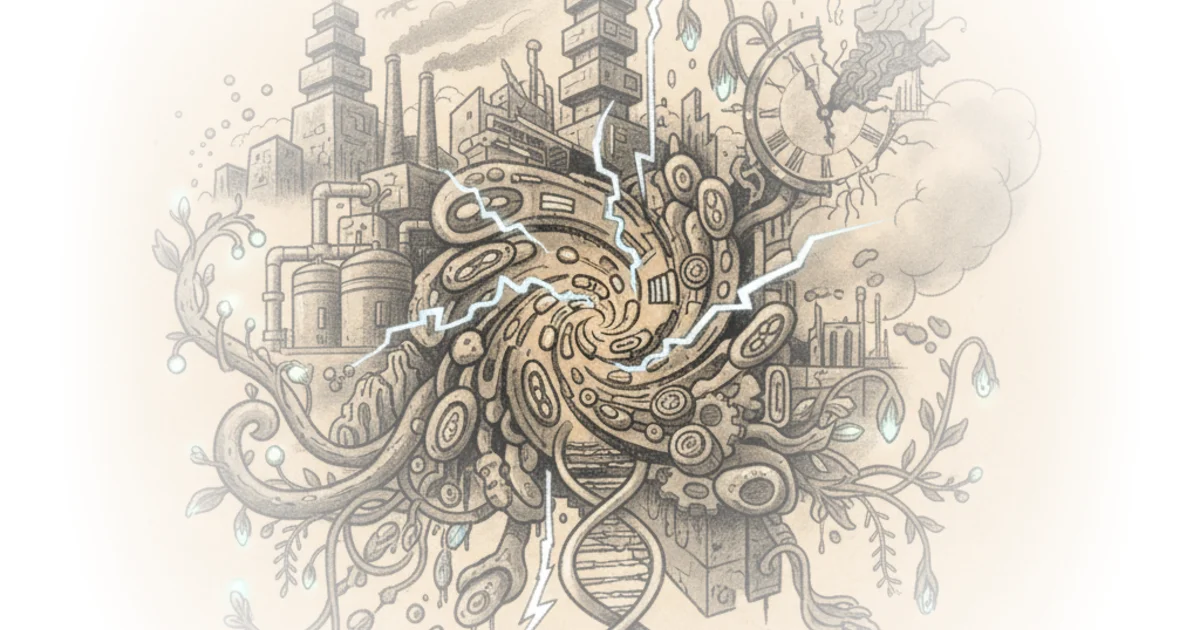
The electric tech stack — power electronics, motors, sensors, control systems — has matured in China through decades of repurposable manufacturing capacity. Watson observes how Chinese city governments pitch existing infrastructure to robotics firms, demonstrating "how readily legacy industrial infrastructure could be repurposed across radically different robotics applications." Biology now occupies the chemical layer of that electrified economy, replacing petrochemicals as the translation mechanism from AI design to physical matter. Watson argues, "Biology offers an alternative. Biological systems are complex matter transducers. They take relatively simple, low-value inputs (CO₂, sugars, amino acids) and convert them into highly structured, high-value molecules at scale."
Feedstocks Set the Ceiling
Energy and feedstock costs determine profitability before biology even begins. Watson cites Cathay Biotech's analysis showing glucose and energy dominate amino acid production costs across regions. "Feedstock production is capital-intensive, volume-driven, and optimised over long time horizons. Margins are thin, logistics matter, and proximity to downstream users becomes critical once transport and storage costs are accounted for." This creates structural tension: biomanufacturing demands cheapest inputs, but food agriculture pulls those inputs first with continuous, immediate demand.
China increasingly decouples industrial feedstocks from food systems entirely. Europe emphasizes flexibility between food and non-food biomass. Watson writes, "Either way, feedstocks are not neutral inputs; they are a strategic layer that determines what can scale."
Sensing Remains the Weak Link
Watson identifies bioelectric sensing as the stack's most underdeveloped layer. "Meaningful insight becomes organism- and process-specific. As a result, sensing fragments into bespoke systems and services." Without standardized sensing, closed-loop control remains impossible and scale-up becomes guesswork. Watson suggests adaptive protein probes and non-destructive internal imaging as promising directions, but notes, "I have seen little evidence of general-purpose interfaces capable of making biological systems broadly legible in real time."
Biology is valuable not because it 'makes things grow,' but because it can reliably build molecular structure at scale.
AI's Three Roles — And Limits
Watson delineates AI's roles clearly: design exploration, scale-up management, and system coordination. But Watson warns against overconfidence. "AI can generate hypotheses and constructs far faster than biological systems can physically realise them. Without reliable inputs, energy-efficient fermentation, and adequate sensing, design output accumulates rather than translating into products." Scale-up presents particular challenges because biological systems do not scale smoothly. Watson writes, "Moving from microlitres to thousands of litres often requires redesigning process conditions and sometimes the biology itself, as effects invisible at small scale begin to dominate and failure modes shift."
Critics might note Watson's framework assumes biology can reliably replace petrochemicals across all applications — a claim still unproven at global scale. Critics might also argue the piece underweights regulatory and safety constraints that legitimately slow Western biomanufacturing adoption. Critics might question whether China's state-directed infrastructure investment can sustain profitability without market signals.
Bottom Line
Watson's bioelectric stack framing explains why scientific capability alone cannot scale biology. Infrastructure, energy costs, and sensing maturity — not strain engineering — determine industrial outcomes. The West treats biology as craft; China treats it as commodity. That distinction, Watson argues, compounds over time.