Adam Tooze reframes the UK's economic paralysis not as a failure of democratic will, but as a self-inflicted wound caused by the silence surrounding the Bank of England. While political analysts obsess over the bond market as an unstoppable force of nature, Tooze argues that this 'invisible hand' is actually a creature of institutional design, one that has been deliberately starved of support to punish political deviation. This is a crucial distinction for any observer trying to understand why the UK remains stuck in a cycle of stagnation while peers like Italy have recovered.
The Ghost in the Machine
Tooze opens with a vivid, almost gothic scenario: a pub where Treasury officials from different eras toast the current government's paralysis. He writes, "The trauma of the fiscal crisis of September-October 2022 sits deep. Back then, in the final stages of Tory decay, a 'mini budget' that challenged fiscal orthodoxy led to a brief but fierce panic in one of the oldest government bond markets in the world." This historical anchor is essential. It reminds us that the current fear of 'bond market vigilantes' is not a law of physics, but a specific memory of a policy failure that was exacerbated by the central bank's refusal to intervene immediately.
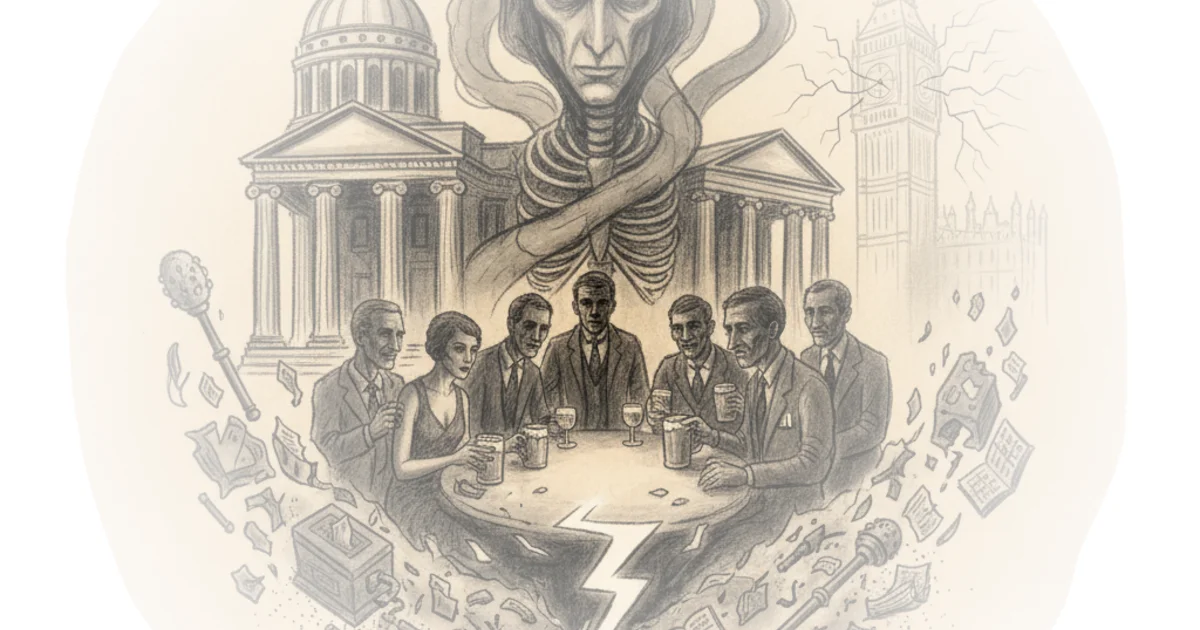
The author's most provocative claim is that the bond market's power is contingent on the central bank's stance. He notes, "The 'bond market' isn't an irresistible objective force like the weather or an avalanche. It can appear like that. But that depends on the way it is being handled, or not handled by the central bank." This shifts the blame from abstract market forces to concrete institutional choices. It suggests that the UK's high borrowing costs are partly a result of the Bank of England's aggressive stance, rather than an inevitable reflection of the country's fiscal health.
"The days of ultra-cheap government borrowing have come to an end" is the headline, but the real story is why the Bank of England is ensuring they stay that way.
Critics might argue that the Bank of England's independence is a necessary bulwark against the inflationary excesses that plagued the 1970s, and that Tooze underestimates the risk of political interference in monetary policy. However, the author counters this by pointing to the European Central Bank's evolution, suggesting that rigid orthodoxy can be just as damaging as populism.
The Italian Mirror and the Trichet Legacy
To illustrate the arbitrary nature of market stigma, Tooze turns to a comparative analysis with Italy. He asks, "How did Italy, in the space of fifteen years, go from being good, to bad and back again?" The answer lies not in Italy's fiscal discipline—which he notes was actually quite tight—but in the actions of the European Central Bank under Jean-Claude Trichet. Tooze writes, "Trichet began a brutal game of cat and mouse. Between 2009 and 2011, Trichet intervened in the bond market to help, only when he thought he had compliance with austerity."
This historical parallel is striking. It draws a direct line from the Eurozone crisis to the current UK situation, suggesting that the fear of market punishment is a tool used by central banks to enforce specific political outcomes. The reference to Trichet's 'cat and mouse' game serves as a warning: when a central bank withholds support to punish a government, it creates a self-fulfilling prophecy of crisis. As Tooze puts it, "It was this cat and mouse game that drove the bond markets crazy and exposed Italy to a violent squeeze."
The contrast with the Bank of England's recent behavior is stark. Tooze highlights that while the ECB eventually pivoted under Mario Draghi with the famous "whatever it takes" mantra, the UK central bank took a harder line. He notes, "The Bank of England stood its ground and toppled the Truss government." This is a bold assertion of institutional power, framing the Bank not as a neutral observer, but as an active political actor capable of destabilizing a government.
The Need for a New Concordat
The piece culminates in a call for a fundamental reset in the relationship between the government and the central bank. Tooze argues that the current "sacred cow" of independence is ill-suited for a post-2008 world of stagnant growth and high debt. He writes, "Since 1997, the independence of the Bank of England has become a sacred cow. But independence is what you make of it." This reframing challenges the reader to reconsider the purpose of central bank autonomy. Is it to protect the currency at all costs, or to support the broader economic health of the nation?
The author suggests that the UK needs a "new concordat" that prioritizes investment-led growth over the fear of bond market reactions. He states, "The top priority should be to lay the ghost of September 2022. The Bank's slowing of QT last month was a concession. An immediate and complete end would send the right signal." This is a clear policy prescription: the central bank must stop its aggressive quantitative tightening to allow the government the fiscal space to rebuild the economy.
"A democracy dogged by fear of bond market vigilantes is unhealthy."
A counterargument worth considering is that such a shift could reignite inflation, a risk that has kept the Bank of England on a tight leash since 2021. Tooze acknowledges the "inflationary pressures" but argues that the current paralysis is a greater threat to long-term stability. He suggests that the UK, as a monetary sovereign, has more room to maneuver than the Eurozone nations did during their crisis.
Bottom Line
Tooze's strongest move is dismantling the myth of the bond market as an external, unstoppable force, revealing it instead as a mechanism shaped by central bank policy. The argument's vulnerability lies in the political feasibility of a "new concordat" in an era where inflation remains a potent political weapon for opponents. Readers should watch whether the Bank of England continues its aggressive tightening or if the pressure for growth forces a policy pivot, as the author urges.