This piece cuts through the noise of generic supply chain anxiety to deliver a stark, data-driven reality: the West is not fighting a broad resource war, but a targeted siege on just 25 specific materials that power everything from fighter jets to AI data centers. Jordan Schneider's curation of this conversation forces a reckoning with the fact that "critical minerals" lists are often political fiction, obscuring where China has already proven it can strangle global industry. For busy leaders trying to navigate economic security, this is not just about geology; it is about identifying the precise choke points where national power is currently held hostage.
The Myth of the Broad List
Schneider frames the discussion by dismantling the prevailing assumption that all "critical minerals" are created equal. He brings in Joris Teer to highlight a terrifying recent precedent: after foreshadowing for years, Beijing finally executed its threat in April, curbing supplies not just to the US but to almost every nation. The stakes are existential for modern infrastructure. As Teer warns, "We were in a bind, and at the time it really seemed like we might enter rare earth Armageddon."
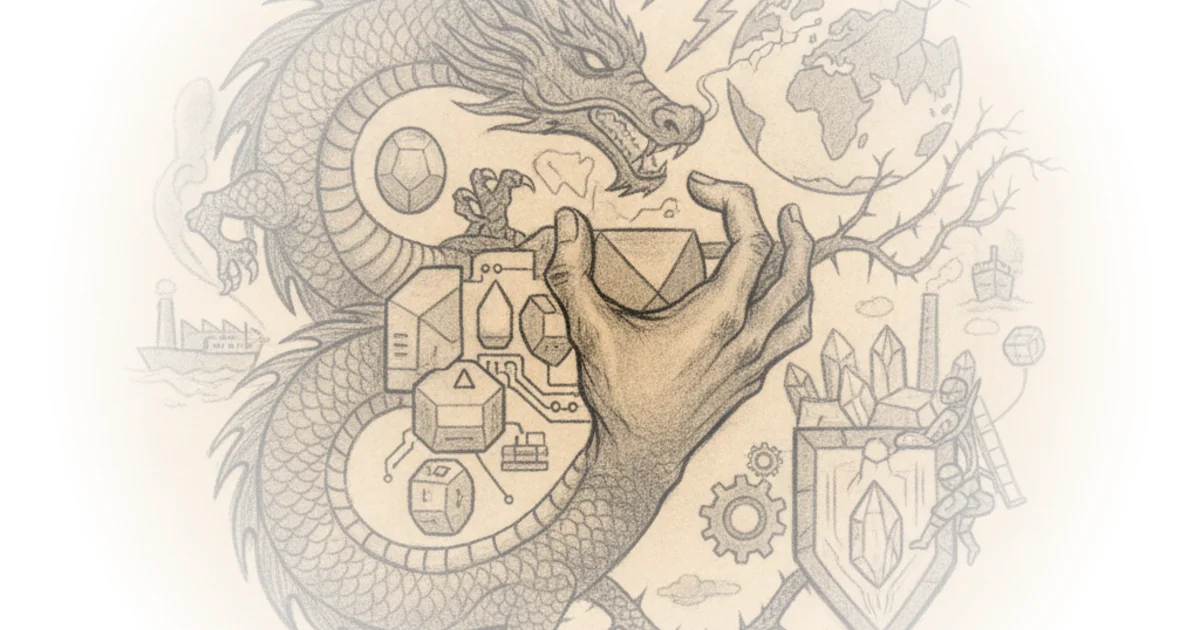
The commentary here is sharp because it moves beyond hypotheticals to hard numbers. Schneider notes that the International Energy Agency defines this scenario as costing the European Union alone $1.5 trillion if permanent magnets become unavailable. Yet, the response has been muddled by broad-brush policies. Teer points out that while Brussels passed a Critical Raw Materials Act in 2023 setting goals for domestic production, "Brussels hasn't taken the required actions." The gap between analytical reports and financial viability remains the defining failure of Western strategy.
Schneider's choice to feature Farrell Gregory is pivotal here. Gregory argues that the US government has been wasting capital on a bloated list of 60 materials when China only holds leverage over about 25. "China is using their leverage and telling us exactly what it is," Schneider paraphrases, suggesting that Washington should stop guessing and start reacting to Beijing's actual moves. This reframing is essential; it shifts the debate from "how do we mine more?" to "what specific materials are actually under attack?"
If critical raw materials are the skeleton of global manufacturing — pull them out and nothing works — then chemicals are the connective tissue and semiconductors are the central nervous system.
The Lithium Distraction and the Gallium Reality
The most provocative argument in Schneider's curation is the assertion that lithium, despite its media dominance, is an overrated priority for national security subsidies. Gregory makes a blunt case: "Lithium gets attention for good reasons... But it stops at the headlines." He argues that because lithium is a massive market with many domestic projects, broad tax credits simply suck up capital without addressing the true vulnerabilities.
In contrast, Schneider highlights the systemic invisibility of materials like gallium. Teer explains that while people obsess over batteries, they ignore that "gallium is used to produce both gallium arsenide and gallium nitride wafers for semiconductors." These are not niche components; they are ubiquitous in radio frequency systems, guided munitions, and jet fighters. The historical context Schneider weaves in is chilling: in 1990, the EU and Japan held the majority of gallium production. By the 2010s, Chinese overproduction collapsed international markets, driving competitors out of business.
This pattern of "overproduction evolved into overdependence" is a recurring theme that Schneider ensures the reader cannot miss. The result? According to the US Geological Survey, gallium was still 100% produced in China last year. Critics might argue that dismissing lithium ignores the sheer volume needed for the energy transition, but Schneider's guests counter that national security and industrial resilience require a different calculus than consumer EV adoption. The focus must be on materials where the supply chain is fragile and the alternative is non-existent.
Beyond Subsidies: The Coordination Trap
Schneider steers the conversation toward the "how" of solutions, revealing a deep skepticism about subsidies alone fixing the problem. Gregory notes that while tools like price floors and tax credits are helpful, they are not direct enough to compete with China's state-backed industrial policy. "You need different tools for different materials," Schneider summarizes, emphasizing that a one-size-fits-all approach fails against varied market dynamics.
The conversation exposes a coordination nightmare. With multiple bureaucracies, from permitting authorities to investment teams, trying to plug holes in the supply chain, the risk of duplication is high. Teer warns that relying solely on "plugging holes" without a holistic demand-side solution is insufficient. The West needs reliable connections for raw materials, chemicals, and semiconductors simultaneously. As Schneider puts it, the challenge is managing a "principal-agent problem" where no single entity has the authority to orchestrate the necessary scale of intervention.
The historical parallel to the 2010 Senkaku boat collision incident looms in the background here; that event was the first time China weaponized rare earths against Japan, yet the West failed to learn the lesson until it was too late for gallium and germanium. The current strategy of "reshoring" faces its own hurdles: environmental opposition (NIMBYism), skilled labor shortages, and the high cost of end-products.
Bottom Line
Schneider's curation delivers a vital correction to the public discourse: the West is not fighting a war for all minerals, but a desperate race to secure 25 specific materials that China has already proven it can weaponize. The strongest part of this argument is its ruthless prioritization, stripping away the political comfort of broad lists to focus on the actual choke points like gallium and heavy rare earths. Its biggest vulnerability lies in execution; identifying the problem is easy, but overcoming the fragmented bureaucracies and environmental hurdles to build competing supply chains remains a monumental, unproven challenge.