Margaret Killjoy transforms a standard fantasy adventure into a sharp critique of how revolutionary violence often ignores the complex economic realities of the communities it claims to liberate. Rather than offering a simple tale of good versus evil, the piece forces readers to confront the messy aftermath when idealism collides with the livelihoods of ordinary people.
The Cost of Idealism
Killjoy frames her narrative not as a triumph, but as a cautionary tale about the unintended consequences of radical action. She introduces a quartet of misfits—Spite, an idealistic warrior; Trant, an alchemist who prefers explosives; Murdy, a cleric of a "soup cult"; and Squash, a captured bandit—who set out to destroy a prison in the Aspodell Mountains. The author writes, "If a village wants to be left alone they simply shouldn't have agreed to let anyone build a prison there," establishing the group's initial, simplistic logic. This framing is effective because it immediately highlights the disconnect between the revolutionaries' moral clarity and the village's pragmatic dependence on the institution they are destroying.
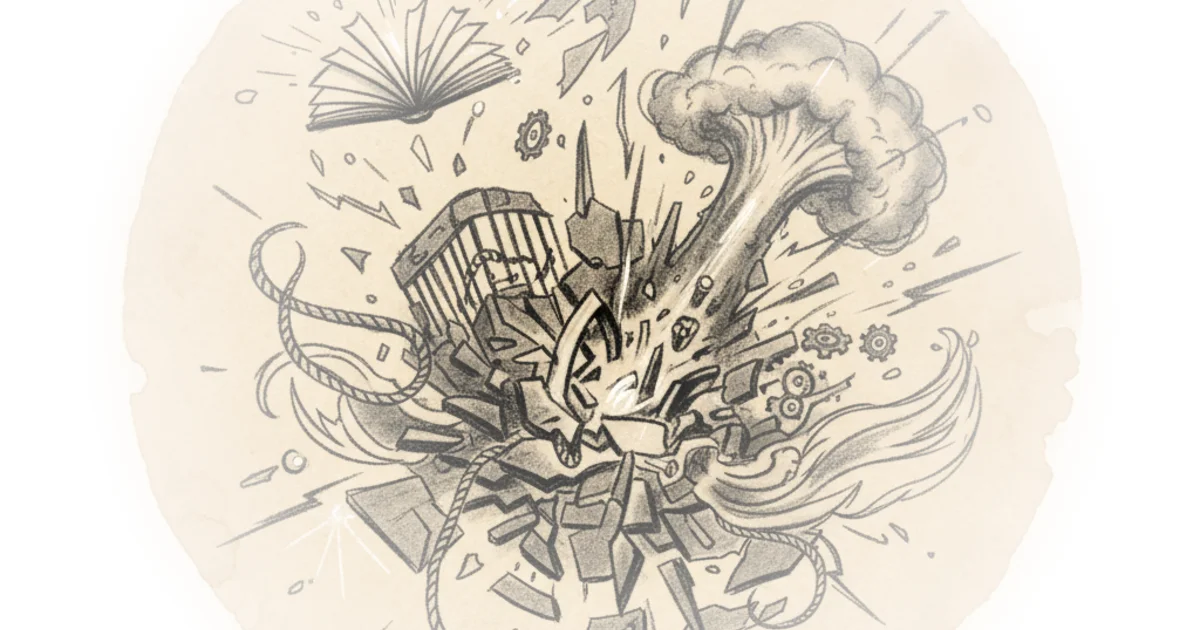
The story draws on the rich lore of the Pathfinder Roleplaying Game, specifically the tension between the tyrannical nation of Cheliax and the democratic Andoran, to ground the conflict. Yet, Killjoy subverts the typical fantasy trope where the heroes are universally cheered. Instead, she notes that the town's economy was inextricably linked to the prison. As the author observes, "most of their economy had been tied into that prison, and many of their family members had worked there as guards and had died in the fighting." This detail shifts the narrative from a victory lap to a tragedy of collateral damage.
"Our work is done," Spite said. "Their fate is in their own hands, where it always belonged." Yet the town did not rejoice; they mourned their dead and feared for their future.
The character of Trant serves as a foil to Spite's moralizing, representing a purely utilitarian approach to destruction. Killjoy writes, "Trant tried to argue that if they'd been concerned about their prison they shouldn't have built it out of explodable materials." This line underscores the absurdity of blaming victims for the infrastructure of their own oppression. However, the author does not let Trant off the hook; his reliance on alchemy and fire is portrayed as a blunt instrument that fails to address the root causes of the conflict.
The Human Toll of Conflict
The narrative does not shy away from the visceral reality of violence. When the explosives detonate, the result is not a clean liberation but chaos. Killjoy describes the scene with unflinching detail: "Many, many of them fell, screaming in agony." This focus on the screaming prisoners and guards alike serves to humanize the casualties, reminding the reader that in any conflict, the human cost is the primary metric.
The story also explores the psychology of the incarcerated through Squash, a shoony (a dog-like humanoid) who views his imprisonment as a personal affront to his panache. Killjoy writes, "He hadn't seen a judge of any kind, and he had the suspicion he'd see a gallows before he'd see a scrap of paperwork to justify his arrest." This detail resonates with real-world concerns about due process and the arbitrary nature of detention, adding a layer of political relevance to the fantasy setting.
Critics might note that the story's resolution—where the heroes flee the town they "liberated"—feels somewhat defeatist. By having the characters escape rather than stay to help rebuild, the narrative risks suggesting that revolutionaries are inherently incapable of governance or community building. However, this could also be interpreted as a realistic acknowledgment of the limits of external intervention. As Killjoy puts it, "Spite tried to argue that surely transformative justice programs, conflict mediation, economic opportunity, and healthier outlets for youthful aggression like competitive sports programs were more effective and moral ways to address the problem of antisocial behavior." The irony, of course, is that Spite cannot implement these programs after blowing up the town's economic engine.
The Limits of Revolution
The piece concludes with the group boarding a ship, leaving the town to its fate. The author writes, "We'll be back," Spite said. "The revolution demands it." But the others are "mostly happy to be lulled to sleep by the waves beneath the ship." This contrast between Spite's unyielding ideology and the others' exhaustion highlights the burnout that often plagues revolutionary movements. The story suggests that while the impulse to destroy oppressive structures is noble, the path to true freedom is far more complex than a single explosion.
The narrative also touches on the concept of the "soup cult," a heretical group dedicated to feeding the hungry. Killjoy writes, "All hail the perpetual stew, brewed a thousand sunsets ago with accidental healing properties, and which must now be kept at a consistent 200 degrees for food safety reasons." This blend of the sacred and the mundane—mixing religious fervor with food safety regulations—adds a unique texture to the world-building, grounding the fantastical elements in relatable, everyday concerns.
"We'll be back," Spite said. "The revolution demands it." But the revolution, like the stew, requires more than just heat; it requires a sustained effort that the story's heroes are ill-equipped to provide.
Bottom Line
Killjoy's "The Tale of the Explodable Prison" succeeds by refusing to offer a tidy moral, instead presenting a nuanced portrait of how well-intentioned violence can fracture a community. Its greatest strength lies in its refusal to romanticize the aftermath of the explosion, forcing readers to grapple with the economic and human costs of revolution. The piece's vulnerability is its lack of a constructive alternative, leaving the reader with the unsettling realization that destroying the prison was only the beginning of a much harder problem. As the story fades out, the reader is left to wonder if the revolutionaries are truly heroes or just another source of instability in an already fragile world.