Yale University delivers a masterclass in historical nuance by refusing to let Reconstruction end on a single date, arguing instead that the era's unfinished business has haunted American democracy for over a century. The lecture's most striking claim is that the struggle over the meaning of the Civil War and the rights of Black citizens did not conclude in 1877, but rather mutated through the Gilded Age, the Jim Crow era, and even into the election of Barack Obama in 2008.
The Myth of a Clean Ending
The core of the argument is that history is not a series of discrete events with clear stop signs, but a continuous, often painful, negotiation of memory and power. Yale University writes, "Reconstruction's not over, folks. It's had many endings." This framing is essential because it dismantles the comforting narrative that the nation moved past its racial trauma simply by passing a few laws or holding an election. The author challenges the listener to consider that the definition of an "American" was still being violently contested in the 1880s and 1890s.
To illustrate this, the lecture examines the film Birth of a Nation, noting that it "ultimately about white supremacy and ultimately about the story of why reconstruction had to be defeated." This is a powerful choice of evidence; by analyzing a piece of pop culture that glorified the Ku Klux Klan, the author shows how the "popular version of the meaning and memory" of the war was actively constructed to justify the rollback of civil rights. The argument lands because it connects high-level political shifts to the visceral cultural forces that shaped public opinion.
"Some thought it was November 4 or November 5, 2008. What happened then? Yeah, it was the night of Barack Obama's victory... Tom Friedman... wrote... 'The American Civil War ended.'"
The author uses this anecdote to highlight a recurring delusion: the belief that a single political victory can permanently resolve deep-seated structural inequalities. Critics might note that equating the 2008 election with the end of the Civil War is hyperbolic, yet the point stands that such moments often trigger a backlash that reveals the fragility of progress. The lecture suggests that the "struggle over memory" is as real as the struggle over policy.
The Gilded Age as a Crisis of Labor
The commentary shifts to the economic transformation of the era, where the lecture argues that the rise of industrial capitalism fundamentally altered the concept of "free labor." Yale University observes that "for the first time, non-agricultural workers outnumbered farmers and wage earners outnumbered independent craftsmen by 1873." This statistic is crucial because it marks the moment when the Republican Party's mantra of "free labor" became a contradiction; how can a laborer be free if they are a "cog with a task in a machine"?
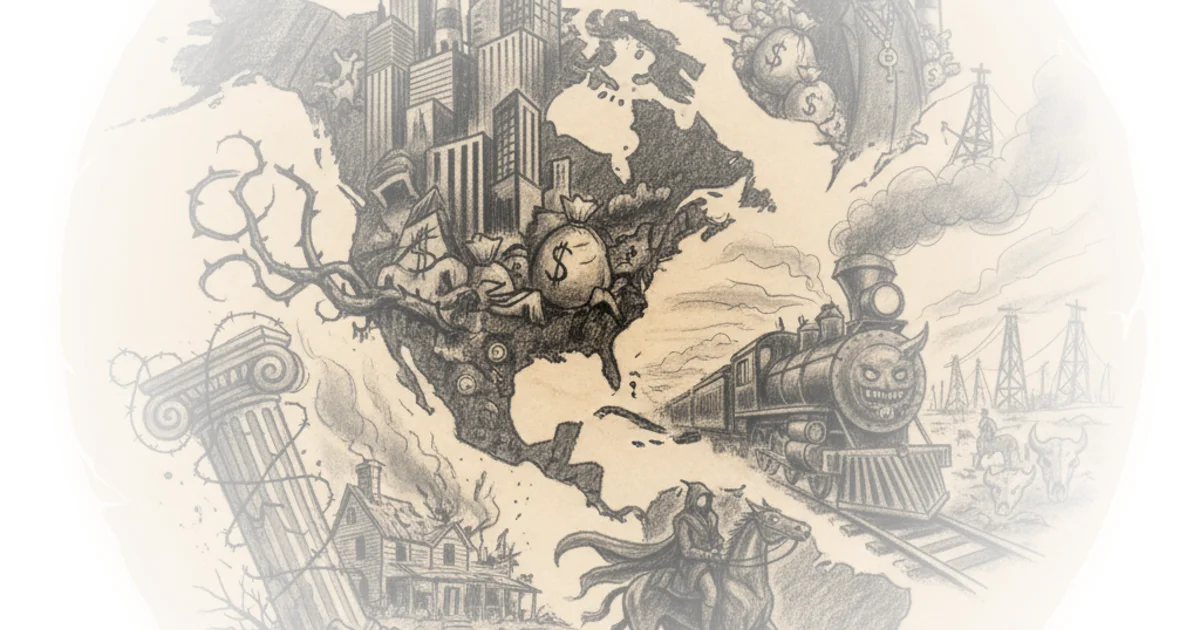
The author paints a vivid picture of a nation in rapid, chaotic expansion. "Railroads were overbuilt. Speculation in western lands was overdone." This boom-and-bust cycle created a new class of workers who were increasingly disconnected from ownership, living in tenements and working for wages they could not control. The lecture effectively links this economic shift to the political retreat from Reconstruction, suggesting that the Republican Party's focus on business interests and Wall Street came at the expense of civil rights enforcement.
The political corruption of the era is described with biting irony. Yale University notes that the Democrats ran a campaign against "corruption, black people, and corruption," framing the era as one where the fight for racial equality was inextricably linked to the fight against graft. The author points out that the authors of the 13th, 14th, and 15th amendments were essentially gone from Washington by the mid-1870s, leaving a vacuum filled by a party more interested in railroads than rights. This is a devastating critique of the political realignment that allowed the South to be "redeemed" by white supremacists.
The West as a Mirror of the South
Perhaps the most distinctive part of the coverage is the expansion of the Reconstruction narrative to include the American West. The author argues that the racial dynamics of the South were not isolated but were exported westward. "The north south axis of reconstruction... was also an east-west phenomena," Yale University writes. This reframing is vital, as it forces the reader to see that the violence against Native Americans, Chinese immigrants, and Mexican-Americans was part of the same national project of defining who belonged.
The lecture details the brutal reality of this expansion, noting that in California, violence against Native Americans became "slaughter or what Californians, white Californians came to call Indian hunting." The author also highlights the specific targeting of Chinese workers, leading to the Chinese Exclusion Act of 1882. This evidence challenges the traditional view of the West as a frontier of opportunity, revealing it instead as a place where the same exclusionary logic of the Jim Crow South was applied to different groups.
"If you and if you're from the West or you visit the West, you'll find Civil War monuments, huge ones, in the center of Denver or Portland or Los Angeles. And you wonder, huh, why do they care so much about the Civil War?"
This question serves as a pivot point, explaining that the presence of these monuments is not an anomaly but a result of ex-Confederates and Union veterans moving west and building competing memorials. The author's point is that the memory of the Civil War traveled with the people, embedding the conflicts of the past into the landscape of the future. This is a compelling way to explain why the past feels so present in modern American geography.
Bottom Line
Yale University's lecture succeeds by refusing to let the reader off the hook with a simple timeline; instead, it presents Reconstruction as a living, breathing struggle that continues to define American identity. The strongest part of the argument is the seamless integration of economic history, racial politics, and cultural memory, showing how they reinforce one another. The biggest vulnerability is the sheer density of information, which might overwhelm a listener trying to grasp the full scope of the Gilded Age's complexities in one sitting. However, the verdict is clear: to understand the present, one must confront the many unfinished endings of the past.