Razib Khan transforms a simple reading list into a profound meditation on how science is made, unmade, and remembered, arguing that the true legacy of genetics lies not in the data points themselves, but in the volatile personalities who first dared to map them. In a landscape often dominated by dry statistical summaries, Khan's piece stands out by weaving together the biographies of giants like James Watson and W.D. Hamilton with the cutting edge of 2025 paleogenomics, suggesting that understanding the human past requires us to confront the messy, often controversial human present.
The Architect of Molecular Biology
Khan centers his narrative on the recent passing of James Watson, framing the co-discoverer of DNA not merely as a Nobel laureate, but as a figure whose life trajectory mirrors the evolution of biology itself. "Along with Francis Crick, he puzzled out the structure of DNA, the substrate of genetic inheritance," Khan writes, immediately grounding the reader in the monumental nature of the discovery. The author is careful to distinguish Watson's American flamboyance from Crick's English reserve, noting that "Watson was a more voluble, flamboyant and provocative figure than the more focused Crick." This distinction is crucial for Khan's argument: the public face of science is often shaped by the personality of its most vocal advocate, not just the rigor of its findings.
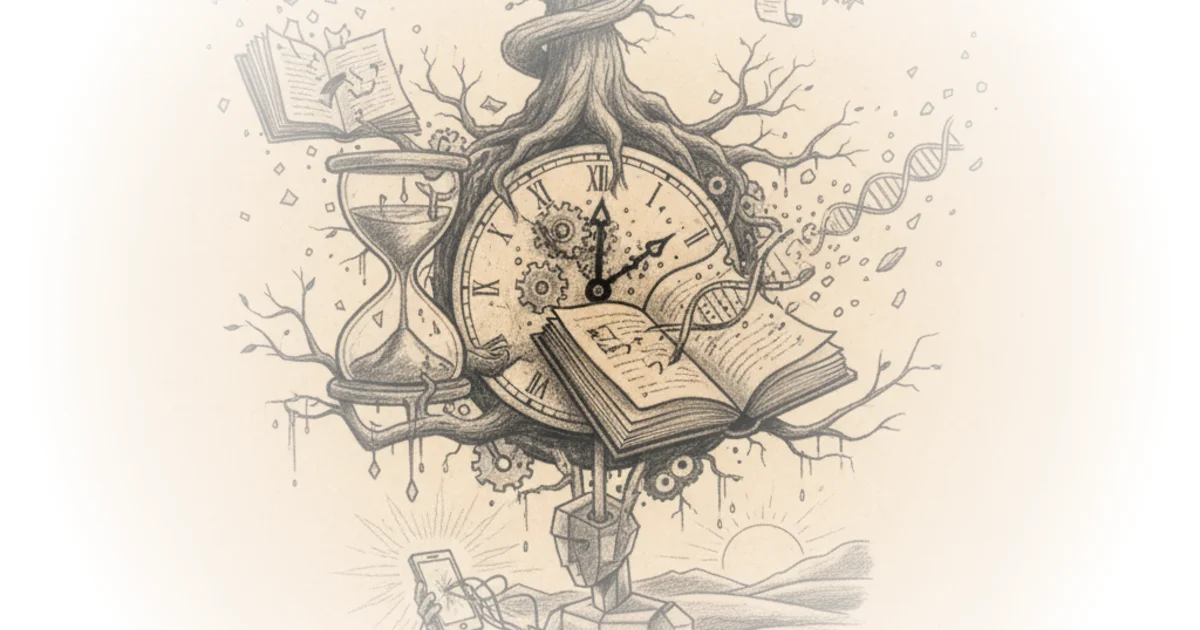
The commentary shines when Khan connects Watson's early career to the broader institutional shifts in American science. He describes how Watson, upon becoming director of Cold Spring Harbor Laboratory in 1968, "transformed it into one of America's premier centers of biological discovery, steering it past its eugenicist past." This reframing is vital; it acknowledges the dark history of the field while highlighting the specific agency of individuals in redirecting its course. Khan argues that Watson's 1965 book, The Molecular Biology of the Gene, was the true catalyst for the field's maturation, asserting that "Understanding DNA as a biological machine allowed researchers to re-conceptualize as biophysical processes abstractions like recombination and mutation." This shift from observing statistical patterns to understanding physical mechanics is presented as the necessary precursor to the genomic revolution.
If Watson's authorship of The Double Helix established his reputation and public stature, it was 1965's The Molecular Biology of the Gene that most influenced working scientists and biology students.
Critics might argue that focusing so heavily on Watson's narrative risks overshadowing the collaborative nature of science, particularly the contributions of women like Rosalind Franklin, whom Khan admits Watson gave "short shrift" to. However, Khan's point is not to whitewash history, but to explain how a specific, reductionist worldview became dominant. He notes that this focus "unlocked the key to the emergence of genomics, which in turn brought big data to genetic inference," suggesting that the trade-off for this powerful new lens was a certain narrowing of perspective.
The Fracture of Biology and the Reconciliation of Minds
The piece deepens as Khan explores the intellectual fault lines within the scientific community, using the rivalry between Watson and E.O. Wilson to illustrate a fundamental split in how biologists view the world. He recounts how the two men clashed in the 1950s, with Watson dismissing traditional taxonomy as the domain of "stamp collectors." This anecdote is not just gossip; it serves as a microcosm for the "eventual fissure of Harvard's biologists into molecular and non-molecular factions," a division Khan notes is "now very common in American science."
Yet, Khan offers a more nuanced view of these conflicts than the standard narrative of bitter feuds. He highlights that despite their public spats and differing temperaments—Watson being "egotistical, bold and vocal" while Wilson was "soft-spoken, if nevertheless quietly self-assured"—the two men eventually found common ground. "Near the end of their lives, Watson and Wilson reconciled on personal terms, developing a friendship based on a shared fascination with biology's power to explain the world around them," Khan observes. This reconciliation is framed around their shared willingness to tackle controversial topics, including the genetics of intelligence. Khan reveals that while Watson was publicly canceled for his 2007 comments on the black-white IQ gap, "Wilson was never canceled on account of such topics, but it has become clear... that he held much the same views as Watson."
This section forces the reader to confront the uncomfortable reality that scientific consensus on certain human traits remains elusive, and that the most rigorous scientists often hold views that the public finds unacceptable. Khan draws a parallel to the Arthur Jensen controversy, noting that "Francis Crick's personal correspondence makes it clear that Wilson also took Arthur Jensen's side," further illustrating how the boundaries of acceptable scientific discourse have shifted over time. The argument here is that the suppression of certain lines of inquiry, even those held by respected figures, may hinder a complete understanding of human biology.
The Quiet Revolutionary and the New Data
Shifting focus to W.D. Hamilton, Khan presents a counterpoint to the Watson-Wilson dynamic. Hamilton is described as occupying a "strange and gray space between Watson and Wilson," combining the mathematical rigor of the former with the naturalist curiosity of the latter. Khan emphasizes that Hamilton's work was largely unknown to the public during his life, yet his ideas were foundational, with Richard Dawkins eulogizing him as the "most distinguished Darwinian since Darwin."
The commentary here is particularly effective in explaining why Hamilton's Narrow Roads of Gene Land remains essential reading. Khan notes that because the volume was published posthumously, "his editors were powerless to force revisions that might have reduced its length and candor," resulting in a work that is "larded with biographical detail and myriad meandering asides" but ultimately reveals the "awkward and sensitive scholar" beneath the math. This candidness provides a humanizing counterweight to the often sterile presentation of scientific data.
Khan then pivots to the contemporary era, contrasting the evolutionary focus of Hamilton with the medical reductionism of modern authors like Siddhartha Mukherjee. He argues that while Mukherjee's The Gene is driven by a desire to "vanquish the ailments that have plagued humanity," it lacks the evolutionary depth of earlier works. This sets the stage for the piece's most timely update: the sequencing of a new, high-coverage Denisovan genome in late 2025. Khan writes that "a staggering 5,400 generations separate Denisovan 25 from Denisova 3," a discovery that allows for "apples-to-apples high-quality genome to high-quality genome" analysis.
Though researchers found this individual, Denisova 25, at the same location, he is vastly older than Denisova 3, who died 65,000 years ago.
This new data, Khan suggests, finally allows scientists to move beyond the limitations of the single 2010 sample and truly understand the population structure of these ancient humans. It is a testament to the power of the molecular approach Watson championed, now applied to questions of deep human history that were previously inaccessible. The piece concludes with a brief nod to the Greenland settlers, reminding us that "the archaeological record... points to their saga's final chapter closing not in triumph but" in failure, a sobering reminder that technological and biological adaptation does not guarantee survival.
Bottom Line
Razib Khan's commentary succeeds by refusing to separate the science from the scientist, arguing that the volatile personalities of Watson, Wilson, and Hamilton were not distractions but essential drivers of biological discovery. The piece's greatest strength is its ability to contextualize the latest genomic breakthroughs within a century-long narrative of intellectual conflict and reconciliation. However, its willingness to engage with the controversial views of these giants, particularly regarding human intelligence, may alienate readers who prefer a more sanitized version of scientific history. As the field moves toward even deeper genomic analysis, the tension between the desire for medical cures and the complexity of evolutionary history will only intensify, making Khan's historical perspective more relevant than ever.