In a literary landscape often obsessed with external crises, this piece from Natural Selections turns the lens inward to a terrifyingly intimate collapse: the moment when severe illness severs the connection between the body and the self. It is a rare, visceral account of depersonalization that moves beyond clinical symptoms to explore the existential horror of losing one's "ghost"—the emergent life force that makes us feel human. For busy minds accustomed to optimizing productivity, this narrative offers a stark, necessary reminder that the machinery of identity can grind to a halt without warning.
The Anatomy of Disappearance
The piece begins by dismantling the supernatural definition of a ghost, redefining it as the vital spark of consciousness. "I do not believe in ghosts, at least, not in the way that people tend to mean when they say that they do," the editors note, immediately grounding the metaphysical in the biological. Yet, they quickly pivot to a more unsettling reality: the ghost is not a spirit leaving a corpse, but a presence that can vanish while the body remains alive. "When our ghost slips away, when we give up the ghost, we die," the text observes, but then corrects itself to describe a living death. "I felt like I wasn't human anymore. My ghost was gone."
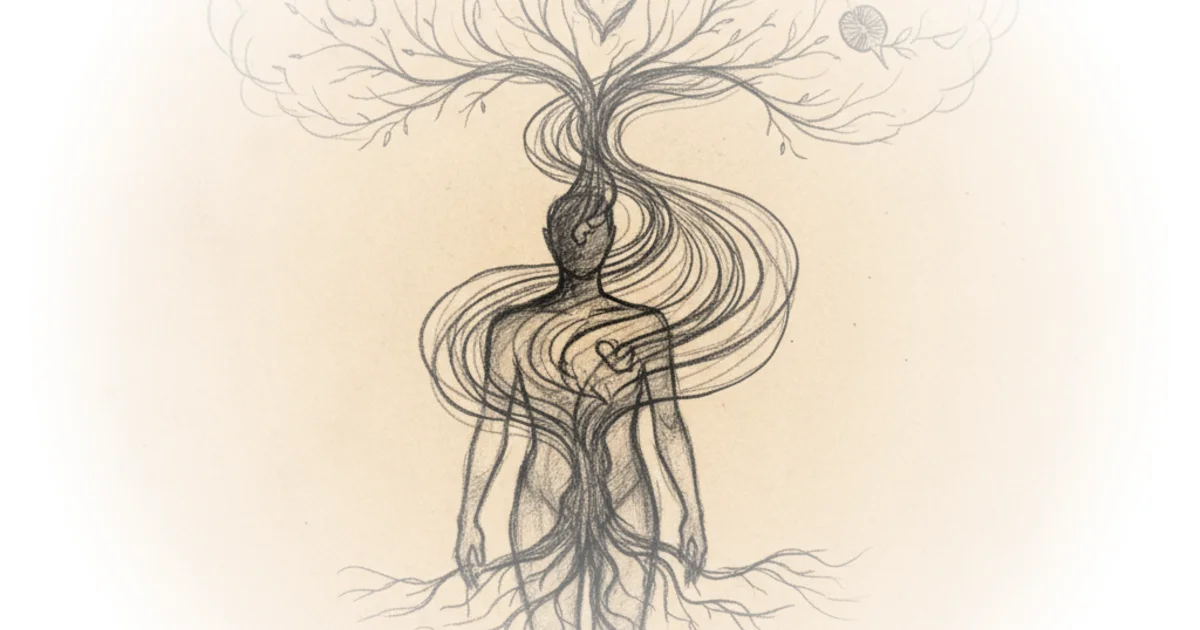
This distinction is crucial. The article argues that the true terror of sickness is not pain, but the erasure of agency. "I couldn't figure out what to think, or what to do, or even what to want to do," the narrative recounts. The author describes a descent into a "flat grey space" where the capacity for choice evaporates. This aligns with historical understandings of "sickness behavior," a state where the immune system's response actively suppresses motivation and social engagement to conserve energy for healing. However, the piece pushes further, suggesting that in extreme cases, this biological shutdown feels less like a pause and more like an erasure of the self.
"I had gone from writing thousands of words a day, to being unable to make a choice on Netflix."
The imagery used to describe this state is hauntingly effective. The author visualizes their consciousness as a "little rowboat in a grey sea," unmoored and drifting. "There were no oars. No horizon. Nowhere to be," the piece describes. This metaphor captures the paralysis of severe illness better than any medical chart could. It highlights a profound vulnerability: our sense of self is not a permanent fixture, but a fragile construct that can dissolve when the body is under siege. Critics might argue that this is merely a poetic description of delirium, but the specificity of the loss—"I couldn't even watch"—suggests a deeper cognitive disconnection that transcends simple fever.
The Unraveling of Integration
The narrative takes a sharp turn when the author attempts to reclaim agency through physical action. "I howled in rage and took action by taking my feverish, unnourished body out in to the Pacific Northwest weather of November and going for a walk," the text reports. This moment of defiance is framed not as a recovery, but as a desperate attempt to anchor a slipping identity. The author sees bald eagles and recalls their love for raptors, yet admits, "I remembered those things, but I also could not remember why I cared."
This disconnect underscores the central thesis: the human condition is an integrated whole that can unravel. "We are more than the sum of our parts, until we start to become less than them," the editors argue. The piece suggests that the separation of mind and body, often debated in philosophy, becomes a terrifying reality during acute illness. The author feels like a "visitor to life," unable to calibrate meaning. "Nothing resonated," the text states. "I continued to disappear. My ghost was leaving me."
The historical context of vitalism—the belief that living organisms are fundamentally different from non-living entities because they contain some non-physical element—lurks in the background here. While modern science rejects vitalism in favor of materialism, the experience described in the piece suggests that the feeling of a vital force is essential to our sense of being. "Our essence is emergent, and cannot yet be explained by a materialist understanding of the world," the piece concludes, leaving the reader with a provocative question: if science cannot explain the ghost, does that mean it doesn't exist, or that our understanding is simply incomplete?
"My breathing became shallower yet on day seven... The fact that my inhale stopped softly about 2/3 of the way to a full breath, every time, should have alarmed me. It did, but only faintly. My capacity for alarm was fading."
The return of the ghost is framed not as a triumph of will, but as a medical intervention. "On day eight I did get antibiotics which are now kicking the crap out of the infections," the text notes. The relief is physical, yet the restoration of the self feels almost magical. "The rowboat is gone and I am back now, my ghost firmly settled within me," the author writes. This sudden return of agency highlights how precarious our sense of self truly is. We are one infection away from losing the very thing that makes us "us."
Bottom Line
The strongest element of this piece is its refusal to treat illness as a mere biological malfunction; instead, it frames the loss of self as an existential crisis that demands a re-evaluation of what it means to be human. Its biggest vulnerability lies in its reliance on a singular, subjective experience, which, while powerful, may not fully account for the spectrum of recovery or the long-term cognitive impacts of such severe sickness. Readers should watch for how this understanding of "sickness behavior" influences future discussions on mental health and the integration of physical and psychological care in medical practice.