In an era where algorithms dictate our choices and social media fragments our shared reality, Boaventura de Sousa Santos delivers a startling inversion: the very foundations of Western rationalism are being hollowed out, not by chaos, but by a mechanical certainty that demands we stop thinking entirely. This is not a standard philosophical critique; it is a diagnosis of a civilization that has outsourced its doubt to machines, trading the slow, painful work of truth-seeking for the instant comfort of pre-digested answers. Santos argues that the three pillars of modern thought—reason, autonomy, and doubt—are being trivialized into tools of neoliberal control, leaving us with a "New Machine" that thinks for us while we become its passive products.
The Limits of the Cartesian Foundation
Santos begins by acknowledging the dominance of René Descartes' famous assertion, "I think, therefore I am," but quickly reframes it as a historical artifact rather than a universal truth. He identifies three core ideas embedded in this phrase: the primacy of reason, individual autonomy, and methodical doubt. These concepts, he argues, became the "common sense of Western modernity," yet they were never truly universal. As Santos notes, "Descartes is not a skeptic, but he uses skepticism methodically to combat it. Herein lies the search for certainty in the modern era and the concept of rigor that dominates modern science: it is not about truth, but about the relentless pursuit of truth."
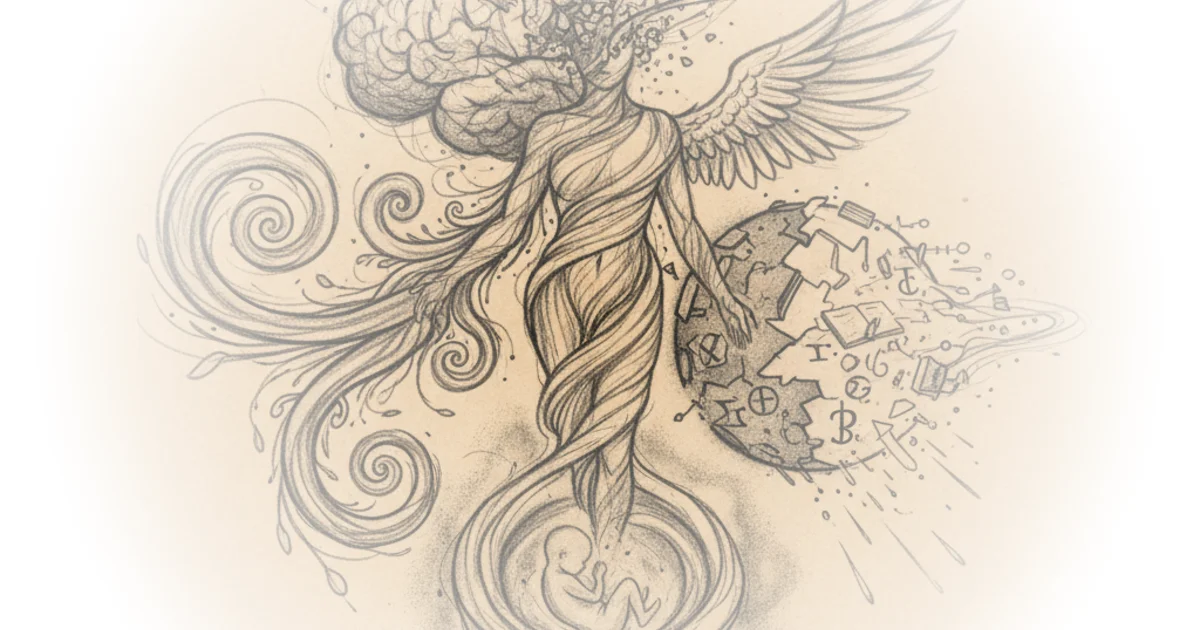
The author's move here is to strip the phrase of its divine status and expose its Eurocentric roots. He suggests that this framework was designed to serve the "nascent bourgeois revolution" and its expansionist goals, creating a worldview where nature is merely an "inert extension" waiting to be mastered by human reason. This perspective aligns with the historical context of the 17th century, where the rise of the bourgeoisie required a philosophy that prioritized individual property and rational calculation over communal or spiritual bonds. Santos writes, "Individual autonomy is precious, but it cannot be conceived in an individualistic way. Individualism was fundamental in promoting the triumph of the bourgeoisie through political liberalism and the primacy of individual property."
"The architect analogy shows the fundamental Cartesian limitation, his Eurocentric monoculturalism. After all, the sand may be full of gold nuggets, and other cultures build houses on sand, or houses in trees, not to mention floating houses on rivers and lakes."
This metaphor is powerful because it challenges the idea that there is only one "solid rock" of truth. Santos proposes an alternative he calls "warm reason," a concept that blends intellect with emotion and collective feeling. He cites Orlando Fals Borda's term sentirpensar (feeling-thinking) to argue that fighting domination requires a combination of reasons, emotions, and affections. Critics might note that blending emotion with reason risks diluting the rigor necessary for scientific or political analysis, but Santos insists this is not a call for irrationalism, but a broader rationalism that acknowledges human interdependence.
The Trivialization of Modernity
The commentary shifts to a stinging critique of how these Cartesian ideals are currently being degraded. Santos argues that we are living in a period where the ascendant thinking of the past is being deconstructed in the name of its maximum realization, resulting in a "denial-trivialization." The first casualty is the separation of collective causes from individual consequences. In our current neoliberal landscape, "social suffering is always experienced as individual suffering and never as collective suffering."
This framing is particularly sharp because it explains the rise of punitive social attitudes. When society is not seen as sick, only individuals are, leading to a culture where "one does not suffer with, one suffers against." Santos observes that this isolation drives people into "negative solidarity," finding comfort only in communities of shared misery. He writes, "Conformity with what has already been thought is not a manifestation of passivity, it is a militant act against loneliness." This insight into the psychology of social media echo chambers is crucial; it suggests that our retreat into algorithmic bubbles is a desperate search for shelter, not just a failure of critical thinking.
The second form of trivialization is the "subjectivity enslaved by false autonomy." Santos describes a world where individuals are told they are free to manage their own bodies and lives, yet they lack the actual conditions to be autonomous. "Neoliberal autonomy is autonomy without the conditions to be autonomous, that is, without being able to decide what autonomy consists of and for what purposes." He uses the example of food delivery workers who are legally "autonomous" but economically enslaved by the need to deliver food to survive. This distinction between legal freedom and material necessity is a vital corrective to the rhetoric of personal responsibility.
The Mechanical Collapse of Doubt
Perhaps the most urgent part of Santos' argument concerns the third pillar: doubt. He contends that methodical doubt requires a "slow temporality" that is incompatible with the speed of modern capitalism and, increasingly, artificial intelligence. "Thinking, in this case, is a waste of time," he writes, describing an era that demands "intellectual and emotional fast food." The danger, he posits, is that we are moving from a state of critical inquiry to one of "non-learning," where skills in human interaction not mediated by AI are disappearing.
Santos delivers a chilling diagnosis of the AI revolution: "Homo sapiens gives way to homo artificialis. Etymologically, artificialis comes from Latin and means made by humans and not obtained from nature. In the age of artificial intelligence, homo artificialis is not the human being who makes, but the human being who is made." This reversal of agency is the core of his warning. By outsourcing our doubt to algorithms, we risk losing the very capacity to question the systems that govern us. He notes that "doubt, whether analytical, dialectical, or rhetorical, has been eliminated by the mechanical certainty of artificial intelligence."
"What is new is the possibility that unlearning will gradually slide into non-learning or, at least, into the non-learning of everything that does not relate to intelligent machines and how to collaborate or cooperate with them."
A counterargument worth considering is that AI can actually enhance critical thinking by handling data processing, freeing humans to focus on higher-level ethical questions. However, Santos would likely argue that the current trajectory of AI development is driven by profit and efficiency, not by a desire to foster human wisdom. The risk is not just that machines think for us, but that we stop valuing the messy, slow, and difficult process of thinking for ourselves.
Bottom Line
Boaventura de Sousa Santos offers a profound and unsettling critique of our current moment, arguing that the tools we built to liberate us—reason, autonomy, and doubt—are being weaponized to enslave us to a new, algorithmic order. His strongest move is reframing the crisis not as a failure of technology, but as a failure of philosophy, where the "warm reason" of collective struggle has been replaced by the cold certainty of the machine. The biggest vulnerability in his argument is the practical difficulty of implementing "warm reason" in a global economy that demands speed and efficiency, but his warning remains essential: if we do not reclaim the right to doubt, we will cease to be the architects of our own reality. The reader must watch for how the integration of generative AI into daily life accelerates this shift from active thinking to passive consumption, potentially eroding the very foundations of democratic agency.