Alex O'Connor, the host of Cosmic Skeptic, tackles a question that usually gets lost in the noise of pop-science: why some aspects of human experience are fundamentally untranslatable, even to a super-intelligent alien. Rather than offering a dry lecture on neurology, he and his co-host Hank Green dissect the gap between explaining how a sensation works and explaining what it feels like, revealing that our most basic instincts—cold, hunger, pain—might be the ultimate barriers to interstellar communication.
The Unexplainable Sensation
O'Connor begins by dismantling the assumption that scientific explanation equals understanding. He illustrates this with a simple scenario: telling an alien why you wear a jacket. "If you were some alien creature who didn't have like sense data on your skin and didn't understand that there was this that cold was then me saying because it's cold would prompt you to then go what's that and why does that do that and why?" This opening move is effective because it immediately exposes the limitation of functional descriptions. You can describe the physics of heat loss, but you cannot transmit the feeling of shivering.
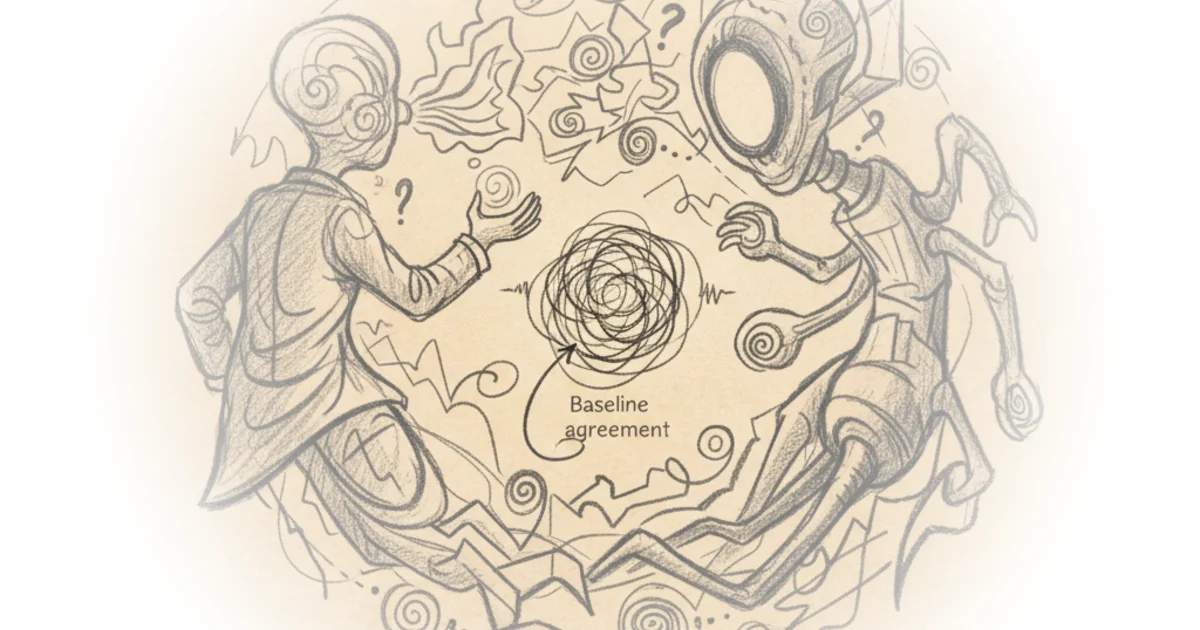
The author argues that while we can explain the chemical mechanisms behind temperature regulation, the subjective experience remains locked away. "I could explain I could say uh so so the way that our bodies function chemically is that we have all we have like these molecules and they they function optimally when there's a certain amount of energy in the system," O'Connor notes, paraphrasing the biological reality. However, he quickly pivots to the core issue: the sensation itself is an "aversion signal" that cannot be reduced to data. This distinction is crucial. It suggests that consciousness isn't just a byproduct of complex chemistry; it is a unique layer of reality that resists translation.
Critics might argue that if an alien possesses a sufficiently advanced neural architecture, they could simulate the human experience of cold without needing the biological hardware. O'Connor anticipates this by introducing the famous "Mary's room" thought experiment. He describes a scientist who knows every physical fact about the color blue but has never seen it. "Mary is in a room and it's black and white... she gets given like every single possible bit of information that it could in principle ever even be possible to write about blue," O'Connor explains. When she finally steps outside and sees blue, "Has she learned something new? And the answer seems to be yes." This thought experiment serves as the piece's intellectual anchor, proving that factual knowledge and experiential knowledge are distinct categories.
We can explain the mechanism of the sensation, but the experience itself remains a locked room that science cannot pick.
The Hard Problem of Consciousness
Moving from specific sensations to the broader nature of mind, O'Connor leans heavily on philosopher Thomas Nagel's seminal essay, "What Is It Like to Be a Bat?" He uses this to argue that we cannot truly imagine the subjective experience of another being, even one we understand biologically. "You can imagine being yourself like you can imagine hanging upside down like like clicking around trying to get around. But that's not imagining what it's like to be a bat. That's imagining what it's like to be you pretending to be a bat," O'Connor asserts. This is a sharp, necessary correction to the common tendency to anthropomorphize alien intelligence. We project our own sensory frameworks onto others, assuming that if they have a brain, they must have a version of our "central trading post."
The author describes this internal processing as a marketplace where different sensations compete. "I kind of imagine it like like inside of me there's like a central trading post and and and there and everybody's trading like fish for berries," he says. In this metaphor, hunger, fear, and cold are different currencies that must be weighed against one another to drive action. The argument here is that "want" is the fundamental currency of consciousness. "I think that all action requires want," O'Connor states, suggesting that without a preference for one state over another, there is no agency. This reframes the alien problem: if an alien lacks the capacity for "want" or the specific qualia of pain and pleasure, they might not be conscious in any way we could recognize.
A counterargument worth considering is that this view is deeply human-centric. It assumes that consciousness must look like a trading post of competing desires. A truly alien intelligence might operate on a logic of pure optimization without any subjective "feeling" of preference. O'Connor hints at this by discussing simple organisms like ciliates, noting that their movement toward light or away from acid might be a "math equation" rather than a sensation. The transition from mechanical reaction to subjective experience remains the "great mystery in the philosophy of mind."
The Limits of Simulation
The discussion culminates in the "China brain" thought experiment, which tests the limits of functionalism. O'Connor asks us to imagine replacing every neuron in a human brain with a person passing notes to replicate the information flow. "If you just have enough information moving in the right way in a complex organization you get the taste of Coca-Cola," he summarizes the functionalist claim. But he pushes back, questioning whether a distributed network of humans could ever generate the singular, unified experience of tasting soda. "It would be really weird," he admits, acknowledging the strangeness of the conclusion. This section highlights the fragility of the idea that consciousness is merely information processing. If the arrangement of matter doesn't guarantee the emergence of experience, then the gap between a biological brain and a silicon chip may be unbridgeable.
The brain will always be the final frontier, the most complicated thing in the known universe outside of all the other brains.
Bottom Line
O'Connor's coverage succeeds by refusing to offer a neat solution to the alien problem; instead, he highlights the profound isolation of human experience. The strongest part of the argument is the rigorous application of the "Mary's room" and "bat" thought experiments to show that physical facts do not equal subjective experience. However, the piece's biggest vulnerability is its reliance on human intuition about what consciousness "feels" like, which may not apply to non-biological or non-carbon-based intelligences. Readers should watch for future developments in AI and neuroscience that might finally bridge the gap between explaining the mechanism and understanding the feeling.