This Juneteenth, Kahlil Greene dismantles a foundational myth of American history: that freedom was a gift bestowed from the top down by Abraham Lincoln and the Union Army. Instead, he presents a radical re-reading of the Civil War as the largest slave revolt in U.S. history, arguing that enslaved people were not passive recipients of liberation but its primary architects. For listeners navigating a landscape where historical narratives are increasingly contested, this piece offers more than a correction; it provides the essential context for understanding why the struggle over how we remember the past is so fierce today.
The General Strike That Ended Slavery
Greene opens by challenging the "standard account" that centers on the Emancipation Proclamation of January 1, 1863, as the singular turning point. He writes, "The version most Americans learn teaches that Abraham Lincoln and the Union Army freed the slaves," a narrative he argues reduces enslaved people to mere beneficiaries rather than agents of their own destiny. This framing is crucial because it shifts the agency from the state to the people, a perspective Greene anchors in W.E.B. Du Bois's 1935 masterpiece Black Reconstruction.
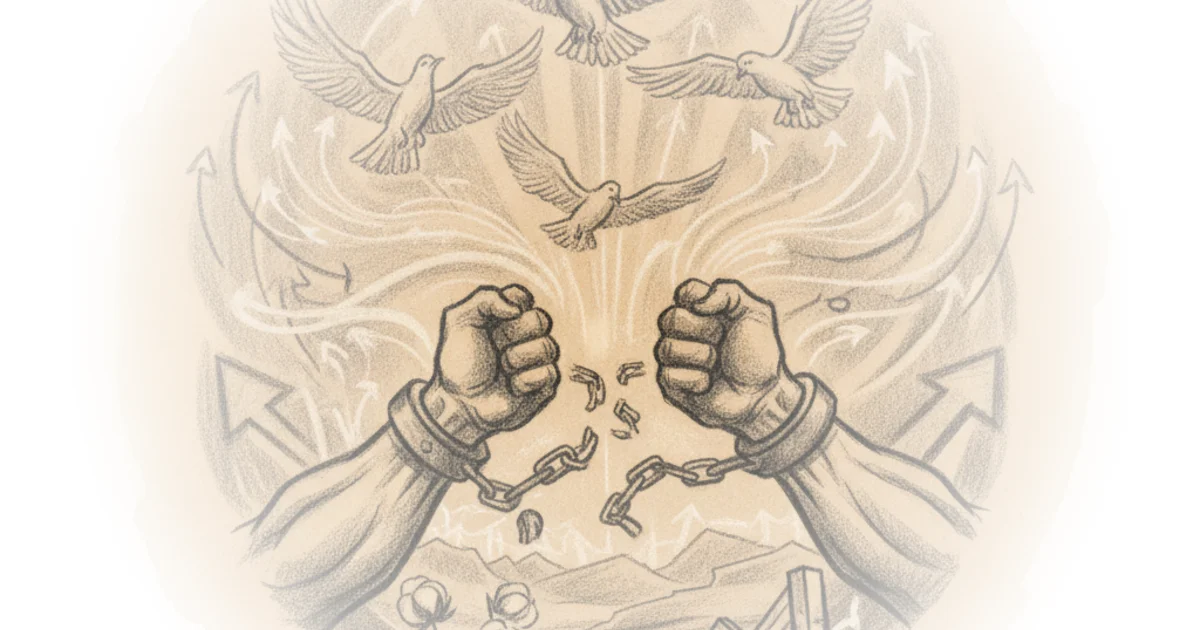
The author explains that Du Bois characterized the mass exodus of enslaved people from plantations not as a chaotic flight, but as a "general strike." By withdrawing their labor, roughly half a million people crippled the Confederate economy while simultaneously strengthening the Union war effort. Greene notes that this was not a passive waiting game; communities had spent generations building an information network known as the "grapevine telegraph" to coordinate these movements. He illustrates this with the story of Dabney, an enslaved man who became a scout for General Joseph Hooker, and his wife, who used coded laundry signals on clotheslines to reveal Confederate troop movements within the hour.
"Enslaved people were the architects of their own freedom. They turned a war to preserve the Union into the largest slave revolt in American history."
This evidence holds up against historical scrutiny, particularly when viewed alongside the concept of "Contraband" during the early war years. When enslaved people fled to Union lines, they forced the federal government to address slavery as a military necessity rather than a moral abstraction. Critics might argue that without the Union Army's ultimate victory, this self-emancipation would have remained localized and unsuccessful. However, Greene counters that the sheer scale of the labor withdrawal—depriving the South of food and cotton while adding 200,000 Black soldiers to the North's ranks—made the rebellion a decisive strategic factor, not just a moral one.
The Cost of Fighting for Freedom
The narrative deepens as Greene details the immense risks Black men took when they finally forced their way into the Union Army. He points out that despite early resistance and federal laws barring them from bearing arms, roughly 180,000 Black men served by war's end, with nearly 40,000 dying in combat. The stakes were uniquely lethal for these soldiers; as Greene writes, "The Confederacy resolved to enslave or execute captured Black troops," a policy brutally enacted at Fort Pillow in 1864 where surrendered Black Union men were massacred.
He highlights the bravery of the Louisiana Native Guards, a regiment led by Black officers like Captain André Cailloux, who died charging Confederate works months before the famous 54th Massachusetts assault. "Capture meant their death or re-enslavement, but they enlisted anyway," Greene observes, emphasizing that these men fought not for the benevolence of white leaders, but for their own survival and liberty. This section effectively humanizes the statistics, forcing the reader to confront the specific, heightened violence faced by Black soldiers who knew that surrender was often a death sentence.
"If Lincoln and the Union Army freed the slaves, the country corrected itself from the top down and Black Americans owe their freedom to the benevolence of Northern whites."
The author's use of historian Stephanie McCurry is particularly potent here. By noting that both Union and Confederate officials described the uprising as a "slave rebellion," Greene strips away the euphemisms often used in traditional textbooks. This reframing suggests that the war was not merely a political dispute between states, but a fundamental struggle over human property that exploded from within the South itself.
The Battle Over Memory
The commentary takes a sharp turn toward the present, connecting historical revisionism to current political maneuvers. Greene argues that the "Lost Cause" narrative—crafted by white Southerners immediately after the war to claim the Confederacy fought for states' rights rather than slavery—is being revived and codified into law. He points to recent executive actions directing federal agencies to purge "divisive, race-centered ideology" from exhibits and new state curriculum standards that suggest enslaved people developed skills for their "personal benefit."
"What gets taught in schools and shown in museums is how most people come to understand the war, which is exactly why these fights matter."
Greene posits that this erasure is not accidental but strategic. By teaching that freedom was a gift from white leaders, the current political climate implies that Black Americans owe their status to the "benevolence" of the state, rather than their own resistance. This mirrors the post-Reconstruction era when historians and organizations like the United Daughters of the Confederacy worked to cement the myth of loyal, contented enslaved people. The author's warning is clear: if we accept the top-down narrative of emancipation, we undermine the legitimacy of the ongoing struggle for racial justice.
Critics might suggest that focusing on the "revolt" aspect risks oversimplifying the complex legal and political maneuvering required to end slavery nationally. However, Greene's argument rests on the premise that without the pressure of the enslaved population's rebellion, the political will to abolish slavery would never have coalesced within the Union government. The evidence from Black Reconstruction supports this causal link: Lincoln's policies evolved only after the "general strike" made the status quo untenable.
Bottom Line
Kahlil Greene delivers a compelling, historically grounded argument that reframes Juneteenth not as a celebration of a presidential decree, but as a recognition of a successful mass uprising. The piece's greatest strength lies in its synthesis of Du Boisian theory with specific, human-scale examples of resistance, making the abstract concept of "self-emancipation" tangible and urgent. Its vulnerability is perhaps only in how it must confront the deep institutional inertia that continues to favor the "Lost Cause" narrative, a battle that Greene correctly identifies as far from over.