Fred Mills doesn't just report on a tunnel; he takes listeners on a visceral journey into the geological heart of the Alps to reveal how humanity is literally rewriting the map of Europe. What sets this coverage apart is the refusal to treat the Mont Cenis base tunnel as a distant statistic, instead grounding the $29 billion price tag in the sweat, explosives, and 10-meter concrete rings that define the daily reality of the site. For the busy professional, this is a rare look at how infrastructure actually gets built when the terrain refuses to cooperate.
The Geopolitical Necessity
Mills frames the project not merely as a construction feat but as an urgent correction to a centuries-old geographical bottleneck. He writes, "France and Italy are two of the largest economies on the planet... but despite that, moving people and goods between them isn't exactly straightforward." This observation lands hard because it exposes a critical inefficiency in the European Union's core: despite political integration, physical barriers still dictate economic flow. The author notes that currently, 92% of freight moves by truck, a statistic that underscores the environmental and logistical failure of the existing 19th-century rail lines.
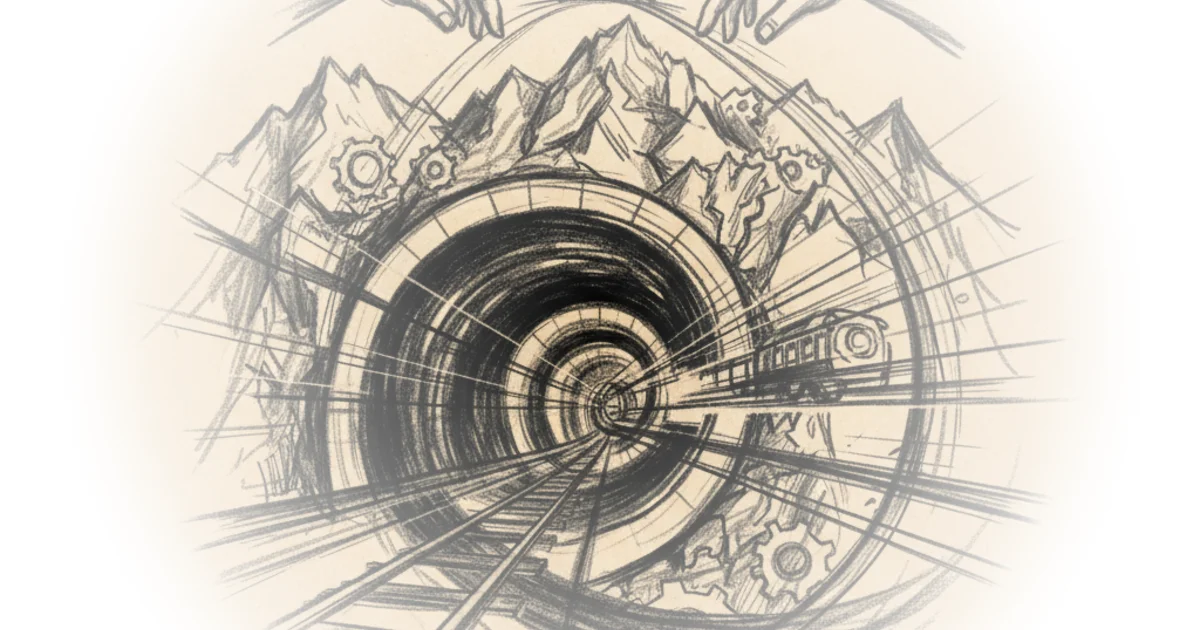
The argument for the new line is built on the promise of a "base tunnel," a technique that burrows through the mountain's foundation to keep tracks flat. Mills explains that this approach "enables faster trains and short journeys," slashing travel time between Lyon and Turin from nearly four hours to under two. This shift is framed as a catalyst for a massive modal shift, with the goal of taking "a million heavy vehicles off the road every year." Critics might note that such grand infrastructure projects often face delays and cost overruns that can erode their projected environmental benefits, but the sheer scale of the proposed CO2 reduction—equivalent to 400,000 homes—makes the risk calculation compelling.
"When you're burrowing through the heart of the mountain, it's easy to get caught up in the insane construction and overlook the voices of those who have unfortunately objected to it."
The Human and Mechanical Battle
The piece shines when Mills transitions from high-level policy to the gritty mechanics of excavation. He describes the "drill and blast" method used in fractured rock zones with a sense of confrontation: "You get to see your adversary. You get to see the rock in front of you, the mountain that you're battling." This personification of geology is effective; it transforms a technical process into a narrative of human endurance against nature. The author details the cycle of drilling, blasting, clearing rubble, and spraying shotcrete, noting that this old-fashioned technique is still necessary for the most treacherous sections.
Contrasting this is the deployment of Tunnel Boring Machines (TBMs), which Mills calls "giant mobile factories." He highlights the sheer magnitude of the machinery, describing the "Viviana" TBM as a 2,000-ton behemoth with a 10.4-meter diameter cutter head. The scale of the operation is further emphasized by the production of 100,000 concrete segments, each 50 centimeters thick, to line the tunnel. Mills points out that the machine is not just digging but also laying the tunnel's skin, a process that requires a synchronized team of 15 people. This section effectively demystifies the "black box" of modern engineering, showing that even with advanced robotics, the project remains a deeply human endeavor.
The Logistics of Water and Waste
A distinctive element of Mills' coverage is his attention to the environmental paradoxes of the build. He notes that water ingress, often seen as a problem, is actually welcomed by workers to suppress dust, a critical health and safety measure. "The water which is too much we pump... we recycle it and we reuse it on the front," he reports. This detail adds a layer of sophistication to the narrative, suggesting that the project's sustainability extends beyond the final product to the construction process itself. However, the author also acknowledges the tension between such massive industrial activity and the quiet valleys it traverses, hinting at the local opposition that often accompanies mega-projects.
"It's essentially like a giant mobile factory, which is why it requires an entire team to operate it."
Bottom Line
Mills' strongest asset is his ability to balance the awe of engineering with the practical realities of geology and logistics, making a complex infrastructure project feel immediate and tangible. The piece's biggest vulnerability lies in its optimistic timeline, as the sheer difficulty of the geology described suggests that the "few years" to completion could easily stretch much longer. Readers should watch for updates on the project's budget and timeline, as the gap between the vision of a seamless European corridor and the reality of drilling through the Alps remains the story's most critical variable.