Andrew Henry doesn't just decode the number 144,000; he dismantles the modern assumption that this group is a literal headcount of saved souls. By anchoring the interpretation in ancient Jewish war customs and magical protection rituals, he reveals a text that is far more concerned with ritual purity and cosmic warfare than with a future census. This is essential listening for anyone tired of the sensationalist prophecy fiction that dominates the conversation, offering instead a rigorous look at how John of Patmos borrowed from the very traditions he was trying to transcend.
The Architecture of a Symbol
Henry begins by grounding the reader in the mathematical symbolism that drives the Book of Revelation, noting that the number is not random but a deliberate construction. "That's 12 12 1,000," he explains, linking the figure to the concepts of wholeness and divine authority found in the twelve tribes of Israel and the twelve disciples. This framing is crucial because it immediately signals to the reader that the text operates on a symbolic logic rather than a literal one. The author effectively contrasts this with the number seven, which also appears constantly to represent perfection, but here the focus shifts to the specific structure of the twelve.
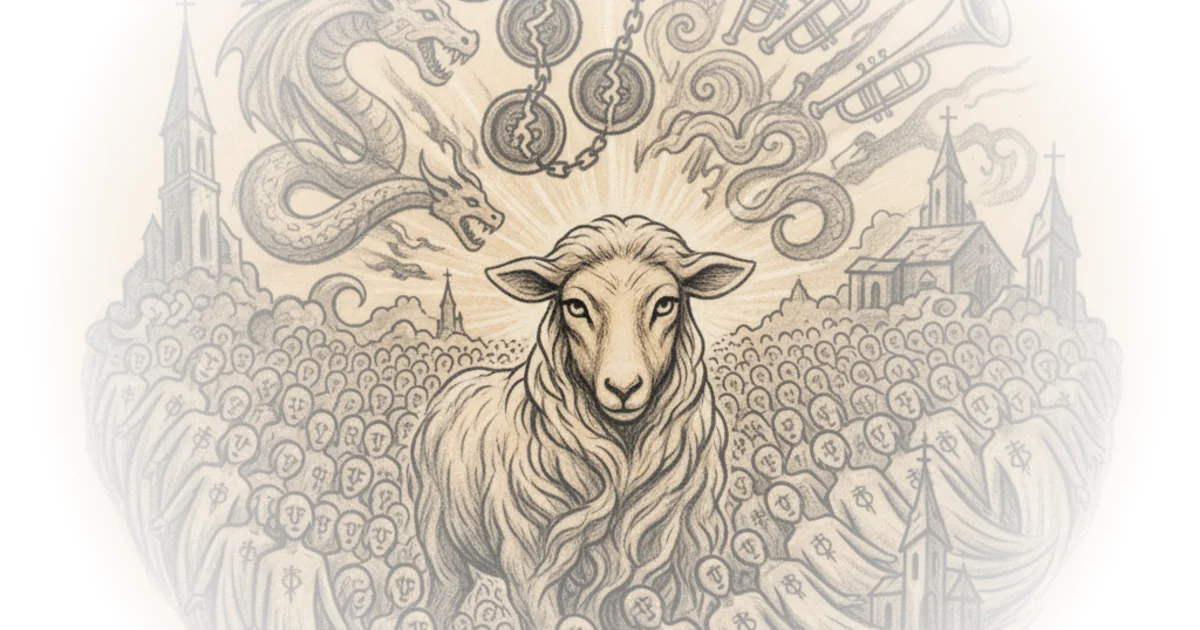
The core of Henry's argument rests on the function of the "seal" mentioned in the text. He writes, "Those seals also feature prominently in rituals involving supernatural protection." This is a vital distinction that many modern readers miss. Henry draws a direct line from the Hebrew Bible's book of Ezekiel, where a mark on the forehead saves the faithful from slaughter, to the Greco-Roman magical traditions where seals were used to ward off demons. "The idea of the protective power of seals shows up in Greek magical handbooks from Roman Egypt as well as apocalyptic texts," he notes. This contextualization transforms the 144,000 from a mysterious elite club into a group of spiritually armored soldiers.
The mark is apatropeic, which means it's meant to protect you from supernatural evil or harm in general.
Critics might argue that leaning so heavily on magical amulets and Jewish mysticism risks overshadowing the distinctly Christian Christology of the text. However, Henry's evidence that John was steeped in Jewish apocalyptic traditions suggests that ignoring these roots actually distorts the meaning more than embracing them.
The Counterfeit Economy
One of the most compelling sections of Henry's coverage is his analysis of the linguistic battle between the seal of God and the mark of the beast. He points out that the author of Revelation deliberately uses different Greek words to describe these markings. The 144,000 bear a sfragis, a term for a protective seal, while the followers of the beast receive a charagma, which Henry describes as "a word more commonly used for branding horses or an imperial stamp on a coin."
This linguistic precision is the piece's strongest analytical move. "Dr. Frankfurter sees this as an intentional parody, a false seal that mimics the real one but reverses its meaning and purpose," Henry writes. The implication is stark: the beast's mark is not a spiritual protection but a commercial and political branding that grants access to an economy of idolatry. By contrasting the sfragis with the charagma, Henry shows that the conflict in Revelation is not just about belief, but about economic and political allegiance. The 144,000 are set apart not just by faith, but by their refusal to participate in the beast's system.
The Warrior's Purity
Perhaps the most challenging aspect of the text for modern audiences is the description of the 144,000 as virgins who "have not defiled themselves with women." Henry tackles this head-on, rejecting the idea that this is merely about sexual asceticism. Instead, he connects it to the ancient laws of war found in Deuteronomy and the Dead Sea Scrolls. "In this worldview, celibacy was not about personal piety or aestheticism. It was a practical requirement for joining the ranks of God's army," he argues.
He draws a fascinating parallel to the War Scroll, an apocalyptic document that also ties sexual abstinence to military readiness. "One passage instructs that soldiers must refrain from sex while on campaign and no man shall go down with them on the day of battle who is impure because of his folly," Henry paraphrases, noting the ancient belief that "angels shall be with their hosts." This reframes the celibacy not as a rejection of marriage, but as a temporary, tactical state of ritual purity required for a cosmic battle. It is a radical re-reading that strips away the Victorian-era moralizing and replaces it with the gritty reality of ancient holy war.
The 144,000 are symbolic warriors, ritually pure and tribally organized.
Some might find the connection to the myth of the Watchers in the book of Enoch—where angels corrupt the earth through sexual union—to be a stretch. Yet, Henry's suggestion that the 144,000 are depicted as having an "angelic nature" helps explain why their purity is so strictly guarded against contact with women. It elevates the group from mere humans to a celestial fighting force.
A Jewish Text with a Heavenly Christ
Finally, Henry challenges the assumption that Revelation is a purely Christian document that has simply adopted Jewish imagery. He posits that the text is fundamentally Jewish in its framework. "We should not look at Revelation as a Christian text with Jewish attributes, but rather as a Jewish text that reveals a heavenly Christ," he asserts. This is a provocative claim that reshapes how we understand the author's intent.
He contrasts John's strict adherence to dietary laws and ritual purity with the Apostle Paul's more lenient approach, suggesting that John and Paul would have been theological opponents. "John's view of the end times also revolves around the restoration of the tribes of Israel," Henry writes, linking the vision to Ezekiel's prophecy of reunification. By emphasizing the tribal breakdown and the specific number of 12,000 from each tribe, Henry argues that the 144,000 likely represent a faithful Jewish remnant, a view held by early church fathers like Victorinus and Oecumenius.
Personally, I don't think John of Patmos and Paul would have gotten along.
This section is the most daring of the commentary, as it forces a re-evaluation of the New Testament's internal diversity. While it may unsettle readers who view the early church as a monolith, the evidence Henry presents regarding John's priestly traditions and his harsh criticism of those eating idol meat is difficult to dismiss.
Bottom Line
Andrew Henry's analysis succeeds by stripping away centuries of literalist speculation to reveal the text's original, gritty context as a manual for spiritual warfare rooted in Jewish apocalypticism. The argument's greatest strength is its linguistic precision regarding the seal versus the brand, but its vulnerability lies in potentially over-correcting toward a Jewish identity that might alienate the text's early Christian audience. Readers should watch for how this historical grounding changes their understanding of modern prophetic movements that still rely on literal interpretations of these numbers. "