Stuart Buck dismantles the modern assumption that universities were always the engines of innovation, revealing instead a centuries-long evolution where research was often an accidental byproduct of teaching or a state-driven necessity. This historical excavation is vital for anyone trying to understand why today's higher education system feels so bloated and misaligned with its original vocational purposes. Buck argues that the "research university" is not a natural law but a specific, relatively recent political invention that fused the state's military and economic needs with the academy's intellectual pursuits.
The Medieval Bundle
Buck begins by stripping away the romanticized view of the medieval university, describing it not as a temple of pure science but as a pragmatic guild for the clergy and nobility. He notes that the business model was simple: "donations paid for the original structures, and then students paid instructors directly." The curriculum was a strange mix of vocational training, moral instruction, and abstract inquiry, where a question about theology was considered just as legitimate as one about physics. Buck writes, "How many angels can dance on the head of a pin? was as legitimate a research question as 'why does light create a rainbow when it goes through a prism?'." This framing is crucial because it highlights that the pursuit of knowledge for its own sake has always been the primary incentive, often at the expense of practical application.
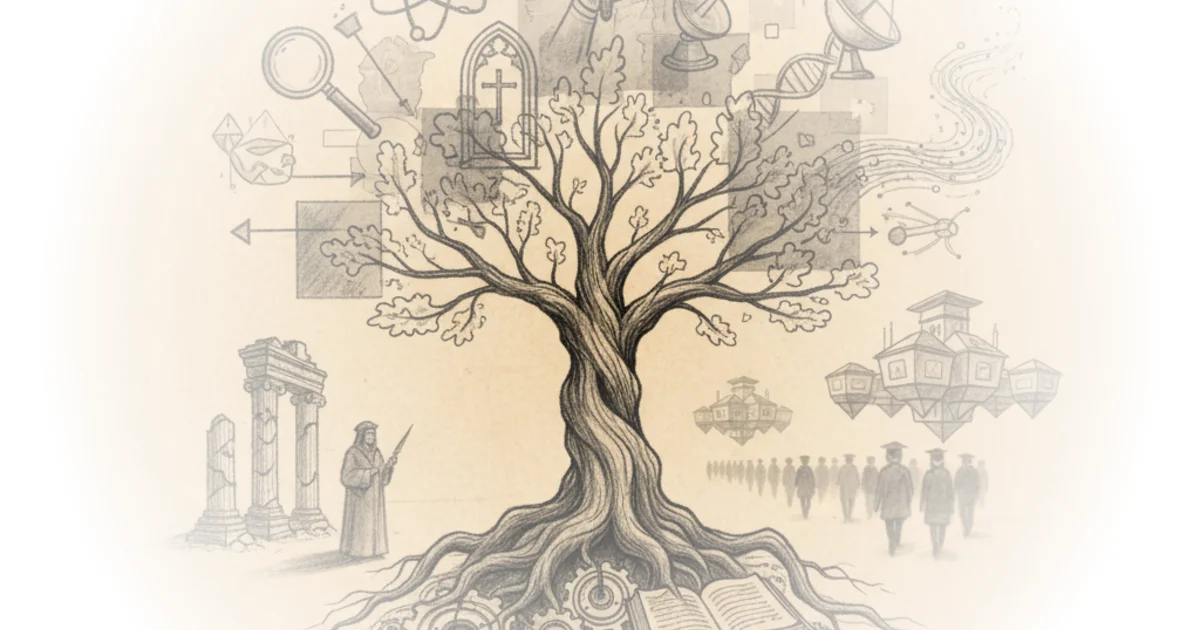
The author points out that the drive to be the first to discover an idea created a culture of secrecy and status-seeking that persists today. "The centrality of ideas and philosophical roots created another strong thread that we will see later: the deep importance of who came up with an idea first," Buck observes. This historical context explains why modern academia is so obsessed with publication priority rather than the speed of implementation. Critics might argue that this focus on "pure ideas" was actually a strength, allowing for the theoretical breakthroughs that eventually enabled practical science, but Buck suggests it also created a disconnect between the academy and the real world that has been hard to close.
The result of this setup was that professors were incentivized to teach well enough to get paid and create ideas that impress other professors.
The State's New Tool
The narrative shifts dramatically in the 19th century, where Buck details how the university was repurposed from a church institution into an arm of the state. As nation-states formed, they needed a legion of competent administrators and a workforce capable of driving industrial and military power. Buck explains that "Countries noticed that there was already an institution set up to train people with the skills that administrators and bureaucrats needed." This was a strategic pivot; the state co-opted the university to serve its own survival and expansion, fundamentally altering the institution's mission.
Buck highlights the Prussian model as the turning point, where Alexander von Humboldt argued that universities should not just transmit knowledge but create it. The victory of Prussia over France in 1871 was widely attributed to this superior education system. Buck writes, "Superior technology that was downstream of university research was another key component of the Prussian victory — from breech-loading steel cannons enabled by metallurgy research to telegraphs improved by developments in electromagnetism." This is a powerful argument: the modern research university was born out of military necessity and geopolitical competition, not a sudden love of science.
However, Buck also notes the irony that even as research became central, the actual creation of technology often happened outside the university walls. "The role of the university's research with respect to technology was to figure out underlying principles and train research as inputs to industrial research done by companies and other organizations," he clarifies. This distinction is often lost in modern discourse, where universities are expected to be both the theoretical lab and the commercial incubator, a dual role that strains their resources and focus.
The American Adaptation
The United States followed this European trajectory, transforming its colleges into research universities to meet the demands of a growing industrial economy. Buck traces how institutions like Harvard and Princeton shifted from training clergy to granting doctorates and conducting research. The creation of land-grant colleges was a specific response to the need for agricultural and industrial productivity. "Congress passed legislation that created the land grant colleges in 1862," Buck notes, emphasizing that these schools were explicitly chartered to use science to aid industry.
Yet, the adoption of the German model came with a trade-off. The tight coupling between the university and the state meant that funding and direction were increasingly dictated by political and economic goals. Buck observes that "Universities and the State became tightly coupled: previously curriculum and doctrine was set by the Church or individual schools — under the new system the state was heavily involved in the internals of universities." This historical entanglement explains the current tension between academic freedom and the demands of government funding agencies. A counterargument worth considering is that this state involvement was essential for democratizing access to higher education and driving the massive economic growth of the 20th century, even if it compromised some of the university's independence.
Professors being in a role that is notionally about teaching but instead spending most of their energy doing research instead and being terrible teachers is a tradition that continues to this day.
Bottom Line
Stuart Buck's historical analysis successfully reframes the modern university not as a timeless institution of learning, but as a flexible tool that has been reshaped by the needs of the church, the state, and the military. The strongest part of his argument is the revelation that the "research university" is a political construct designed for national power, which helps explain why it often struggles to serve the broader public good. The biggest vulnerability in this framing is the potential underestimation of how the pursuit of pure knowledge, even when disconnected from immediate utility, has historically driven the most profound technological leaps. Readers should watch for how current policy debates about university funding and mission might be repeating the 19th-century mistake of forcing a single model to serve too many conflicting masters.