Fred Mills doesn't just recount a structural failure; he exposes how political desperation and financial incentives can override the immutable laws of physics. While many reports focus on the engineering specs of the Ituango Dam, Mills anchors the disaster in the human and historical context of Colombia's most violent region, arguing that the dam was never just a power plant—it was a geopolitical gamble that went catastrophically wrong.
The Weight of History
Mills begins by establishing the sheer scale of the ambition before revealing the fragility of the foundation. He notes that the project was "Central to Colombia's ambitions to become energy independent and part of its massive infrastructure building boom." This framing is crucial because it explains why the stakes were so high. The author details a population boom that added the equivalent of Australia's entire population to Colombia in just a few decades, creating a desperate need for power that the aging grid could not meet.
The narrative takes a darker turn as Mills connects the construction site to the region's bloody past. He writes, "The dam's reservoir is thought to cover dozens of mass graves," citing estimates of thousands of murders and forced disappearances in the area between 1990 and 2016. This is not merely background color; it is the core of the tragedy. The government marketed the dam as a path to peace, yet the construction process was marred by corruption and rushed timelines. Mills points out that the project was "marketed by the government as a step forward from that violence," a claim that rings hollow when the site itself is built over a graveyard. Critics might argue that infrastructure development inevitably displaces communities and disrupts history, but Mills effectively demonstrates that in this case, the political urgency to "bring peace and prosperity" blinded engineers to the very real risks of building on such unstable ground.
Engineering Under Pressure
The technical heart of the commentary lies in how the dam was built. Mills explains that the geography of the central Andes left engineers with only one option: "They had to dig tunnels through the mountains." Unlike modern projects that might use massive tunnel boring machines, the sheer constraints of the canyon meant workers had to rely on "the old-fashioned way with explosives." This decision, combined with the region's geological volatility, set the stage for disaster.
As the project fell behind schedule, the pressure to perform became the primary driver of decision-making. Mills highlights a critical moment where financial incentives overrode safety protocols: "EPM had an array of financial incentives to keep production schedule. They were set to receive $22.3 million US if the project began to deliver energy as promised before December." The author argues that the company "would have begun to lose credit standing if the profits weren't realized," creating a perfect storm where speed was valued over structural integrity. The result was a "drill and blast" technique applied to "highly fractured rock" without sufficient time for the ground to settle.
Money and political pressure can't be substitutes for rigorous engineering practice.
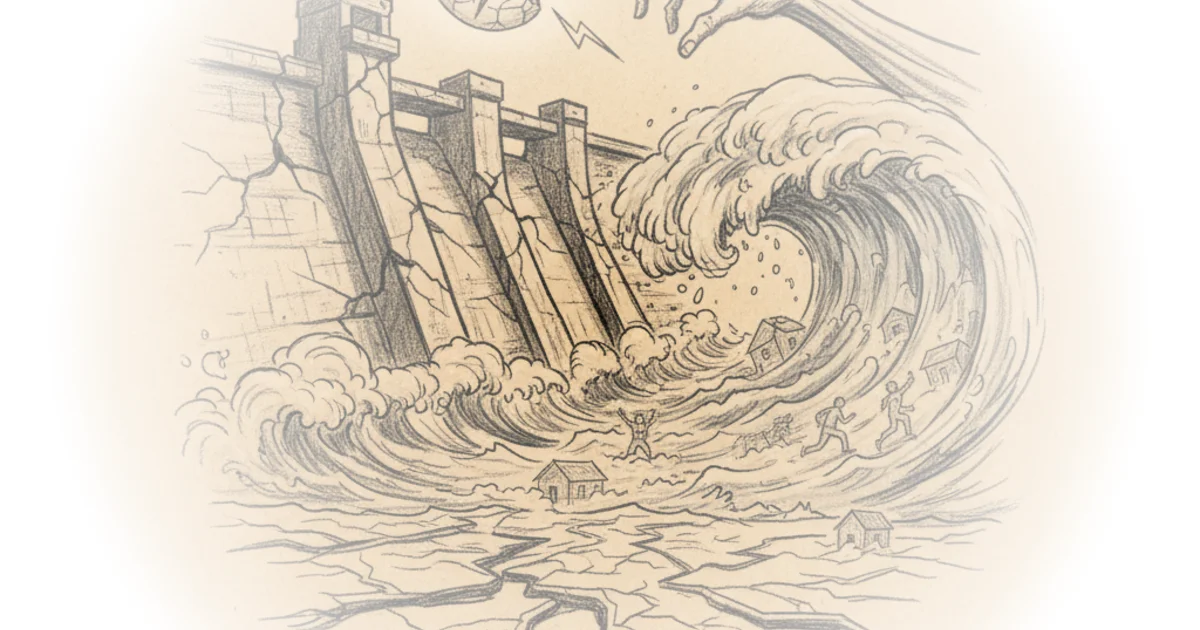
This sentence serves as the moral and technical thesis of the piece. When the diversion tunnels collapsed in 2018, it wasn't because the technology was unknown, but because the "groundwater had softened the rock, meaning it couldn't hold as much weight as it should have done." The river, no longer diverted, turned the tunnel into a "pressurized cavity" that simply gave way. Mills describes the frantic response where engineers had to "rapidly increase the height of the dam in the space of just a matter of weeks" and use an untested spillway. This section is compelling because it strips away the mystique of modern engineering, revealing a desperate scramble to contain a force of nature that was allowed to grow too large, too fast.
The Human Cost
The final layer of Mills' coverage focuses on the immediate and long-term human toll. The collapse forced the evacuation of 25,000 people, turning Puerto Valdivia into a "ghost town" where "more than 400 families were now homeless." Mills emphasizes that this was not an ancient structure failing, but a "brand new" project that was "just a few weeks before it was due to be complete." This irony underscores the central failure: the very thing designed to secure the future nearly destroyed the present.
The author notes that the river supports "one of the richest farming regions in Latin America," including the sugarcane and coffee industries that are vital to Colombia's economy. The dam was supposed to tame the river's floods, but instead, its failure threatened the "food security for millions." While the project is now being salvaged with new tunnels and a target completion of 2027, the social fabric of the region remains torn. Mills concludes that "local communities were not properly consulted either, and environmental impact reports failed to take into account the enormous risk and cost to human life." This oversight suggests that the disaster was not just a technical miscalculation, but a systemic failure of governance.
Bottom Line
Fred Mills delivers a masterclass in connecting engineering failure to social consequence, proving that the most dangerous variable in any infrastructure project is not the geology, but the human pressure to finish on time. The piece's greatest strength is its refusal to treat the dam as an isolated technical event, instead weaving a narrative where corruption, violence, and desperation converge. The biggest vulnerability in the argument is a slight lack of detail on the specific geological studies that were ignored, which would have strengthened the case against the engineering team, but the overall verdict remains clear: when you rush a mountain, the mountain wins.