Then & Now makes a startling claim: the most volatile political battles of our time aren't fought in legislatures or courtrooms, but in the quiet space where a viewer feels a tear while watching a fictional character on a screen. By tracing the roots of modern polarization back to 18th-century German philosophy, the piece argues that we have dangerously separated the rational machinery of the state from the emotional engine of culture, a split that fuels today's most intractable conflicts.
The Rational Trap
The commentary begins by dismantling the modern assumption that politics is purely about economics, laws, and taxes. Then & Now writes, "Culture politics and our own psychological lives are inseparably intertwined." This is a crucial reframing for busy readers who often dismiss "culture war" issues as distractions from "real" policy. The author suggests that these debates are actually about how we relate to one another on a fundamental level, far deeper than simple political maneuvering.
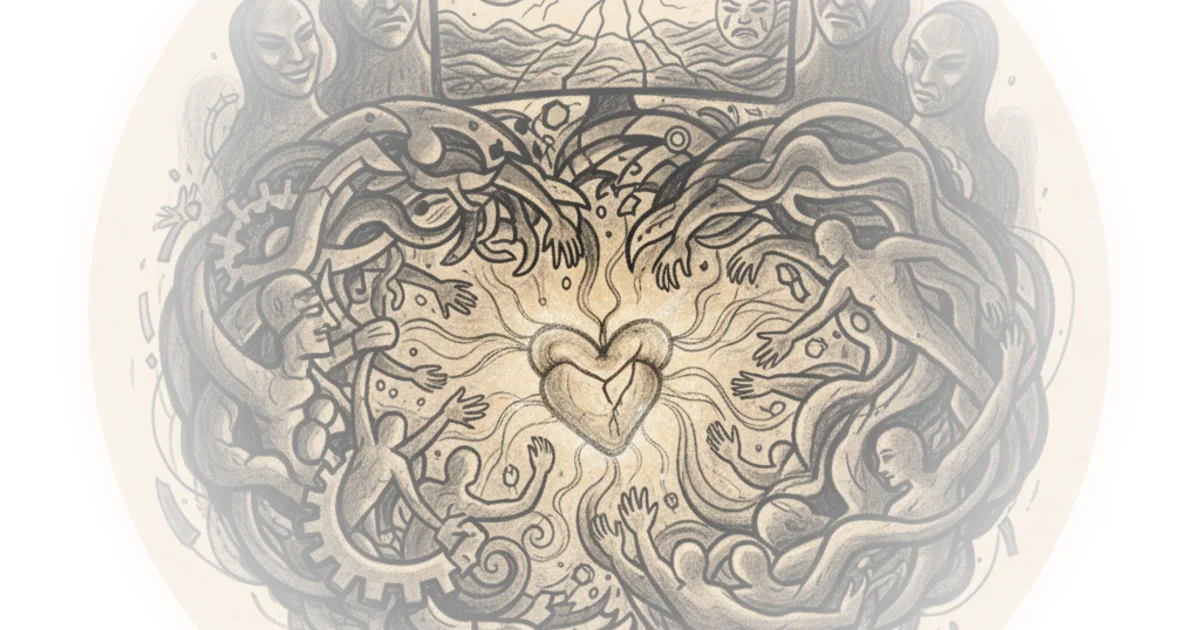
The piece identifies a specific grievance driving current tensions: the feeling that major institutions like Hollywood, universities, and the media have been captured by a specific ideological mindset. Then & Now notes that "Andrew Breitbart was right when he said that politics is Downstream from culture." This attribution is effective because it validates the conservative complaint without endorsing the personality cult often surrounding it, focusing instead on the structural reality that values are established in art and stories before they become law. The argument holds weight because it explains why policy debates often feel so emotionally charged; they are clashes of competing cultural narratives, not just data points.
Politics and the Arts are not separate. We make political decisions based not on one or the other but on a strange mix of both.
The Schiller Solution
To explain how we got here, Then & Now pivots to a historical deep dive, introducing Friedrich Schiller, a German writer whose work predates the French Revolution. The author argues that the Enlightenment's attempt to divide the world into a "rationalist world" and an "emotional one" created a fracture in modern life. We have the "white-coated rational scientist" and the "passionate songwriter," but in reality, these realms always collide. Then & Now writes, "The rational politician relies on Poetic rhetoric and impassioned speeches... artists have to rely on the bureaucracies of universities or things like record labels."
The piece uses Schiller's reaction to the French Revolution to illustrate the danger of this split. When the revolution turned violent, Schiller lamented that it was "a moment of prodigal opportunity met with a generation unprepared to receive it." The author paraphrases Schiller's insight: the revolution failed because it unleashed violent impulses without first cultivating the moral character necessary to sustain freedom. This is a powerful lens for viewing modern instability; it suggests that institutional change without cultural preparation leads to chaos.
Then & Now explains Schiller's concept of Bildung, or moral education, which he believed could be achieved through art. The core argument is that "it's through beauty that one progresses towards freedom." In a world where the division of labor separates us into isolated roles, art offers a way to reunite our fragmented selves. Then & Now writes, "In Beauty the separation between emotion and reason between sympathy and logic between science and art can be reunited." This is the piece's most distinctive contribution: it posits that aesthetic experience is not a luxury, but a political necessity for maintaining a free society.
Critics might note that this romantic view of art risks overestimating the unifying power of beauty in a deeply polarized society where different groups literally cannot agree on what is "beautiful" or "noble." However, the author's focus on the mechanism of feeling—how art allows us to practice empathy for strangers—remains compelling.
The Unacknowledged Legislators
The commentary concludes by connecting Schiller's 18th-century philosophy to the modern concept of the "imagined community." Then & Now argues that we relate to people we will never meet not just through laws, but through shared cultural stories. "Artists of all types are engaged in the practice of creating these new moral Horizons," the author writes, quoting Percy Shelley's famous line that poets are the "unacknowledged legislators of the world."
The piece acknowledges that while conservatives often dominate the headlines during culture wars, history suggests that "liberals have always won them because at their heart they're usually about Toleration." Then & Now points to the artistic endeavors attached to civil rights and women's suffrage as evidence that "there are clear and memorable works of artistic Endeavor attached to them." This reframes the culture war not as a battle to be won by one side, but as an ongoing negotiation of the moral horizons that define our collective life.
We don't just relate to this unknown other politically... but we also relate to them culturally through television shows music and film.
Bottom Line
Then & Now's strongest move is resurrecting Friedrich Schiller to explain why the "culture war" is actually a war over the psychological foundations of freedom, not just a squabble over values. The piece's biggest vulnerability is its idealistic assumption that beauty can naturally heal political fractures in an era where algorithms actively weaponize division. Readers should watch for how this framework applies to the next major flashpoint: if the argument holds, the most significant political shifts won't come from a new law, but from a new story that changes how we feel about our neighbors.