Noah Smith delivers a startling diagnosis for a profession in existential crisis: the very concept of the "heroic genius" in mathematics is becoming an obsolete relic, not because human intellect is failing, but because the collective intelligence of the machine has finally outpaced the individual bottleneck. While the news cycle fixates on the specific breakthroughs of OpenAI's new model, Astra, Smith reframes the event as a fundamental shift in how humanity processes truth, arguing that the era of the solitary solver is ending not with a whimper, but with a spiritual reckoning for those who built their identities on being the indispensable ones.
The End of the Solitary Genius
Smith anchors his argument in the raw, visceral reaction of the mathematical community to recent AI achievements. He highlights the despair of mathematician Kirwin Hampshire, whose public breakdown serves as the emotional core of the piece. "I am suffering a profound spiritual crisis due to these developments," Hampshire writes, describing a feeling of living inside a nightmare where the magic of discovery is evaporating. Smith uses this extreme reaction to illustrate a deeper truth: the identity of the mathematician was inextricably linked to the ability to solve problems that no one else could.
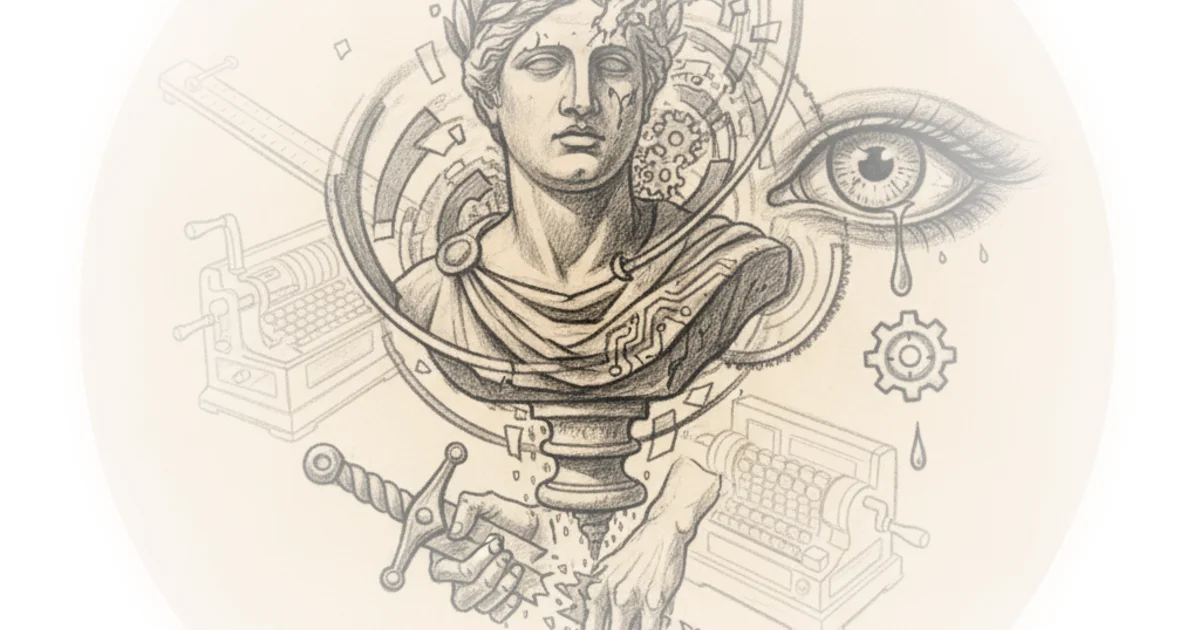
The author suggests that this despair stems from a loss of purpose rather than a loss of utility. "The story of human discovery and the triumph of the human spirit will soon be excised from this discipline," Hampshire warns, fearing that prompting a proof will become as "auraless as ordering doordash." Smith acknowledges the validity of this grief but challenges the underlying assumption that the "heroic leap" was ever the primary engine of progress. He argues that we have long romanticized the individual genius, ignoring the reality that "most of what we did was always a collective enterprise."
The story of human discovery and the triumph of the human spirit will soon be excised from this discipline.
Smith posits that the "hero" was a necessary fiction born of technological limitation. In a world where information had to pass through a single human brain to be understood and communicated, the person who could hold the most complex idea was a hero. But that bottleneck is gone. The shift is not merely about automation; it is about the architecture of knowledge itself. Smith notes that even skeptics like Daniel Litt, who once bet against AI's potential in frontier math, have conceded the point, admitting that the models may not yet be perfect but that "I also expect this is a matter of (not too much) time."
The New World-Mind
The core of Smith's analysis is a reframing of Artificial Intelligence not as a replacement for workers, but as a new "world-mind." He draws a parallel to the concept of edge computing, where individual nodes (humans) gather data and report back to a central processor. Historically, that central processor was society itself—a slow, messy network of universities and corporations. Now, AI is becoming that central clearinghouse.
Smith writes, "AI is really a new world-mind — a technology that takes the accumulated findings of individual humans... and integrates them into a general picture of the world." This analogy is powerful because it demystifies the AI's capabilities; it is not magic, but an aggregation of human effort at a scale no single brain could manage. He compares this transition to the shift in financial markets after the 2008 crash, where trading moved from over-the-counter deals between people to central clearinghouses. The human element didn't vanish, but the mechanism of coordination changed fundamentally.
In this new paradigm, the "heroic" individual is no longer needed to bridge the gap between data and theory. Smith argues that the information bottlenecks that once required a Newton or a Perelman to widen have been removed. "Unlike human society, AI doesn't need heroic human geniuses," he observes, noting that its ability to understand complex ideas is no longer limited by the capacity of a single human brain to apprehend them.
Critics might argue that this view underestimates the role of human intuition in defining which problems are worth solving, a nuance that AI might struggle to replicate without human guidance. However, Smith counters that the role of the human is shifting, not disappearing. We remain the "edge compute," the sensors that gather unique, real-world data and feed it back to the system. "For most people — even most scientists — this is basically the same thing they were doing before, except instead of a group of their colleagues at a seminar, they'll be reporting their findings to AI."
A Golden Age for the Rest, a Crisis for the Few
The piece concludes with a bifurcated outlook: a golden age for scientists who use math as a tool, and a crisis of identity for those who use it as a trophy. Smith cites economist Przemek Chojecki, who views the development as "the best time ever" for science, predicting that AI will boost progress "100x." For researchers in fields like economics or biology, math was often a burden, a "wracking of brains" that slowed down empirical discovery. Now, that burden is lifted.
For most people, math was always a burden, like stamping metal or drilling holes. Now that burden has been alleviated by machines.
However, for the pure mathematicians whose joy came from the struggle itself, the outlook is bleak. Smith quotes Fields Medalist Jacob Tsimerman, who recently joined OpenAI, to highlight the distinction between doing math for truth and doing it for the challenge. "I enjoy the challenge, the process, resolving confusions, finding strategies, grappling with problems," Tsimerman admits. Smith points out that if the challenge is removed, the motivation for many to continue their work may vanish. "If that disappears, that is not a trivial issue and many of them might not want to do it anymore."
Smith ultimately argues that the profession will not die, but it will have to evolve. He notes that academic mathematicians are incredibly cheap relative to the economy, making a mass layoff unlikely. Instead, the profession will shift from being the "indispensable solvers" to being the curators and teachers of a new, machine-augmented reality. The "age of heroes" is over, but the age of exploration, aided by unfathomably powerful machines, is just beginning.
Bottom Line
Smith's most compelling insight is that the anxiety surrounding AI in mathematics is not about the loss of jobs, but the loss of a specific kind of human mythology—the belief that a single mind can stand apart from the collective and solve the unsolvable. The argument's greatest strength is its refusal to panic, instead offering a structural explanation for the emotional turmoil: the "hero" was a function of the bottleneck, and the bottleneck is gone. The vulnerability lies in whether the new "edge compute" role can sustain the same level of intellectual passion for those who have spent their lives chasing the solitary thrill of the breakthrough. The world is moving toward a future where the machine does the heavy lifting of theory, and humanity must find new sources of meaning in the data it provides.