Rafael Holmberg delivers a startling reframing of our collective anxiety, arguing that the true horror of our current moment isn't the approaching disaster, but the realization that we are already living inside the aftermath. By dissecting David Cronenberg's The Fly alongside the original 1957 short story, Holmberg exposes a dangerous ideological trap: the way we obsess over the "end of times" actually serves to prolong the very systems destroying us.
The Desire for the End
Holmberg begins by distinguishing between two cinematic versions of catastrophe. In the 1986 film, the protagonist Seth Brundle watches his mutation unfold in real-time. This, Holmberg argues, represents a "pragmatist's ideal version of the end" because it is calculable and inevitable. He writes, "Seth Brundle's gradual mutation is a certain march towards an unrecoverable catastrophe." The film allows us to fetishize the destruction, turning a biological nightmare into a source of compulsive enjoyment. This mirrors our current relationship with climate change and geopolitical collapse; we watch the data rise and the order dissolve, yet we remain paralyzed by a strange, self-destructive fascination.
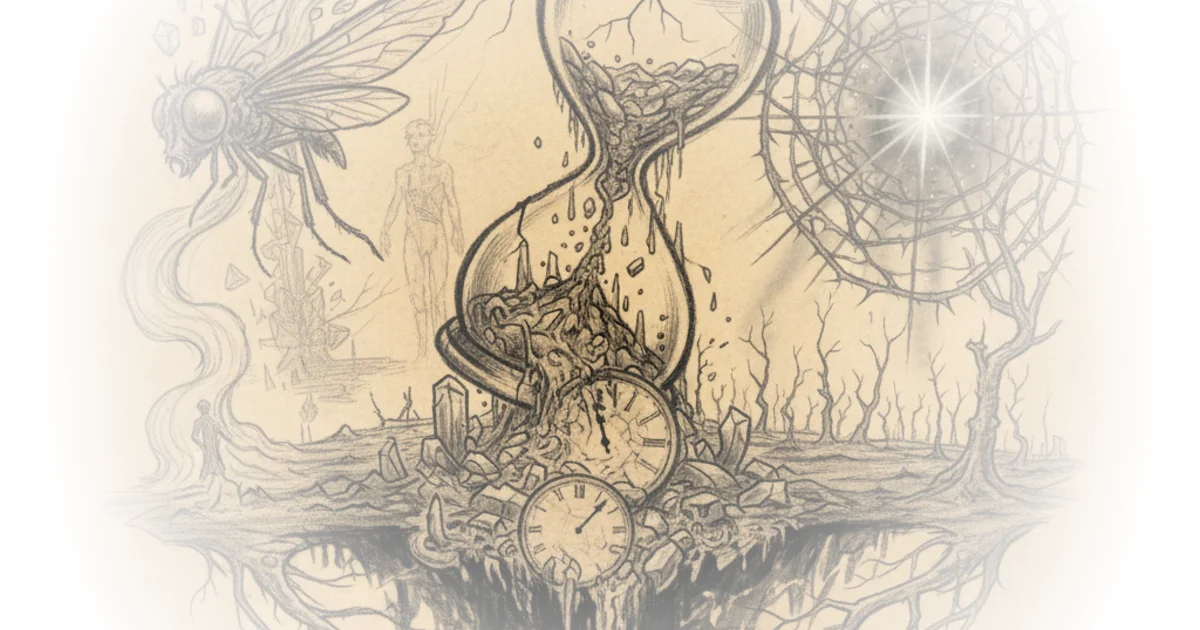
The author connects this to the Freudian concept of the death drive, suggesting that our engagement with disaster is not just fear, but a form of enjoyment. "It is not enough to claim that ideology functions by disavowing, for example, the climate disaster," Holmberg writes. "Instead, an element of self-destructive enjoyment, of a desire that acts against itself, must be introduced." This is a provocative claim. It suggests that our doom-scrolling and apocalyptic speculation are not acts of resistance, but symptoms of a system that feeds on our anxiety. Critics might argue that this psychologizes structural failures, potentially letting powerful actors off the hook for their role in engineering these crises. However, Holmberg's point remains sharp: our emotional response to the end is complicit in its continuation.
The End that Precedes Itself
Shifting to the original short story, Holmberg identifies a second, more disorienting form of the end. In Langelaan's version, the scientist is already dead and transformed before the narrative begins. The story becomes a retrospective reconstruction of a catastrophe that has already occurred. "The catastrophe itself is an initially empty enigma," Holmberg notes. He draws parallels to Nevil Shute's On the Beach, where the nuclear war has already happened, and the characters are merely waiting for the fallout to reach them. The question is no longer "when" but "what exactly took place."
This framing forces a confrontation with the reality that the "end" is not a future event, but a present condition we are struggling to recognize. "The fatal insight is mutated from a compulsive drive towards an absolute limit-point, into a guessing-game from beyond the grave," Holmberg writes. He argues that we are currently in this phase with ecological collapse; the damage is done, yet we act as if we are still in the prevention stage. "The true problem is of retroactively constructing a collective narrative which allows us to recognise that we are already living the end." This is a crucial distinction for policymakers and the public alike. If we treat climate change as a future threat to be averted, we miss the reality that we are already navigating the consequences of irreversible shifts.
The end of things as they are today is the very thing which at the same time indefinitely prolongs today.
The End as Asymptotic Continuity
Finally, Holmberg introduces a third, perhaps most damning, form of the end: the asymptotic approach. Here, the idea of the end is used to justify the continuation of the current system. He points to the Doomsday Clock, maintained by the Bulletin of the Atomic Scientists, as the perfect example of this mechanism. "Each year, 'experts' from The Bulletin of the Atomic Scientists' Science and Security Board gather to decide on how far from 'midnight', or the end, we currently are," he observes. The irony, he notes, is that this clock is managed by the very global order it claims to warn against.
Holmberg argues that capitalism has mastered the art of commodifying its own demise. "Whatever this end is that we so easily speak of, it is an End not external to, but internally thinkable by, today's global market." By constantly moving the clock back or forward, the system creates a perpetual state of emergency that never actually resolves. This creates a "perpetual sliding towards an end that is kept present and articulated by the very fact that it cannot be reached." The author suggests that this mechanism is not accidental but structural. "In order for a political structure to continue, it must furnish the notion of its own end." The constant threat of collapse becomes the engine that drives the status quo forward.
Bottom Line
Rafael Holmberg's most potent contribution is the argument that our obsession with the apocalypse is a feature, not a bug, of the current global order. The strongest part of this analysis is the exposure of how the "end" is commodified to maintain continuity, turning our fear into a tool for the very systems causing the crisis. The argument's vulnerability lies in its heavy reliance on psychoanalytic theory, which may feel abstract to readers seeking concrete policy solutions. However, the piece succeeds in shifting the focus from the event of the end to the ideology that sustains it, urging us to stop waiting for the catastrophe and start recognizing the one we are already in.