A Raid, Not a Strategy
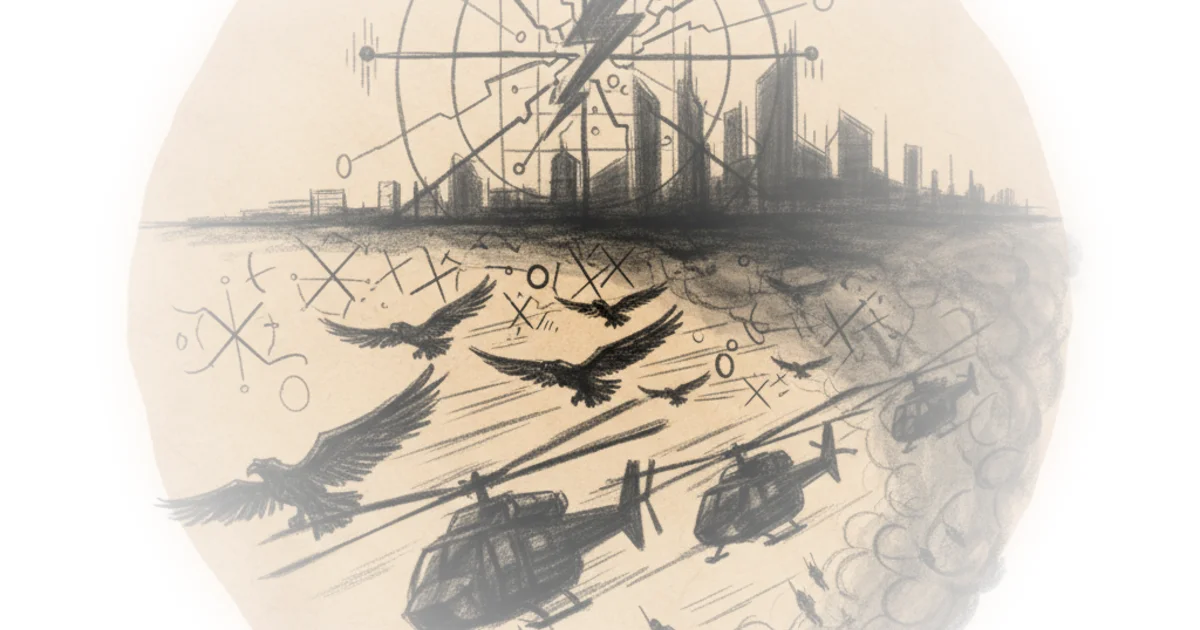
The abduction of Nicolas Maduro from a military compound in Caracas represents the kind of operation the United States military excels at: precise, dramatic, and tactically flawless. Delta Force operators breached a fortified complex, extracted a sitting head of state, and had him on a Navy vessel within hours. As a feat of special operations, it is difficult to fault. As a piece of foreign policy, it raises questions that the Trump administration appears uninterested in answering.
The article frames Operation Absolute Resolve as the inaugural act of what analysts have dubbed the "Dandro Doctrine," a muscular revival of the Monroe Doctrine that goes beyond deterring foreign powers to asserting an American right to remove leaders deemed hostile. Trump himself drew the parallel to Theodore Roosevelt, casting the United States as a regional enforcer wielding a big stick. The historical echo is deliberate, and it is not flattering. Roosevelt's interventionism left a legacy of resentment across Latin America that took decades to partially repair.
The Day After Problem
The most striking element of the analysis is not the operation itself but what comes next, or rather, the apparent absence of a plan for what comes next. The article notes that Trump rejected the democratic opposition leader Maria Corina Machado as a transitional figure, calling her "too weak," while simultaneously floating Maduro's own vice president, Delcy Rodriguez, as a possible successor. This is a remarkable admission. The United States removed a dictator and immediately began negotiating with his deputies.
Trump rejected a proposal floated by parts of his own administration that Venezuela should be led during a transitional period by Maria Corina Machado, the leader of the Democratic opposition and a Nobel Peace Prize laureate. Speaking bluntly to reporters, Trump said Machado was too weak and lacked real support inside the country.
The suggestion that Rodriguez may have been aware of the operation in advance, possibly with the knowledge of Venezuela's entire ruling elite, paints a picture not of liberation but of a palace coup facilitated by American helicopters. If the same power structure remains intact minus one man at the top, the word "democratization" becomes difficult to use with a straight face.
The Oil Arithmetic Does Not Add Up
Trump has spoken grandly about rebuilding Venezuela's oil industry with American investment. The numbers tell a different story. Venezuela's production has collapsed from three million barrels per day to roughly 900,000, and the vast majority of its reserves consist of ultra-heavy crude that requires specialized infrastructure and imported diluents to extract.
Analysts at Rystad Energy estimate that restoring production to 3 million barrels per day would require roughly $110 billion in investment. And that figure covers upstream exploration and production alone. It is a staggering sum, roughly equivalent to what all US oil majors invested globally in 2024 combined.
Even under optimistic projections, reaching peak production would take close to nine years. American oil companies have reason to be cautious: ExxonMobil and ConocoPhillips both had assets nationalized under Hugo Chavez. Only Chevron, operating under a special license, has maintained a presence, and it accounts for just 20 percent of current output. The idea that American energy firms will pour tens of billions into a country with an uncertain political future, no functioning power grid, and a history of expropriation requires a level of optimism that oil executives do not typically possess.
The Geopolitical Logic
Where the oil economics falter, the geopolitical rationale is more coherent, even if uncomfortable. Controlling Venezuelan oil does not require maximizing production. It requires denying access to rivals. Blocking Chinese companies from expanding in the region and squeezing Cuba's energy supply, which depends on roughly 30,000 barrels of Venezuelan crude per day, are tangible strategic objectives regardless of whether American firms ever bring production back to historic levels.
The article makes a compelling case that Cuba is the next target on the administration's list. Secretary of State Marco Rubio, the son of Cuban immigrants, has been characteristically blunt about it:
Look, if I lived in Havana and I was in the government, I would be concerned at least a little bit.
The logic that "the road to the fall of the government in Havana runs through Caracas" has circulated in Washington foreign policy circles for years. With Maduro removed, that road is now open, and Rubio appears eager to travel it.
The International Law Question
The article does not shy away from the legal dimension. Abducting a sitting head of state from his own capital is a clear violation of international law and state sovereignty. The comparison to Reagan's invasion of Grenada in 1983 and Bush's removal of Noriega from Panama in 1989 is apt, and the conclusion is the same: the United States faced no meaningful consequences then and will face none now.
A world governed by the law of the strong is once again becoming the default setting. The United Nations has grown dysfunctional and the United States no longer seeks to enforce international law. Instead, like China and Russia, it is actively undermining its foundations.
This is a fair observation, though it could be pushed further. The erosion of international norms is not solely an American project. Russia's invasion of Ukraine, China's militarization of the South China Sea, and the general paralysis of the UN Security Council all preceded this moment. What Operation Absolute Resolve demonstrates is that the United States has decided to stop pretending that rules-based order applies to its own conduct in its neighborhood, a posture that other great powers adopted long ago in theirs.
Counterpoints Worth Considering
Critics of this framing would note that Maduro was no innocent bystander. He presided over the destruction of what was once South America's wealthiest economy, oversaw fraudulent elections, imprisoned political opponents, and stands credibly accused of narcotics trafficking. The humanitarian crisis under his rule drove millions of Venezuelans into exile. The argument that his removal violates international norms must contend with the fact that those same norms failed to protect the Venezuelan people from his government.
Defenders of the operation would also point out that diplomatic alternatives had been exhausted. Years of sanctions, negotiations, and internationally brokered agreements produced no change in Maduro's behavior. The question is not whether Maduro deserved to be removed, but whether unilateral military abduction sets a precedent that the United States will come to regret when applied by other powers to leaders they find inconvenient.
Bottom Line
Operation Absolute Resolve succeeded as a military operation and failed as a policy announcement. The Trump administration demonstrated that it can remove a dictator in a matter of hours but has not demonstrated that it knows what to do with the country afterward. The willingness to work with Maduro's own lieutenants, the dismissal of the democratic opposition, and the absence of any credible transition plan suggest that regime change, as so often in American history, was the easy part. The Dandro Doctrine promises more of the same across the hemisphere, but a doctrine built on force without follow-through is not a strategy. It is a series of raids.