In an era where democratic norms feel increasingly fragile, Brad DeLong excavates a forgotten pivot point in American history: Abraham Lincoln's 1854 Peoria speech. This is not a hagiography of a future president, but a sharp analysis of how a politician re-adopted the Declaration of Independence as a weapon against the "sacred right" to enslave others. DeLong argues that this moment was less about immediate policy solutions and more about drawing a bright line between self-government and despotism—a distinction that remains terrifyingly relevant today.
The Rejection of Cynical Self-Government
DeLong frames Lincoln's intervention as a refusal to accept the cynical logic of his time, specifically the doctrine of "popular sovereignty" championed by Stephen Douglas in the Kansas-Nebraska Act. While Douglas sold this as a democratic advance for westerners, DeLong notes that Lincoln saw it for what it was: a mechanism allowing local majorities to dominate minorities without external interference. As Brad DeLong writes, "Lincoln said, democracy is more than the right of some men to decide whether other men shall be slaves." This distinction is crucial because it challenges the modern tendency to view all forms of local control as inherently virtuous.
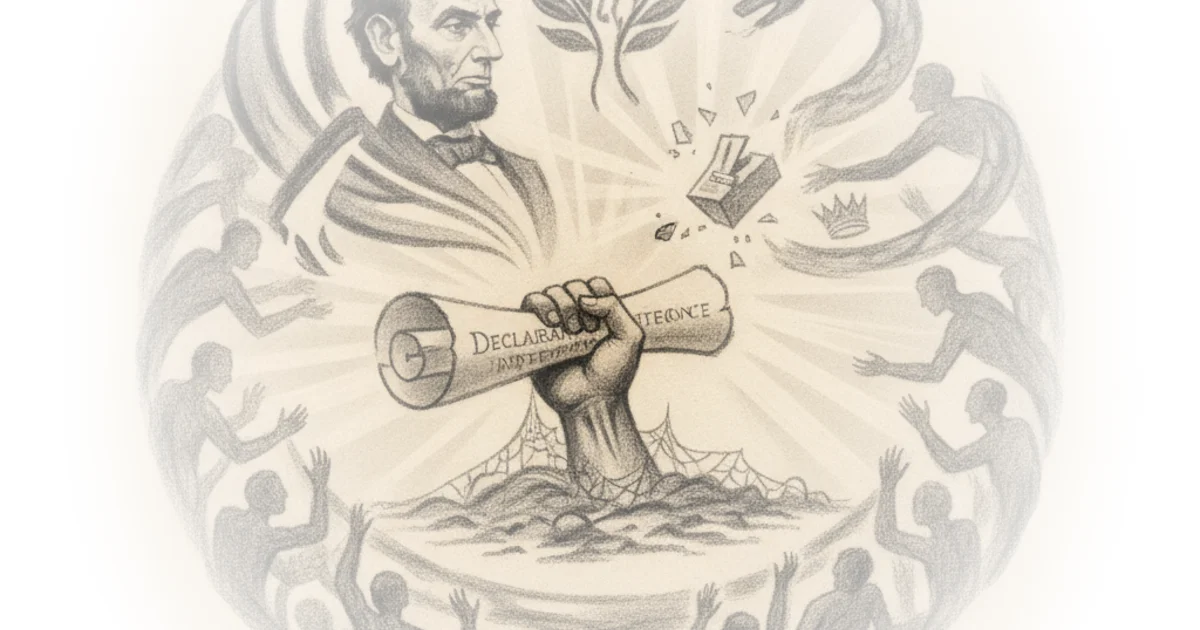
The author emphasizes that Lincoln refused both cynicism and moral posturing. He admitted he did not know exactly how to dismantle an existing institution built on centuries of prejudice, yet he insisted that a government ruling over people without their consent is not self-government at all. "When one man governs another without that other's consent, that is not self-government, but its negation," DeLong highlights from the speech. This lands with particular force because it strips away the legalistic defenses of slavery to reveal the raw power dynamic underneath: domination.
When the white man governs himself that is self-government; but when he governs himself, and also governs another man, that is more than self-government—that is despotism.
Critics might argue that Lincoln's admission of uncertainty regarding immediate emancipation weakens his moral stance. However, DeLong suggests this honesty actually strengthens the argument by grounding it in political reality rather than abstract idealism. Lincoln acknowledged that "a universal feeling, whether well or ill-founded, can not be safely disregarded," showing a pragmatist who understood that principles must eventually navigate the messy terrain of human prejudice.
The Antagonism of Principles
The commentary shifts to the philosophical core of Lincoln's argument: the irreconcilable conflict between the "Spirit of '76" and the emerging "Spirit of Nebraska." DeLong points out that Lincoln viewed the repeal of the Missouri Compromise not just as a policy error, but as an existential threat to the republic's soul. He connects this historical moment to the Northwest Ordinance of 1787, noting how early leaders like Jefferson had already established a precedent for prohibiting slavery in new territories based on the belief that "all men are created equal."
Brad DeLong writes that Lincoln saw the repeal as wrong not only in its direct effect but because it allowed the principle to spread globally: "The declared indifference... I can not but hate. I hate it because of the monstrous injustice of slavery itself." The author argues that this hatred was rooted in a fear that American hypocrisy would undermine freedom worldwide, enabling enemies of liberty to taunt the nation as hypocrites. This framing elevates the debate from a domestic squabble over land into a global struggle for the credibility of democratic institutions.
The piece draws on a Latin maxim attributed to Anchises—"pacisque imponere morem, parcere subiectis, et debellare superbos" (impose the ways of peace, be merciful to the subjected, and permanently subdue the haughty)—to illustrate Lincoln's vision of a republic that must actively suppress arrogance to preserve peace. DeLong suggests this was an early articulation of a "politics of non-domination," where the state exists to protect the weak from the strong, rather than enabling the strong to crush the weak under the guise of local autonomy.
Our republican robe is soiled, and trailed in the dust. Let us repurify it. Let us turn and wash it white, in the spirit, if not the blood, of the Revolution.
A counterargument worth considering is whether Lincoln's call to "re-adopt" the Declaration was a realistic political strategy or merely rhetorical grandstanding. DeLong acknowledges that Lincoln knew "the great mass of white people" would not immediately accept social and political equality for Black men. Yet, by insisting on the principle even when its full application seemed impossible, Lincoln planted a seed that would eventually force the nation to confront its contradictions. The argument holds up because it treats the Declaration not as a finished product, but as a living standard against which current laws must be measured.
Bottom Line
Brad DeLong's analysis succeeds in reframing the 1854 crisis not as a prelude to war, but as a fundamental struggle over the definition of democracy itself. The strongest part of this argument is its insistence that "self-government" becomes a lie when it includes the power to enslave others. Its biggest vulnerability lies in the immense difficulty of translating such high-minded principles into immediate policy without causing social collapse—a tension Lincoln himself could not fully resolve. Readers should watch for how modern institutions handle similar conflicts between local autonomy and universal rights, as the "Spirit of Nebraska" often hides behind the language of freedom today.