Henry Oliver does not merely list books; he issues a challenge to the modern obsession with efficiency, arguing that the deepest truths of history and human nature are found only in works that demand total immersion. In a cultural moment that prizes speed, Oliver's assertion that "some people tell me they don't have time to read War & Peace, which is complete nonsense" serves as a radical defense of slow, deep engagement. He frames reading not as a task to be completed, but as a state of being, suggesting that to skip the monumental is to miss the very texture of life itself.
The Architecture of Clarity
Oliver's treatment of Leo Tolstoy is the centerpiece of his argument, elevating the Russian master above the standard canon by focusing on a specific quality: transparency. He writes, "Tolstoy's greatness is made out of his clarity: he gives you everything you need. There is nothing hidden, implied, or 'unreliable'." This is a deliberate counter-narrative to the modern literary preference for ambiguity and the "unreliable narrator." Oliver suggests that the most profound storytelling is actually the most direct, capable of rendering the chaos of history with "vivid, cinematic, expansive realism."
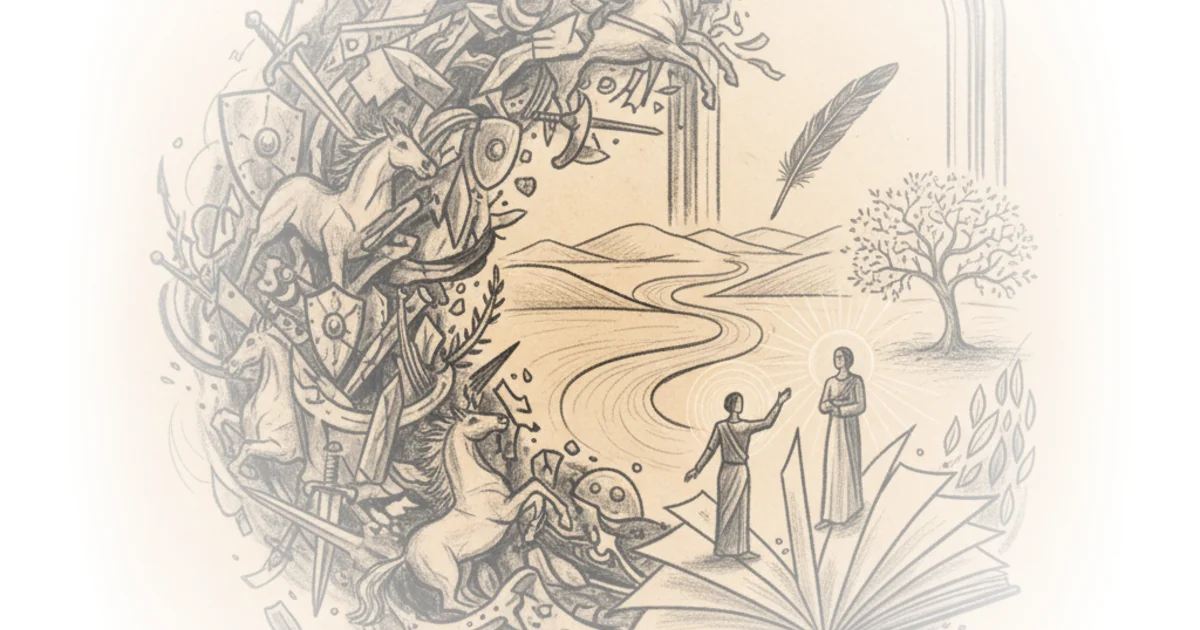
The author's personal anecdote about reading War & Peace while exchanging messages with a friend illustrates his point that such works are social and lived experiences, not solitary academic exercises. He notes, "It has been said many times that one does not read this book, one lives it." This framing is powerful because it shifts the metric of value from plot consumption to emotional resonance. Oliver recalls specific scenes—the bear hunt, the dying count, Natasha packing the cart in the fire—not as plot points, but as memories of a life lived alongside the characters.
"If you might die without reading Tolstoy, then stop making excuses and do what you know you ought to do."
This urgency is not born of fear, but of a belief in the transformative power of literature. Oliver draws a parallel to Peggy Noonan's reflection on William F. Buckley Jr. and Moby Dick, capturing the regret of a life unlived without these texts. While critics might argue that demanding such a time commitment from busy readers is elitist, Oliver's defense is pragmatic: the book is merely "four or five 'regular size' novels," a volume any dedicated reader can manage if they prioritize it.
Philosophy, History, and the Long Now
Moving beyond fiction, Oliver curates a non-fiction list that emphasizes the enduring relevance of conversation, religious inquiry, and intellectual history. He highlights Agnes Callard's Open Socrates for its ability to make the reader "take much more seriously the role of conversation in my life." This aligns with a broader theme in his selection: the necessity of engaging with difficult ideas through dialogue rather than monologue.
In his discussion of Francesca Wade's biography of Gertrude Stein, Oliver connects the literary figure to a pivotal moment in cultural history, noting that Stein "went to the second night of the Rite of Spring." This specific detail anchors Stein not just as a writer, but as a witness to the violent rupture of modernism, much like the historical upheavals Tolstoy chronicled. Oliver argues that even those who dislike Stein will find value in the "well-researched, well-written" account of her life as a "real late bloomer."
The inclusion of Helen Castor's The Eagle and the Hart, a double biography of Richard II and Henry IV, further reinforces Oliver's interest in the mechanics of power and legitimacy. Just as the 1913 premiere of The Rite of Spring shattered expectations of what art could be, the deposition of Richard II shattered the medieval conception of the divine right of kings. Oliver finds the book "compulsive," suggesting that the study of these historical fractures offers a mirror to contemporary institutional dynamics.
"Woolf must be the best critic of the twentieth century."
Oliver's reverence for Virginia Woolf's essays and Adam Smith's prose underscores his belief that non-fiction should be judged by its literary merit as much as its intellectual content. He describes Smith as "a very good prose writer," a reminder that economic theory, when stripped of jargon, is a form of storytelling about human nature. This approach challenges the reader to see the "English tradition" not as a dry archive, but as a living conversation spanning centuries.
The "Good Bad Book" and the Case for Genre
Perhaps the most provocative section of Oliver's commentary is his defense of Ayn Rand's Atlas Shrugged. He acknowledges the book's polarizing reputation, admitting that "some of you won't be able to stand the fact that I enjoyed this book." Yet, he reframes the critique of "cardboard characters" as a limitation of the critic, not the work. He argues that "there used to be such a thing as a 'good bad book'," and that Rand's novel, despite its flaws, functions as "the best genre novel ever written" because it is a relentless page-turner.
This defense is nuanced; Oliver does not claim the book is a masterpiece of psychological realism, but rather that it succeeds in its own genre conventions. He writes, "I am able to read a certain amount of that stuff each year without turning up my nose, much to my benefit." This suggests a pragmatic approach to reading where the goal is engagement and the expansion of one's horizons, even into areas of intellectual disagreement.
He balances this with high praise for Diana Wynne Jones's Fire and Hemlock, describing it as "stunningly good" and relevant to "culture wars of its day about divorce." By placing a children's fantasy alongside political philosophy and historical biography, Oliver constructs a reading list that refuses to be categorized by genre or age. He asserts that books like The Magician's Nephew are "the best children's book ever written," implying that the deepest wisdom is often found in the simplest forms.
"Jewels never lose their lustre and this was every bit as good on the seventh (?) read, and continues to improve with age."
This observation about Brideshead Revisited serves as a metaphor for Oliver's entire philosophy: great literature is not a one-time consumption but a resource that deepens with repeated engagement. Whether it is the "heartbreaking" Leopoldstadt or the "delightful" The Railway Children, the common thread is the book's ability to return to the reader with new meaning.
Critics might note that Oliver's list is heavily weighted toward the Western canon and the English language, potentially overlooking the global diversity of contemporary thought. However, his inclusion of Mikhail Bakhtin's Rabelais and the translation of The Odyssey by Emily Wilson suggests an awareness of the broader intellectual landscape, even if his primary focus remains on the Anglo-American tradition.
Bottom Line
Henry Oliver's commentary is a masterclass in defending the slow, immersive act of reading against the pressures of modern efficiency. His strongest argument lies in the conviction that clarity and depth, as exemplified by Tolstoy, are not obstacles to be overcome but the very conditions for understanding history and life. The piece's vulnerability is its reliance on a specific, high-culture literacy that may alienate readers outside that tradition, yet its ultimate verdict is clear: the time spent with these books is not lost, but invested in the only currency that truly matters—human understanding.